

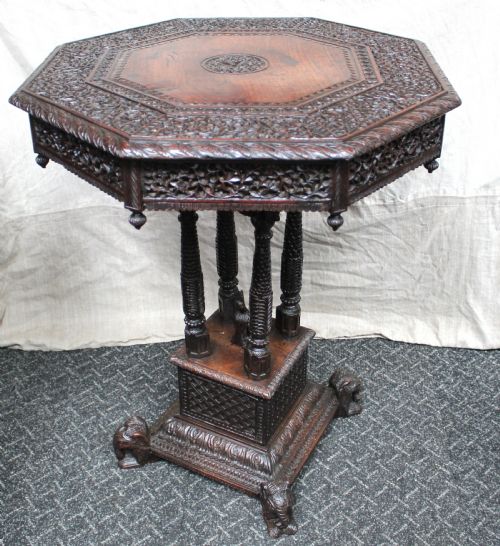
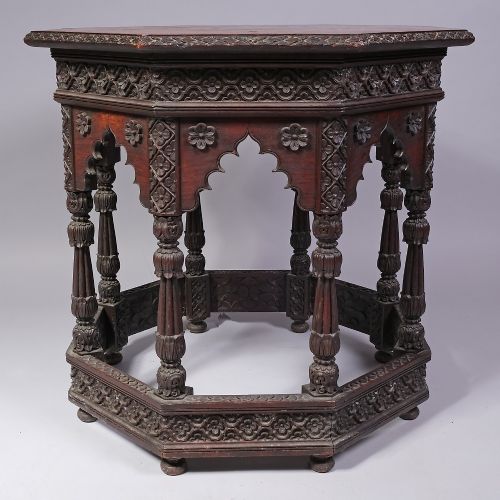


Victorian Teak Accent Table
A Victorian teak accent table brings dense colonial carving and sturdy hardwood grain directly into a modern room.
Victorian Teak Accent Table
When you search for a Victorian teak accent table, you encounter nineteenth-century occasional, side, and coffee tables produced across the Indian subcontinent and Burma. These pieces span the Victorian era, specifically appearing in decades from the eighteen-forties through the nineteen-hundreds, alongside later twentieth-century examples.
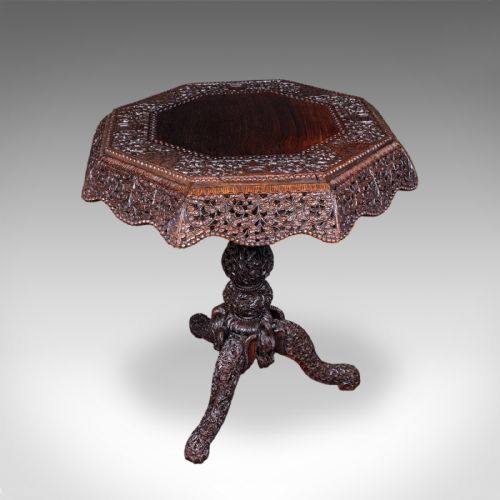
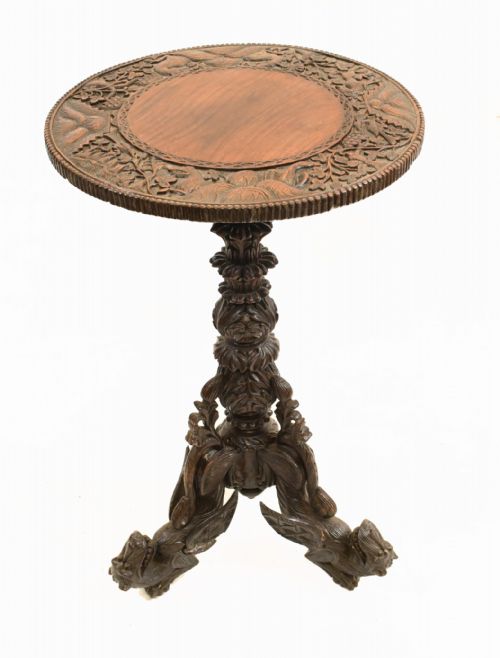
The most common forms on this page are octagonal side tables, occasional tables, and tip-top or pedestal tables often associated with Anglo-Indian and Anglo-Burmese colonial craftsmanship. Alongside these are specialised shapes such as shield-shaped coffee tables, folding campaign tables, two-tier side tables, and nesting tables.
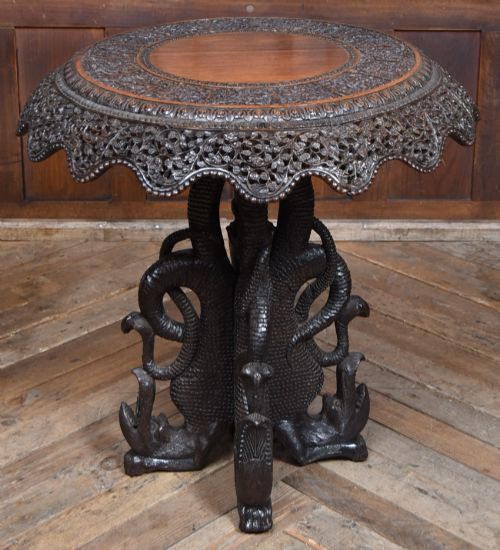
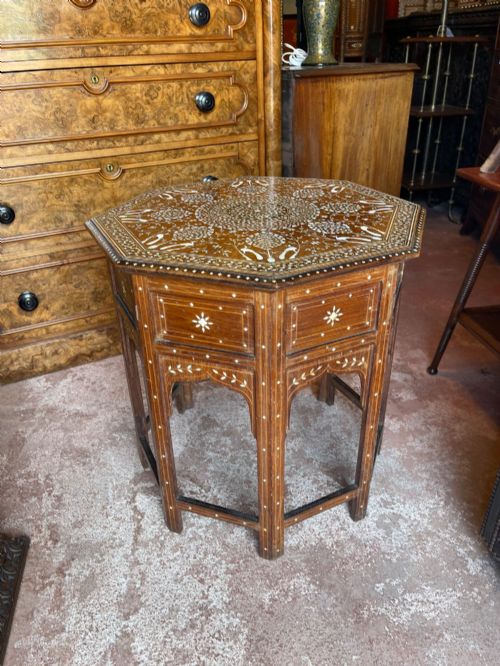
The regional styles range widely, encompassing Hoshiarpur brass inlaid tables, Bombay Presidency elephant and camel tables, and heavily carved Burmese tea or lamp tables. These objects served utilitarian and decorative roles in colonial homes, functioning as compact surfaces for lamps, tea sets, and ornaments.
Materials and Construction Methods
Makers constructed these tables primarily from solid teak and regional Indian hardwoods, occasionally incorporating secondary timbers like burr walnut or rosewood. The dense grain of teak provided a durable foundation capable of withstanding intricate hand carving without splintering.
Surface ornamentation relied heavily on deep relief carving, which covers surfaces in floral, geometric, and zoomorphic motifs including elephants, camels, and peacocks. Workshops also integrated contrasting materials, setting sheet brass inlay and bone details directly into the wooden framework.
Structural elements varied from fixed pedestal bases and four-legged supports to folding campaign mechanisms and tilt-top actions. Joinery was adapted to the needs of colonial transport and domestic versatility, resulting in pieces that combine rigid stability with portable design.
Victorian Teak Accent Table Retail Price Guide 2026
Typical asking prices for victorian teak accent table among the pieces listed under this phrase on Sellingantiques today, from the lower quarter to the upper quarter. They describe what is for sale here now, not the wider market.
Listings feature teak, hardwood, rosewood, bone, brass, and wax finish.
Evaluating the Craftsmanship
Quality rests upon the depth, sharpness, and discipline of the hand carving across the timber surface. Superior pieces display crisp undercutting and balanced symmetry in complex motifs, whereas lesser examples rely on shallow, repetitive scoring that lacks dimensional depth.
The integration of secondary materials defines the upper tier of production, particularly the precision of brass inlay and bone work set into the hardwood. In finer tables, metal and bone components sit flush with the surrounding wood and maintain secure placement despite timber movement over time.
The Victorian Teak Accent Table Glossary
- Anglo-Indian
- A descriptive term for furniture made in India during the British colonial period, blending European forms with local carving traditions. These pieces frequently utilise native hardwoods such as teak.
- Teak
- A dense, durable tropical hardwood valued for its natural oils and resistance to moisture. It forms the primary structural material for nineteenth-century colonial tables.
- Hoshiarpur
- A North Indian centre renowned for intricate woodwork featuring inlaid brass and sheesham or teak panels. Tables from this region are easily identified by their dense geometric and floral metalwork.
- Tip-Top
- A table mechanism featuring a hinged top that rotates into a vertical position for storage or transport. This form is common among nineteenth-century occasional and lamp tables.
- Octagonal
- A geometric shape with eight sides, frequently defining the tabletops of Indian occasional and tea tables. This configuration showcases continuous border carvings along each edge.
Victorian Teak Accent Table: Frequently Asked Questions
What is an elephant table?
An elephant table is a regional Anglo-Indian occasional piece featuring structural supports carved in the likeness of elephants. These figures typically form the legs or pedestal base of the table.
Such items reflect nineteenth-century colonial taste and showcase the figurative wood-carving skills of artisans working in regions like the Bombay Presidency.
How do I use an accent table?
These compact pieces function effectively as bedside stands, lamp supports, or coffee surfaces in compact spaces. Their varied heights and shapes allow them to sit beside sofas or armchairs.
The distinct carved surfaces also mean these tables serve as standalone decorative focal points within a room.
What distinguishes Anglo-Burmese furniture?
Anglo-Burmese furniture is characterised by deep, heavy relief carving executed in dense teak. The motifs often incorporate elaborate foliage and animal figures specific to nineteenth-century Burmese workshops.
These tables frequently take octagonal or multi-tiered forms designed for colonial domestic use.
How does brass inlay work?
Brass inlay involves recessing thin metal wire or sheet into hand-carved channels within the hardwood surface. Artisans hammer the metal into place to create intricate geometric patterns.
This technique provides a sharp visual contrast against the dark grain of teak or hardwood.