
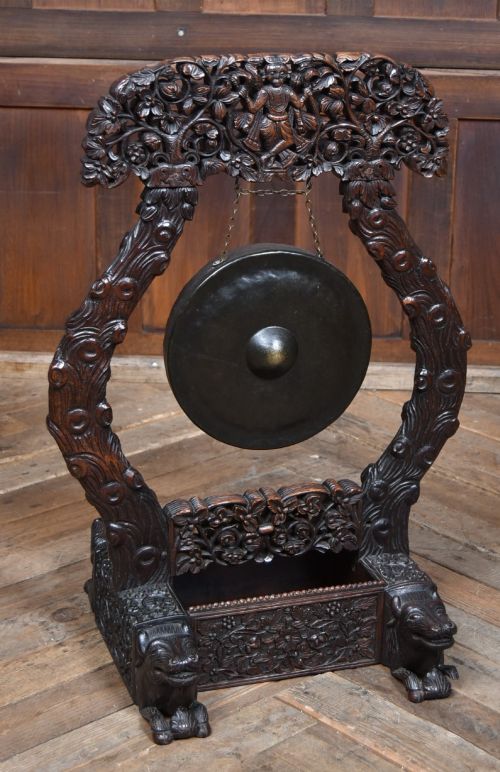


Victorian Tabletop Dinner Gong
These victorian tabletop dinner gong pieces summon households to the meal with clear resonance, offering functional charm from the nineteenth century.
Victorian Tabletop Dinner Gong
A victorian tabletop dinner gong brings a resonant call to the dining room using suspended metal discs paired with striking mallets. The selection on this page centres on compact table versions designed to sit on sideboards rather than stand upon the floor.
Most examples date across the nineteenth century, including specific years like eighteen-eighty, eighteen-eighty-eight, eighteen-ninety and nineteen-ten. These pieces draw on styles such as Victorian Aesthetic Movement, Japonisme, Anglo-Indian, Arts and Crafts and Rustic Victorian.
Framing structures range widely in material and form, encompassing carved wood, bamboo, wrought iron, and animal horn. Makers utilised diverse cultural motifs, producing everything from simple brass circles to intricately carved Burmese and Chinese frames.
Materials and Construction
Wood elements frequently feature detailed carving, reflecting the aesthetic movements and regional tastes of the nineteenth century. Textile elements occasionally appear in the suspension cords or accompanying details, completing the composition of each table gong.
Listings span the nineteenth and early twentieth centuries, incorporating materials from brass and bronze to oak, silver plate, cattle horn, and bamboo.
Assessing Quality and Execution
Quality rests in the resonance of the metal disc and the stability of its supporting frame. Superior examples display harmonious proportions between the heavy gong and the sturdy wood, horn, or iron mount that holds it.
The fineness of hand-carved details on oak or bamboo frames distinguishes standard production pieces from more ambitious artistic works. Original silver plating and well-preserved horn components also elevate the character of an individual table gong.
The Victorian Tabletop Dinner Gong Glossary
- Dinner Gong
- A resonant metal disc struck with a mallet to announce meals in a home. These were popular in large nineteenth-century households.
- Aesthetic Movement
- A late nineteenth-century design style emphasising visual beauty over narrative meaning. It often drew inspiration from Japanese and other Asian art forms.
- Silver Plate
- A thin layer of silver applied to a base metal object. This finish gave the appearance of solid silver at a lower cost.
- Japonisme
- The influence of Japanese art and design on Western makers. This style appears in many decorative arts of the Victorian period.
- Anglo-Indian
- A term describing objects made in India for British residents or export to Britain. These pieces often combine traditional Indian carving with British furniture forms.
Victorian Tabletop Dinner Gong: Frequently Asked Questions
How do you strike a dinner gong?
Strike the centre of the metal disc firmly with a padded mallet to produce a rich, resonant tone. Avoid using hard metal strikers that might crack the alloy.
Allow the sound to fade naturally rather than dampening the vibrating metal with your hand.
Where were these placed?
These compact gongs sat upon sideboards, serving tables, or hallways in Victorian homes. Their modest size allowed them to occupy domestic spaces without requiring dedicated floor room.
Servants used them to signal that dinner was served, carrying the sound clearly through adjacent rooms.
How do I clean the metal frame?
Dust the wood, horn, and metal components regularly with a soft, dry cloth to prevent grime accumulation. Avoid harsh chemical polishes that can strip original patinas from brass and bronze.
Silver-plated surfaces require gentle maintenance using dedicated silver cloths to preserve the plating.
How are different periods identified?
Examine the materials, construction methods, and stylistic cues such as Aesthetic Movement motifs or bamboo framing. Nineteenth-century pieces often display hand-cut joinery and specific patination on the brass or bronze.
Dates like eighteen-eighty or nineteen-ten appear on certain marked examples, helping to anchor the chronology.