


Victorian Stationery Bureau
A victorian stationery bureau combines a compact writing slope with internal compartments for letters and papers, offering a practical workspace for the home.
Victorian Stationery Bureau
When you search for a victorian stationery bureau, you encounter compact writing furniture designed for nineteenth-century correspondence and household administration. The pieces on this page span the Victorian, Edwardian and late nineteenth-century periods, capturing an era when letter writing required dedicated storage for paper, pens and envelopes.
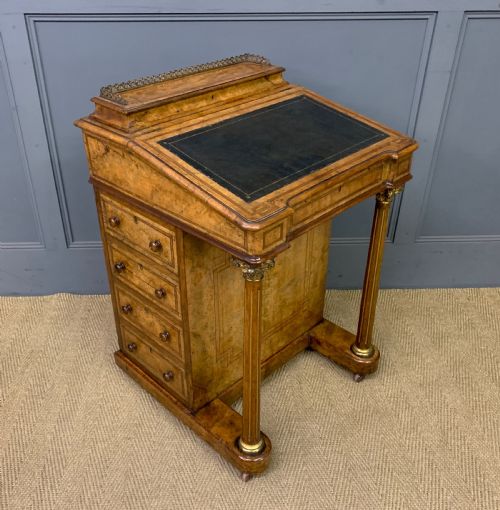
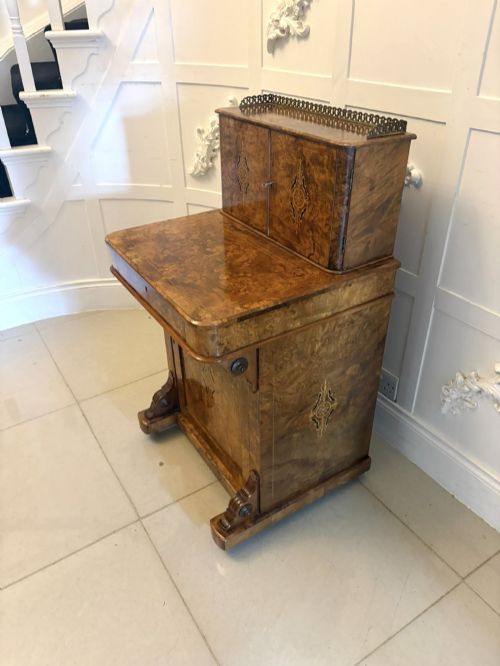
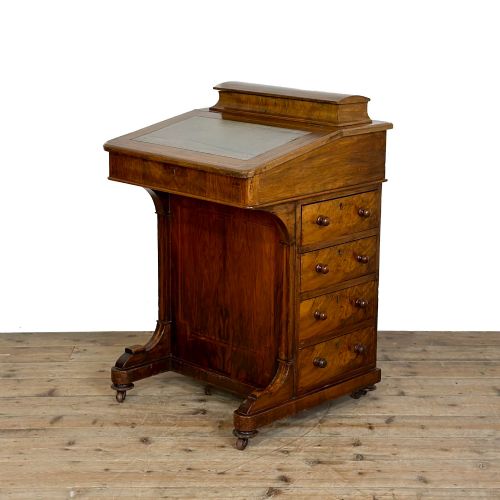
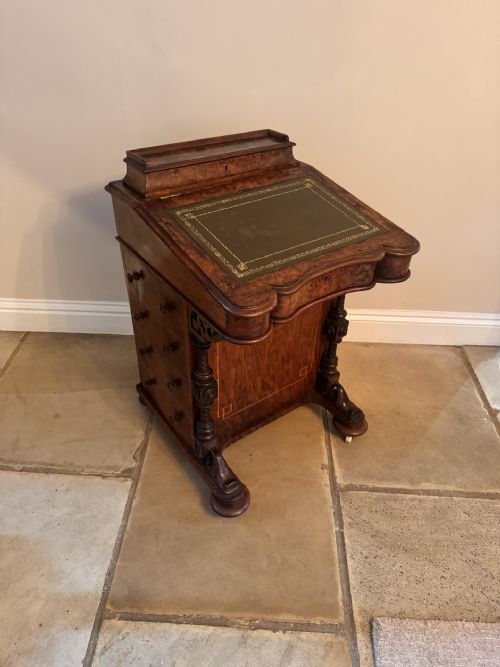
The most common form you will meet is the Davenport desk, along with related writing cabinets, correspondence desks and secretaire chests. These pieces typically feature a sloping writing surface above a set of drawers or a cabinet base, often incorporating stationary compartments either built into the superstructure or housed within a pop-up mechanism.
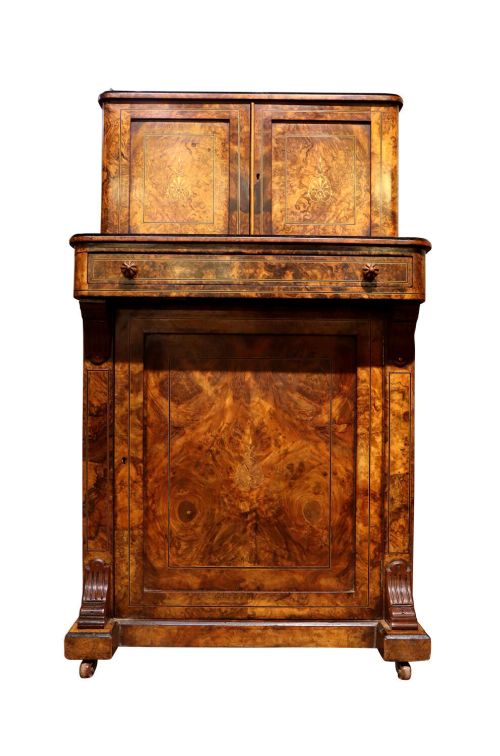
The selection ranges from burr walnut and rosewood models inlaid with boxwood to carved oak and mahogany examples. Makers employed styles such as Sheraton Revival and Anglo-Indian alongside standard Victorian vernacular, resulting in both simple domestic writing desks and elaborate marquetry pieces.
How they were made
Cabinet makers constructed the carcases of these desks using solid timbers like oak and mahogany as structural foundations, applying decorative veneers such as burr walnut and rosewood to the visible exterior surfaces. Boxwood inlay and marquetry added ornamental detail to the desk lids and stationery compartments.
Specialist mechanisms defined the more complex variants, utilising brass hardware for pop-up stationery cabinets, sliding writing surfaces and writing boxes. Carved details, such as the Green Man motifs on oak models, relied on traditional hand-carving techniques applied directly to the solid wood components.
The listings on this page feature walnut, rosewood, oak and mahogany pieces spanning the Victorian, Edwardian and Arts and Crafts styles.
What varies in quality
The choice of timber veneer dictates the visual impact of the piece, with heavily figured burr walnut and finely grained rosewood sitting at the upper end of the scale. The crispness of boxwood inlay and the intricacy of marquetry further distinguish standard commercial production from finer workshop output.
Mechanical complexity separates simple slope-front desks from pop-up piano davenports and patent metamorphic writing tables. The smoothness with which internal stationery compartments, drawers and rising desk tops operate reflects the original standard of joinery and hardware used.
Maple & Co.
The Victorian Stationery Bureau Glossary
- Davenport
- A small Victorian writing desk featuring a sloping top hinged over a pedestal of drawers. The design typically includes side drawers and an upper stationery compartment.
- Secretaire
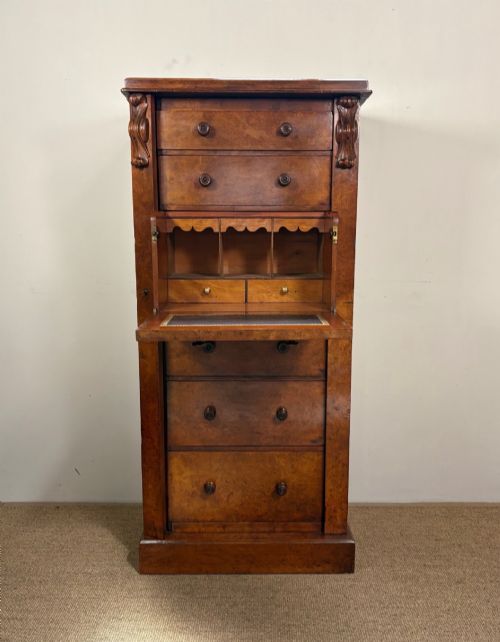
- A desk or chest of drawers containing a concealed writing drawer or drop-front writing flap that encloses small pigeonholes and internal compartments.
- Marquetry
- The art of applying decorative veneer pieces of different woods and materials to form pictorial or geometric patterns on the furniture surface.
- Bonheur du jour
- A light lady's writing desk featuring a raised set of small drawers and pigeonholes on the upper surface for stationery storage.
- Pop-up
- A mechanism built into desks and cabinets that raises an internal stationery compartment or writing surface when released by a spring or catch.
Victorian Stationery Bureau: Frequently Asked Questions
What is a Davenport desk?
A Davenport is a compact Victorian writing desk with a sloping, hinged writing surface positioned above a pedestal of side drawers. It typically includes an upright stationery compartment at the back.
First popularised in the nineteenth century, these pieces were designed for drawing rooms and boudoirs where space was limited but proper correspondence facilities were required.
How do pop-up stationery compartments work?
Pop-up mechanisms use internal springs, weights or levers connected to the desk lid so that opening the writing slope automatically raises the stationery compartments hidden behind it.
Cabinet makers of the Victorian and Edwardian periods patented various space-saving designs to keep writing materials concealed when the desk was not in use.
What woods were commonly used?
Makers relied on solid structural timbers like oak and mahogany, often covering them with decorative veneers such as burr walnut and rosewood. Boxwood was frequently used for contrasting stringing and inlay work.
Richly figured grain patterns were prized for visible surfaces, while secondary woods like pine or oak were used for drawer linings and internal dividers.