
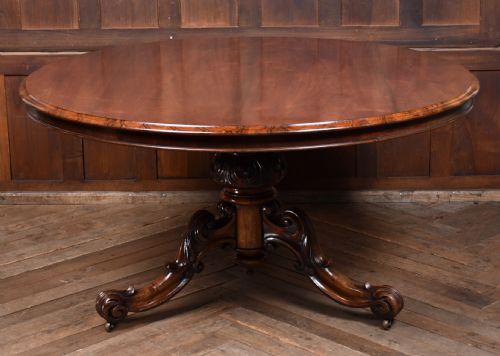


Victorian Snap Top Dining Table
These Victorian snap top dining table pieces combine versatile everyday dining with ingenious space-saving design.
Victorian Snap Top Dining Table
A Victorian snap top dining table offers a practical surface for meals that tilts vertically when not in use to save floor space in period rooms. These tables date primarily from the nineteenth century and appear in forms such as loo tables, breakfast tables, and circular centre tables.
Buyers meet variations ranging from compact occasional pieces to large mahogany models capable of seating ten people. The selection spans standard Victorian production alongside Regency style pieces and earlier nineteenth-century examples.
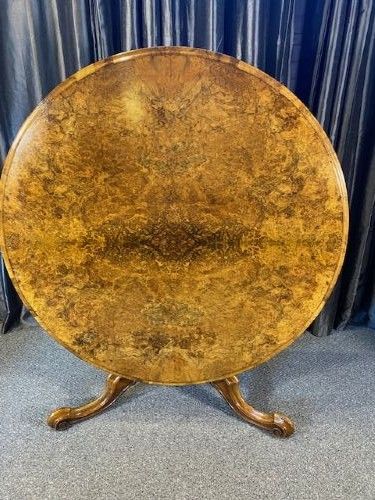
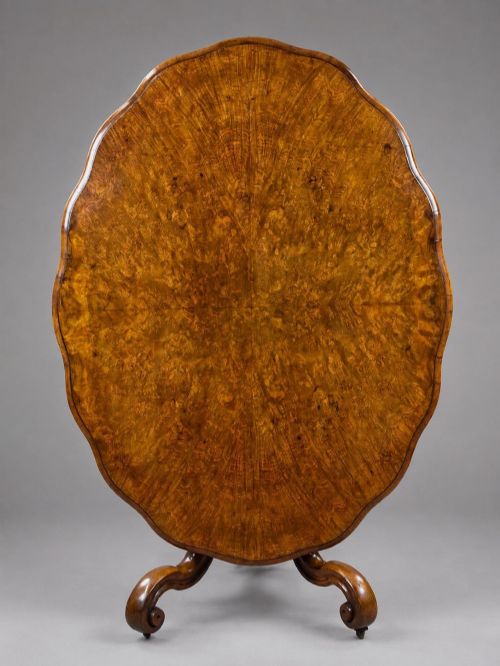
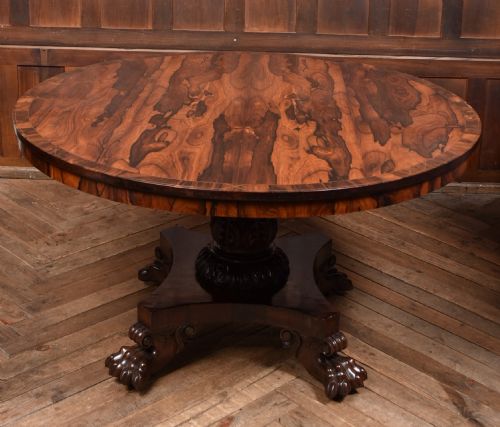
Timbers such as mahogany, rosewood, and walnut dominate the construction, often featuring burr walnut veneers or inlaid details on round and rectangular tops.
How they were made
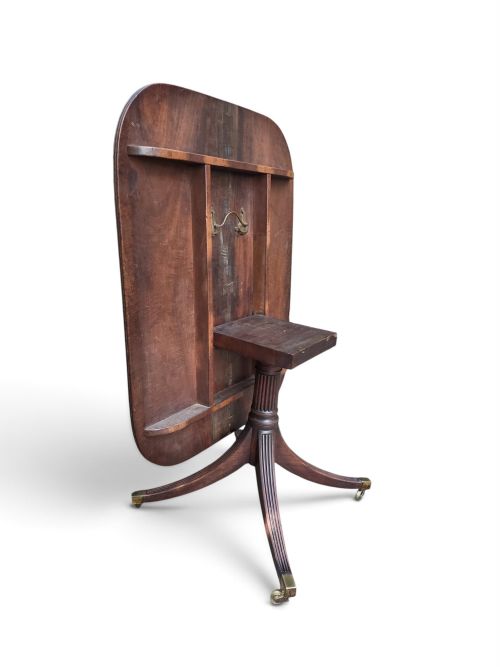
Joiners built these tables using solid hardwoods alongside carefully cut veneers, applying burr walnut and mahogany over stable secondary woods to create decorative surface patterns. Turned central columns support the heavy tops, resting on splayed legs fitted with brass castors for mobility.
The pivoting mechanism utilises robust timber catches and metal locking pins that allow the top to tilt and lock securely into a horizontal position. Ebonising and delicate inlay techniques add surface contrast on specific round and rectangular examples.
What varies in quality
The selection of timber grain defines the visual appeal, particularly where figured mahogany, rosewood, or burr walnut veneer shows rich natural patterning across the top. Superior examples maintain smooth operation in the tilting mechanism and stability in the central column and splayed leg assembly.
Proportion and execution of turned elements dictate the overall elegance of the piece, distinguishing standard utility tables from grander reception furniture.
The Victorian Snap Top Dining Table Glossary
- Snap top
- A table construction featuring a hinged mechanism that allows the top to tilt vertically against the central column. This design originated to clear floor space in domestic rooms when dining concluded.
- Tilt top
- An alternative term for a snap top table, describing any nineteenth-century table where the top pivots on its base. They frequently served as breakfast or centre tables.
- Loo table
- A large round Victorian table designed for card games, which utilised the tilt top feature for storage. These often display elaborate burr walnut or rosewood veneers.
- Splayed legs
- Support legs that angle outward from the central column to provide stability for a pivoting top. They frequently terminate in brass castors.
- Burr walnut veneer
- Thin slices of decorative wood cut from walnut tree growths, displaying complex swirling grain patterns. Cabinet makers applied these over solid cores on finer Victorian tables.
Victorian Snap Top Dining Table: Frequently Asked Questions
How do I operate the tilt mechanism?
A wooden catch or metal pin beneath the top releases the mechanism so the surface pivots vertically.
Ensure you support the weight of the timber securely while operating the catch to prevent sudden movement.
Can these function as daily dining tables?
Larger nineteenth-century examples accommodate multiple diners comfortably and offer sturdy everyday surfaces.
Their tilt function also allows convenient storage against a wall when extra floor space is required.
What woods were commonly used?
Mahogany, rosewood, and walnut appear frequently across the nineteenth-century listings.
Craftsmen also utilised burr walnut veneer and pine on specific tables.
How do I distinguish between a loo table and a breakfast table?
Loo tables typically feature large round tops intended for evening card games.
Breakfast tables serve a similar form but often date across the broader nineteenth-century period for morning dining.