

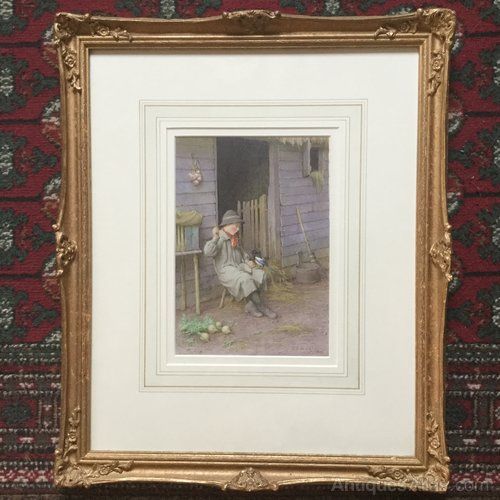


Victorian Rural Genre Scene
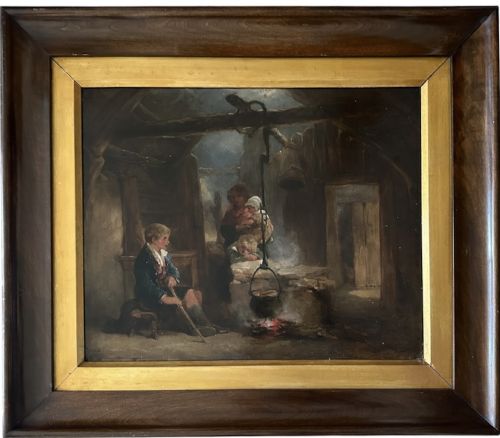
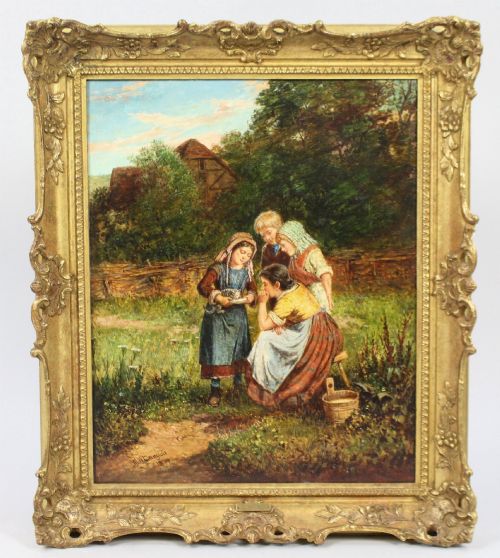
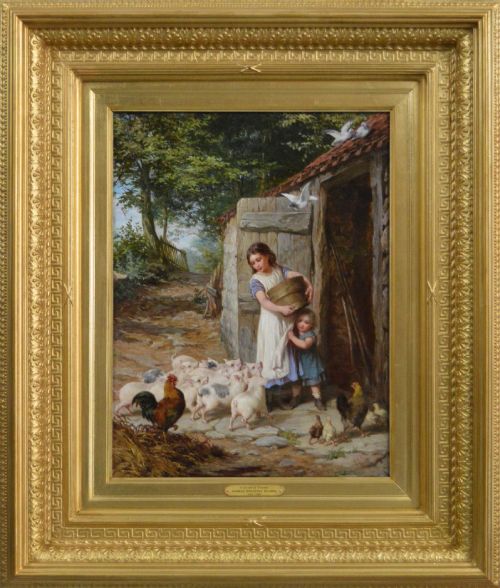
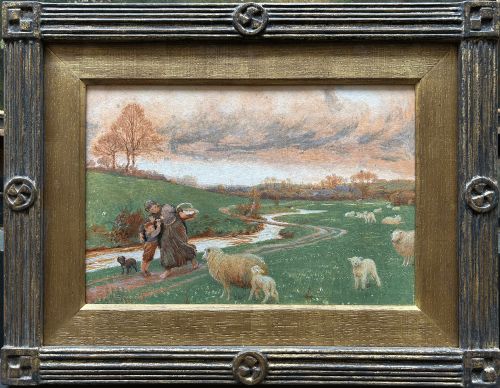
These Victorian rural genre scenes capture everyday country life, bringing domestic farmyards, cottage gardens and working people into the home.
Victorian Rural Genre Scene
A victorian rural genre scene portrays everyday country life, often focusing on farmyards, cottage doors, children with animals and agricultural labourers at work or rest. These works bridge landscape painting and narrative art by placing human and animal figures at the centre of pastoral settings.
The versions most commonly met on this page date from the nineteenth century into the Edwardian period, executed in oil on canvas, oil on board or watercolour. Subjects range from quiet cottage garden moments involving children and pets to busier scenes featuring horses, poultry, pigs and farmworkers.
Materials and Techniques
Paintings in this category rely primarily on oil on canvas, oil on board and watercolour on paper, capturing rural light and texture through traditional brushwork. Many works are housed in period giltwood frames embellished with gesso mouldings.
Artists built their compositions through careful layering of pigment, balancing detailed studies of farm animals and human figures against softer, atmospheric landscape backgrounds.
Several cottages housed within these frames clearly struggle to keep their domestic pets out of the fruit baskets and breakfast bowls.
Evaluating Quality
Quality rests upon the artist's ability to render anatomical proportion in human and animal figures, as well as the liveliness of the brushwork within the surrounding landscape. Stronger examples display depth in the composition and individual character in the depiction of figures and livestock rather than formulaic repetition.
The condition of the canvas and the preservation of the original pigment layers significantly influence the visual impact of the piece. The presence of a period gilt frame that complements the composition also contributes to the overall integrity of the work.
George Whitton Johnstone·Mark William Langlois·George Augustus Holmes·Miles Birkett Foster·Charles Edward Wilson·James Kyd·Henry John Yeend King·Arthur Longley Vernon·Edward Brice Stanley Montefiore·John Henry Dell·George Kilburne·Daniel Pasmore·Ernest Walbourn·Alfred Banner·John Frederick Herring Jnr·Edward Killingworth Johnson·Robert McGregor·Arthur Claude Strachan·George Cole·Thomas Blinks·Thomas Mackay·Charles Hunt Jnr
The Victorian Rural Genre Scene Glossary
- Genre painting
- A branch of art depicting scenes from ordinary life, such as domestic interiors, market scenes and farmyard activities. These works focus on the everyday experiences of ordinary people rather than historical or mythological subjects.
- Gesso
- A plaster-like mixture applied to wooden frames or panels as a base for moulding and gilding. It provides a smooth surface for intricate decorative relief work on period frames.
- Giltwood
- Timber that has been coated with a thin layer of gold leaf or gold paint. This finish is commonly found on traditional frames surrounding nineteenth-century paintings.
- Lithograph
- A printmaking technique based on the antipathy of oil and water, allowing artists to reproduce tonal drawings on stone plates. Several examples on this page relate to original paintings produced through this medium.
Victorian Rural Genre Scene: Frequently Asked Questions
What subjects appear in these paintings?
The works depict agricultural life, including farmyards with horses and livestock, cottage doors with children and pets, and labourers working near streams or fields.
Animals feature prominently alongside human figures, ranging from working cart horses to domestic poultry, goats and donkeys.
Which mediums were used?
Artists worked primarily in oil on canvas, oil on board and watercolour on paper.
Many of these paintings retain their original giltwood and gesso frames from the nineteenth century.
How do I date these works?
Dating relies upon artist biographical dates, stylistic markers of Victorian realism, and framing materials characteristic of the nineteenth and early twentieth centuries.
Most pieces date between the mid-nineteenth century and the Edwardian era.
How should I display them?
These works suit traditional interiors, studies and living rooms where their pastoral subjects and gilt frames can be appreciated in natural light.
Direct sunlight and damp environments should be avoided to protect the canvas, paper and gilt frames from deterioration.