

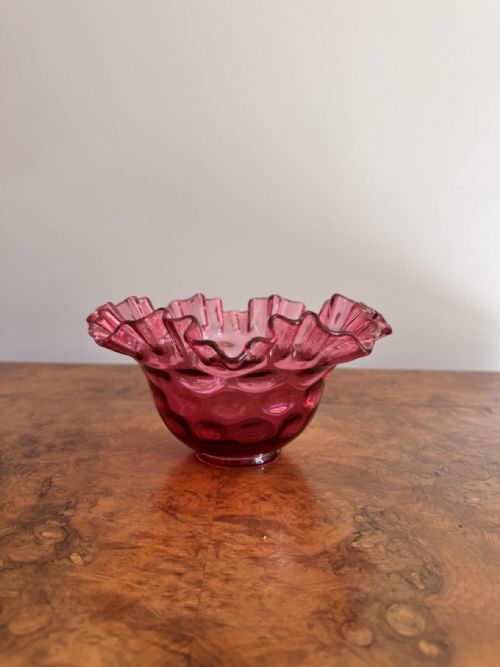
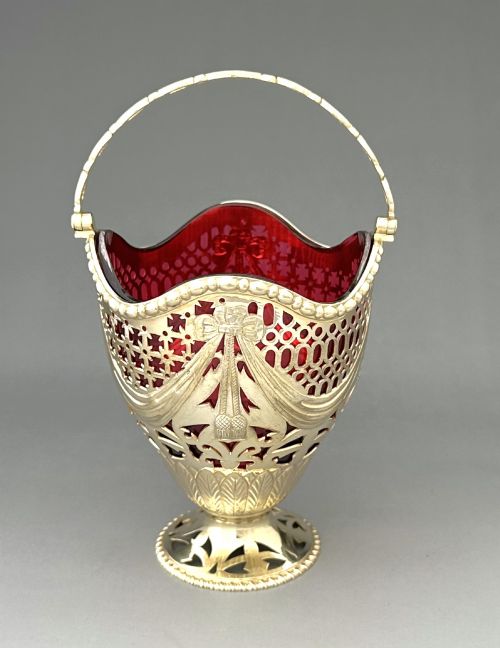


Victorian Ruby Glass Dish
A victorian ruby glass dish brings rich colour and nineteenth-century craftsmanship to a table, offering a vibrant focal point for serving preserves or sweets.
Victorian Ruby Glass Dish
A victorian ruby glass dish encompasses sugar baskets, preserve dishes, butter dishes, salt cellars, tazza forms, and decorative bowls spanning the nineteenth century and the Edwardian era. These tableware items serve both functional and decorative purposes within domestic settings, often holding preserves, sugar, or butter.
The versions most commonly met on this page date from the Victorian period through to nineteen-ten, frequently featuring rich cranberry or ruby tones. They appear both as standalone glassware and paired with silver plate, silver-gilt stands, or pierced spoons.
How they were made
These vessels rely on specialist glassmaking techniques that incorporate mineral additives to achieve deep ruby and cranberry hues within the glass body. Artisans shape the molten material into bowls and dishes, sometimes adding frilled rims or decorative patterns.
Metalwork complements the glassware through silver plating and silver-gilt mounts, creating fitted stands, baskets, and handles that secure or display the glass inserts. Gilding and piercing further enhance select pieces, particularly those paired with ornate metal frames.
Victorian Ruby Glass Dish Retail Price Guide 2026
Typical asking prices for victorian ruby glass dish among the pieces listed under this phrase on Sellingantiques today, from the lower quarter to the upper quarter. They describe what is for sale here now, not the wider market.
Listings span the nineteenth century, the Victorian era, and the Edwardian period up to nineteen-ten.
What varies in quality
The calibre of a victorian ruby glass dish rests upon the depth and evenness of the glass colour, alongside the finesse of any accompanying metalwork. Finely pierced silver-gilt frames and crisp gilding elevate a piece above standard production.
Design complexity also distinguishes individual items, with matched stands, lidded forms, and multi-piece sets demonstrating superior craftsmanship compared to simpler standalone vessels.
George Fox
The Victorian Ruby Glass Dish Glossary
- Cranberry Glass
- A type of transparent red glass produced by adding gold chloride to the molten batch. It forms the primary material for many nineteenth-century tableware items.
- Silver-Gilt
- Silver that has been coated with a thin layer of gold on its surface. This technique provides a rich metallic finish often seen on baskets and mounts.
- Tazza
- An elevated pedestal plate or shallow bowl used for serving sweetmeats or fruit. These pieces sit upon a central foot or stem.
- Preserve Dish
- A small vessel specifically designated for holding jams, jellies, or fruit preserves at the table. They frequently include spoons or fitted stands.
- Silver Plate
- A base metal coated with a thin layer of silver to simulate solid silverware. This method allowed makers to produce ornate stands and baskets at a lower cost.
Victorian Ruby Glass Dish: Frequently Asked Questions
How were these dishes used originally?
These vessels served functional roles on the dining table for holding sugar, butter, salt, or fruit preserves during formal meals.
Their vibrant colours also made them popular decorative ornaments for sideboards and display cabinets when not in active use.
Are the glass and metal parts original?
Many pieces combine blown glass liners with fitted metal stands, baskets, or frames created specifically for that vessel.
Collectors look for matched sets where the glass insert and the silver-plated or silver-gilt mount share the same period of manufacture.
How do I care for ruby glass?
Wash these items gently by hand in lukewarm water using a mild detergent, avoiding harsh scrubbing or abrasive materials.
Keep them away from sudden temperature changes to protect the glass structure and any delicate gilding or metal mounts.
How can I tell the period?
Dating relies on stylistic markers within the metal stands, the manufacturing techniques of the glass, and hallmarks where silver is present.
Victorian and Edwardian pieces often display distinct decorative motifs, such as frilled rims or pierced metalwork characteristic of those decades.