


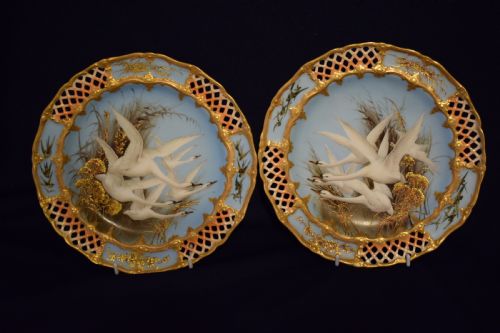


Victorian Royal Worcester China
Victorian Royal Worcester china pieces are finely painted cabinet objects and tableware carrying rich gilt and enamel work that bring a distinct nineteenth-century elegance to a room.
Victorian Royal Worcester China
Victorian Royal Worcester china spans decorative items and table wares produced across the nineteenth and early twentieth centuries, including cabinet plates, ewers, loving cups, and painted vases. The porcelain takes many forms, from blush ivory vessels to pierced cabinet plates and sculptural figurines of cherubs.
Among these objects, buyers frequently encounter floral painted rose vases and bird-decorated pieces featuring swans, alongside specialised items like candle snuffers and demitasse sets. The selection reflects both Victorian extravagance and Edwardian refinement, drawing on aesthetic movement designs and Sevres styles.
The range includes works associated with specific artists and retailers, such as Phillips of Oxford Street, showcasing the breadth of output from the Staffordshire ceramic tradition. Pieces extend from mid nineteenth century dessert plates through to later twentieth-century decorative porcelain.
Materials and production methods
Makers shaped ceramic clay into porcelain bodies, applying smooth glazes to form the pristine base required for detailed surface painting. Artisans used enamel colours to build up delicate floral motifs, figures, and feathered bird scenes.
Gold leaf, gilding, and gold gilt accents were hand-applied to frame painted panels, rim edges, and handles, adding a metallic sheen. Pierced work and sculptural elements were carefully modelled by hand before firing.
Listings feature porcelain, enamel, and gold leaf applied across Victorian, Edwardian, and Aesthetic Movement styles.
Distinctions in quality
Quality in this china rests upon the precision and execution of the hand-painting, particularly where artists depict intricate feathers, flowers, or figural details. Pieces bearing named work by accomplished painters stand apart in execution.
The richness of the gilding and the crispness of moulded or pierced porcelain forms separate standard production items from finer cabinet pieces. Balance in form and subtlety in enamel shading indicate superior studio output.
Kerr and Binns·C Baldwyn·Hadley Worcester·Charles Baldwyn·E Raby
The Victorian Royal Worcester China Glossary
- Blush ivory
- A soft, matte cream-coloured porcelain body used by Worcester during the late nineteenth century to mimic the warmth of real ivory.
- Cabinet plate
- A decorative ceramic plate intended for display on a wall or in a cabinet rather than for everyday dining use.
- Ewer
- A large ceramic jug with a flared spout and an ornate handle, typically produced for decorative display.
- Gilding
- The application of gold leaf or powdered gold mixture to the surface of porcelain to create metallic highlights.
- Demittasse
- A small cup used for serving strong black coffee, usually accompanied by a matching saucer.
Victorian Royal Worcester China: Frequently Asked Questions
What are these porcelain plates used for?
Cabinet plates are primarily intended for visual display in cabinets or mounted on walls rather than for serving food.
Their decorative painted scenes and gilt borders are preserved by keeping them out of daily dining service.
How do I identify blush ivory porcelain?
Blush ivory pieces feature a distinctive soft, warm, matte cream glaze that resembles the tone of natural elephant ivory.
This finish provides a muted background for hand-painted floral motifs and raised gold detailing.
Were these pieces painted by hand?
The better examples feature individual hand-painted artwork created by notable studio artists and ceramic painters.
Subjects range from botanical studies of roses to detailed studies of swans and birds against tinted backgrounds.
What is a candle snuffer?
A candle snuffer is a small, sculptural porcelain figurine designed with a hollow interior and a handle for extinguishing flames.
These functional items often depict characters, animals, or historical figures modelled in glazed ceramic.