

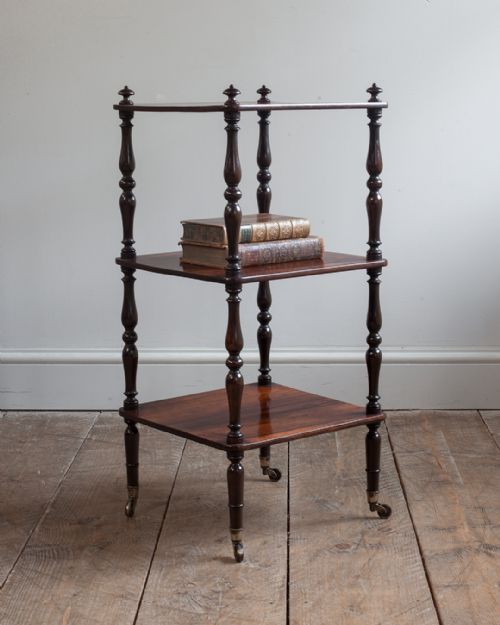


Victorian Rosewood Display Stand
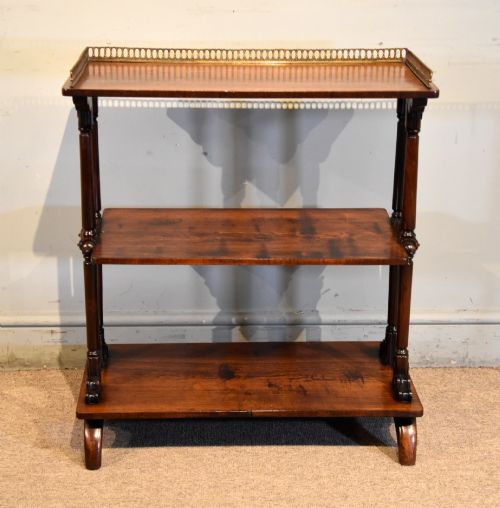
A victorian rosewood display stand brings layered timber and glazed or open tiers together to hold books, plants and ornaments.
Victorian Rosewood Display Stand
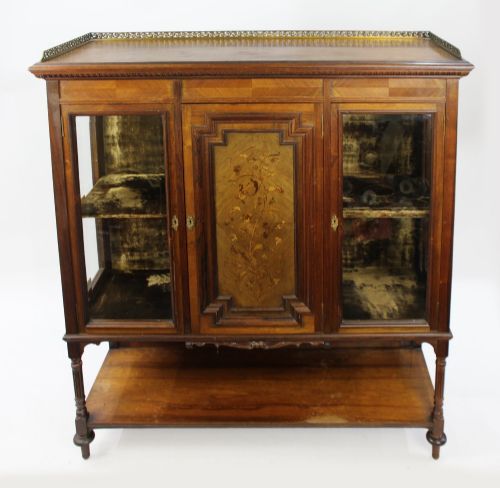
A victorian rosewood display stand spans multiple forms including étagères, whatnots, bookcases, and plant stands produced across the nineteenth century. These pieces served functional roles in period drawing rooms and parlours for organising books, ceramics, and small decorative objects on open or enclosed shelves.
The material palette draws heavily on rich rosewood timber, often paired with brass, glass, marble, and mirror accents. Surviving examples range from simple three-tier stands to large multi-functional side cabinets and corner units reflecting Victorian, Regency, and Edwardian design influences.
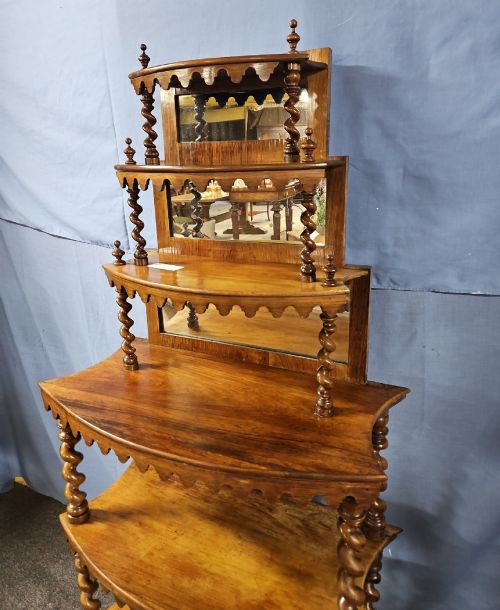
Makers working in the nineteenth century utilised diverse stylistic vocabularies, incorporating French Rococo revival curves, Chinese export carving, and Aesthetic Movement crossbanding. Buyers encounter everything from compact corner whatnots to elaborate tiered structures fitted with marquetry inlay.
Materials and Construction
Cabinet makers constructed these stands using dense rosewood timber, frequently complemented by secondary hardwoods, satinwood stringing, and elaborate marquetry inlay. Structural elements often rely on turned or carved upright supports holding fixed timber or glass shelves.
Higher tier pieces incorporate specialised decorative details such as ormolu mounts, mirrored backs, brass gallery rails, and inset marble slabs for plant or lamp placement. Joinery techniques varied from straightforward peg and slot assemblies for tiered whatnots to more complex cabinet framing.
Victorian Rosewood Display Stand Retail Price Guide 2026
Typical asking prices for victorian rosewood display stand among the pieces listed under this phrase on Sellingantiques today, from the lower quarter to the upper quarter. They describe what is for sale here now, not the wider market.
A nineteenth-century whatnot once served as the ultimate test of dusting endurance for any household with too many knick-knacks.
Judging Quality
Quality rests in the grain pattern of the rosewood timber, the crispness of any carved detailing, and the structural integrity of the tiered uprights. Superior examples display thoughtful proportions and clean joinery that keeps multi-tiered shelves rigid without excessive reinforcement.
The presence of secondary materials like matched marble tops, fine brass galleries, or precise marquetry inlay elevates a piece from standard utility furniture to high-status cabinet work. Original surface patination and intact structural elements separate workshop pieces of note from routine production.
Collinson & Lock·Edwards & Roberts·Gillows·Samson & Son
The Victorian Rosewood Display Stand Glossary
- Étagère
- A piece of furniture consisting of a set of open shelves for displaying small ornaments. These tiered stands became popular in the nineteenth century for drawing room displays.
- Whatnot
- A multi-tiered shelving unit used for storage and display of decorative objects. They appear in corner, rectangular, and revolving configurations across the Victorian period.
- Marquetry
- Decorative veneer work where pieces of wood, ivory, or shell are fitted into a ground to form geometric or floral patterns. This technique ornamented the panels of finer cabinets and tabletops.
- Ormolu
- Gilded bronze or brass mounts applied to furniture for decorative effect. Makers used these metallic accents to highlight corners, feet, and crestings.
- Canterbury
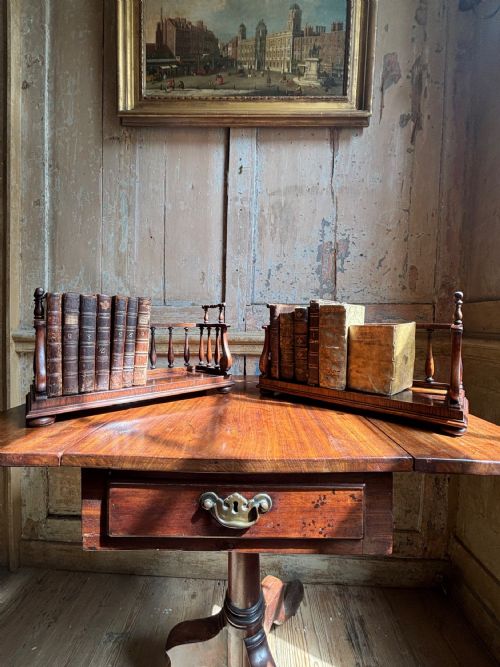
- A low, multi-section stand originally designed to hold sheet music or books. Some Victorian variants combine this compartmented base with upper display shelves.
Victorian Rosewood Display Stand: Frequently Asked Questions
What is a whatnot used for?
A whatnot functioned as a versatile display and storage piece in nineteenth-century interiors. It held books, ceramics, and small decorative items across its ascending open tiers.
Placed in drawing rooms or parlours, these stands kept everyday accessories within reach while utilising vertical space efficiently.
How do I identify a Victorian piece?
Victorian stands typically display the dense grain and deep brown tones of rosewood timber, often accompanied by turnings, spindle galleries, or marquetry inlay. Construction methods from this era involve specific joinery and hardware styles characteristic of the nineteenth century.
Comparing the shelf arrangement, edge moulding, and secondary woods helps confirm the nineteenth-century period of manufacture against later reproductions.
Where should I place a display stand?
These stands suit sitting rooms, hallways, and studies where their multi-tiered shelves can hold books, plants, or decorative collections. Corner models fit neatly into unused angles, while larger bookcases and cabinets anchor main walls.
Keep rosewood pieces away from direct heat sources and strong sunlight to protect the timber and polished surface finish.
What is the difference between an etagere and a whatnot?
An étagère specifically emphasises open tiered shelving designed primarily for decorative display. A whatnot shares this tiered structure but frequently includes enclosed compartments, lower drawers, or music racks.
Both terms describe open shelving units from the period, though makers applied them with some overlap depending on the specific configuration of drawers and partitions.