



Victorian Relief Moulded Pitcher
A victorian relief moulded pitcher brings tactile depth and classical movement to the table, formed by pressing clay into detailed metal or plaster matrices.
Victorian Relief Moulded Pitcher
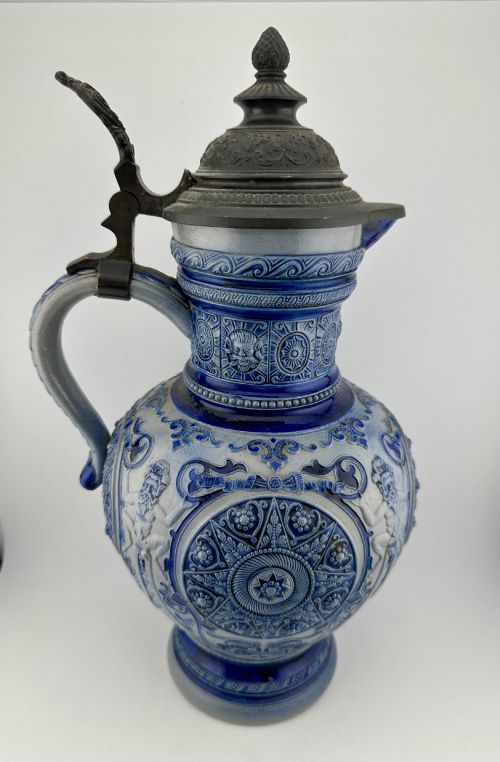
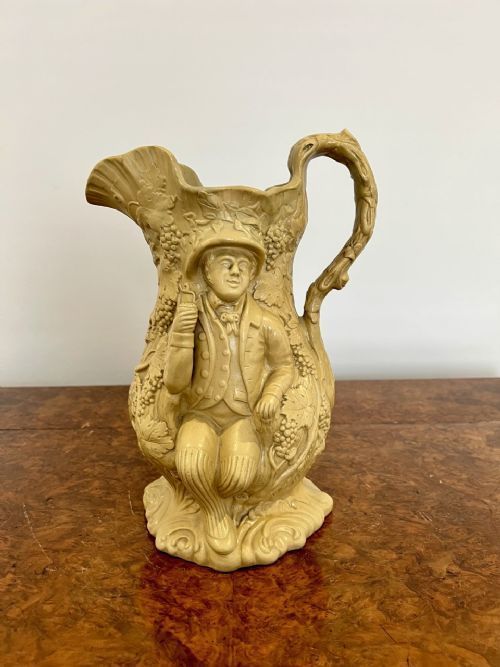
A victorian relief moulded pitcher stands as a sturdy earthenware or stoneware vessel shaped with raised figures, foliage, and classical scenes. These domestic and decorative pieces appear most frequently in nineteenth-century contexts, spanning styles from Victorian Classical Revival to Gothic and Majolica.
Buyers encountering this page will find various forms ranging from large exhibition pitchers and milk jugs to graduated sets of three. The physical evidence shows earthenware, glazed ceramic, salt glaze, and white stoneware constructions.
Makers recorded in the listings include Charles Meigh, Jones & Walley, Minton, Ridgway & Sons, and George Jones. These workshops produced both buff-coloured stoneware and colourful majolica designs featuring subjects like the Bacchanalian dance, bullrushes, and lilies.
Materials and technique
Potters utilised earthenware and stoneware bodies, often applying salt glaze or vibrant majolica glazes to seal the porous clay. The relief decoration relied on metal or plaster moulds that pressed three-dimensional motifs directly into the damp clay wall.
Specialised sprigging techniques allowed distinct applied ornaments, such as cream sprigged details on salt glazed stoneware, to adhere to the vessel before firing. Pewter elements occasionally completed the mounts on these nineteenth-century jugs.
Victorian Relief Moulded Pitcher Retail Price Guide 2026
Typical asking prices for victorian relief moulded pitcher among the pieces listed under this phrase on Sellingantiques today, from the lower quarter to the upper quarter. They describe what is for sale here now, not the wider market.
Wellington shares exhibition space with dancing figures and bullrushes on these stout Victorian vessels.
Judging the range
The distinction between standard domestic wares and exhibition-grade pieces rests upon the sharpness of the moulding and the depth of the relief work. Finer examples retain crisp detailing in every mythological figure and vegetative scroll without blurring in the glaze.
Colour application also dictates the tier, where controlled majolica washes or uniform salt glazing enhance the contours rather than pooling in the recesses. The crispness of signature marks and the balance of applied handles reveal the skill of the original workshop.
Charles Meigh·Jones & Walley·Minton·Ridgway & Sons·George Jones
The Victorian Relief Moulded Pitcher Glossary
- Relief moulded
- A ceramic manufacturing process where clay is pressed into a carved mould to create raised patterns. This technique produces tactile ornamentation without the need for hand carving.
- Salt glaze
- A glassy, slightly textured finish achieved by throwing common salt into the kiln during high-temperature firing. The sodium reacts with the silica in the clay body to form a durable coating.
- Majolica
- A colourful lead-glazed earthenware style popular during the Victorian period. It employs vibrant metallic oxides painted directly onto an opaque white glaze.
- Parian
- A fine white ceramic material developed to imitate carved marble. It is frequently utilised for unglazed portrait busts and decorative jugs.
- Sprigged
- A decorative technique where individually moulded clay motifs are applied to the surface of a vessel using slip as an adhesive. This method creates layered, contrasting relief details.
Victorian Relief Moulded Pitcher: Frequently Asked Questions
What is a relief moulded pitcher?
A relief moulded pitcher is a nineteenth-century ceramic vessel featuring raised decorative scenes pressed into the clay body during manufacture. These pieces utilise earthenware or stoneware and often display classical motifs or botanical designs.
They serve as both functional serving containers and decorative objects. The moulded exterior provides a tactile surface that distinguishes them from smooth glazed ceramics.
How do I date these jugs?
Dating relies on stylistic clues, ceramic bodies, and recorded maker marks from the nineteenth century. Victorian pieces often combine classical revival themes with industrial moulding techniques that emerged after eighteen-hundred.
Changes in glaze types, from salt glaze to colourful majolica, help narrow the period of manufacture. Marked pieces from known potters offer precise chronological reference points.
Were these pitchers used daily?
Many of these vessels functioned as practical milk jugs, water pitchers, and table servers in nineteenth-century households. Their durable earthenware and stoneware construction suited regular domestic use.
Larger exhibition pieces and delicate majolica examples were likely intended for display rather than heavy service. Graduated sets suggest they also fulfilled pantry storage and serving roles together.
How should I display them?
Displaying these pitchers benefits from placement where natural light catches the raised surface details and glazed finishes. Grouping graduated sets or contrasting colours like sage green Parian ware with dark basalt creates visual interest.
Sturdy shelving is essential given the weight of stoneware and earthenware vessels. Keeping them away from direct heat protects the historic ceramic bodies.