



Victorian Porcelain Saucers
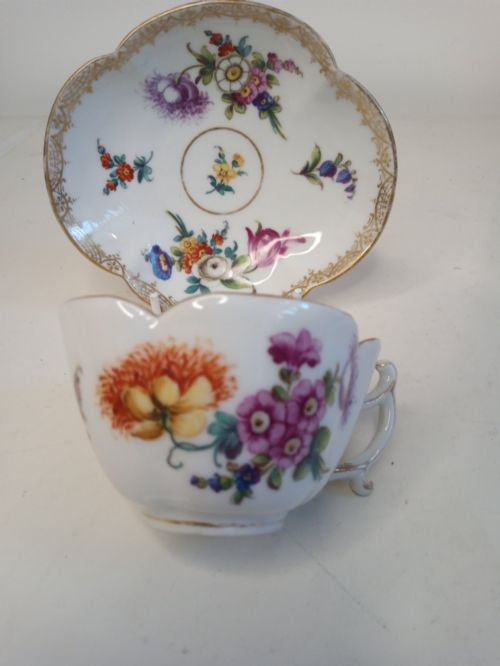
These Victorian porcelain saucers bring hand painted detail and gilded edges to the table, offering a touch of nineteenth century elegance.
Victorian Porcelain Saucers
When you search for Victorian porcelain saucers, you encounter individual tea vessels and pieces belonging to larger tea services, sets, or trios. These items span periods from the nineteenth century into the early twentieth century, reflecting varied production dates across the Victorian and Edwardian eras.
The versions most commonly met on this page range from single hand painted examples to components of afternoon tea services and demitasse sets. They originate from English and continental makers, appearing in forms like teacups and saucers alongside occasional specialised items.
Makers represented in the evidence include Royal Worcester, Masons, Davenport, and Meissen, producing everything from simple bone china to intricate Imari and Dresden flower patterns. Each piece carries the stylistic markers of its period, from Rococo Revival curves to neoclassical restraint.
How they were made
Makers utilised porcelain and bone china as the primary base materials, shaping them into tea wares, coffee cups, and decorative items. Artisans applied enamel paints by hand to create intricate floral and decorative motifs across the surface.
Gilding, gold leaf, and gold gilt accents were frequently added to rims and handles to catch the light. Certain pieces also incorporate brass components alongside the porcelain body, particularly in mixed media items like candle holders.
Victorian Porcelain Saucers Retail Price Guide 2026
Typical asking prices for victorian porcelain saucers among the pieces listed under this phrase on Sellingantiques today, from the lower quarter to the upper quarter. They describe what is for sale here now, not the wider market.
Some saucers arrived accompanied by unexpected brass candle holders, proving that Victorians wanted their tea and their ambient lighting served with equal flair.
What varies in quality
The standard of painting determines much of the distinction between pieces, with meticulous hand painted brushwork standing apart from simpler applied transfers. The crispness of Dresden floral details or Imari patterns dictates the visual depth of the surface.
The application of gilding and gold leaf shows variation in weight and preservation across different examples. Heavier, more secure gold work and finer porcelain bodies indicate higher grade production from established potteries.
Royal Worcester·Masons Patent Ironstone·Davenport·Meissen·Wileman Foley Shelley·Hirsch Dresden·Spode Copeland·Royal Crown Derby
The Victorian Porcelain Saucers Glossary
- Bone China
- A type of porcelain containing bone ash that produces a durable, slightly translucent body. It forms the base for many nineteenth century English tea wares.
- Demitasse
- A small cup used for serving strong black coffee or espresso. These often accompany matching saucers in cabinet collections.
- Imari Pattern
- A decorative style featuring rich underglaze blue and overglaze iron red, supplemented by gold. It originates from Japanese export wares but inspired extensive European imitation.
- Rococo Revival
- A nineteenth century design movement characterised by asymmetric scrolls, curving lines, and naturalistic floral motifs. This style heavily influenced Victorian tea service decoration.
- Solitaire Set
- A single person tea set comprising a teapot, cup, saucer, and sometimes a small tray. These compact sets were designed for private use in bedrooms or parlours.
Victorian Porcelain Saucers: Frequently Asked Questions
How do I date a Victorian saucer?
Dating relies on maker marks stamped or painted on the underside, alongside stylistic cues like shape and gilding style. Victorian pieces often combine robust porcelain bodies with hand painted floral decoration characteristic of the nineteenth century.
Changes in registration numbers and factory marks help narrow down production years to specific decades. Comparing the pattern details with known factory output provides further chronological clarity.
Can I use these saucers daily?
While these pieces were originally designed for functional use, their age and hand painted details require careful handling. Many collectors prefer to display them or reserve them for occasional gentle use rather than daily dining.
Hand washing in warm water with mild soap preserves the delicate enamel and gold leaf. Dishwashers and microwaves should be strictly avoided to protect the historic glaze.
What is a true trio?
A true trio consists of a teacup, a matching saucer, and a corresponding side or tea plate made by the same factory in the same pattern. These pieces were manufactured together as a cohesive set for an individual diner.
Finding a complete trio ensures consistency in the porcelain body, glaze colour, and gilding wear. They represent a complete single place setting from a historic tea service.