

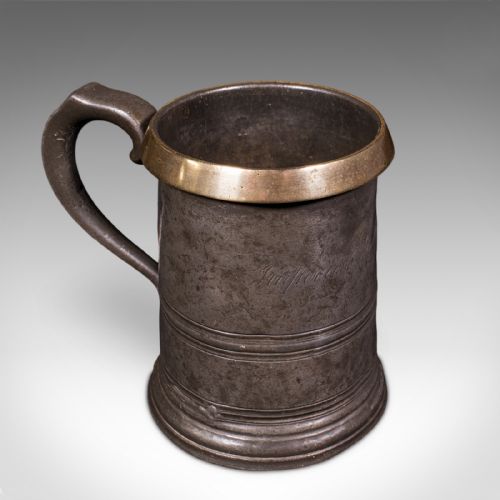


Victorian Pewter Measures
Victorian pewter measures are robust serving vessels forged for public houses and taverns, prized by collectors for their heavy metal heft and historic touchmarks.
Victorian Pewter Measures
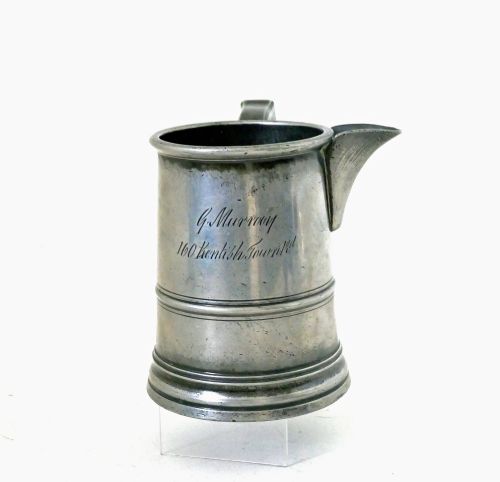
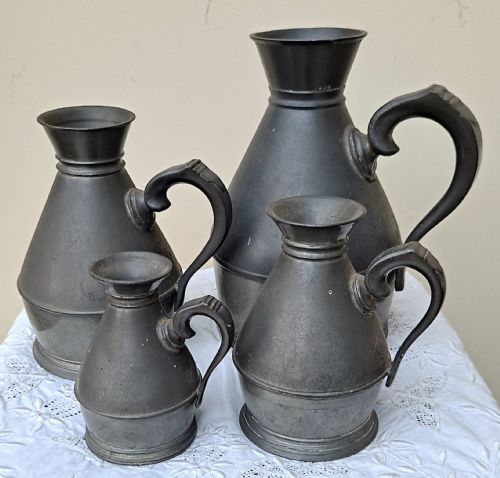
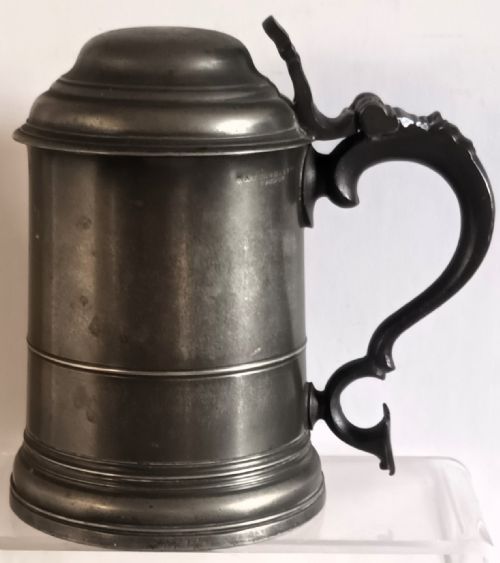
Victorian pewter measures comprise tankards, jugs, and pitchers designed to pour exact quantities of ale and spirits in busy public houses. The examples found here span the nineteenth century, including sets of haystack measures and individual quart and half-pint vessels.
The most common forms on this page are standard tavern measures, often marked with crown stamps and VR ciphers denoting official capacity and royal verification. These range from simple bell-shaped tankards to multi-piece sets used together on tavern counters.
Materials and construction
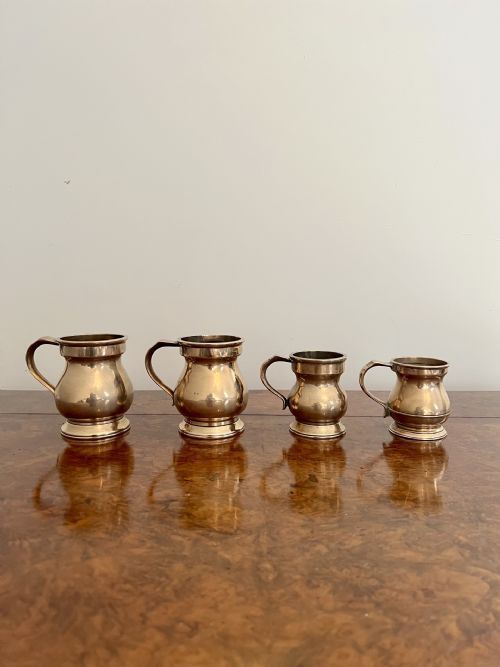
These items are constructed predominantly from pewter, a durable tin alloy often strengthened with small quantities of other metals to withstand daily tavern use. Occasional brass components appear on handles or rims, adding structural contrast to the grey metal bodies.
Makers shaped the metal through casting and hammering, finishing the surfaces by hand to create smooth cylindrical or bulbous walls. Engraved tavern names, capacity details, and touchmarks were punched or scratched directly into the soft metal by manufacturers and inspectors.
Victorian Pewter Measures Retail Price Guide 2026
Typical asking prices for victorian pewter measures among the pieces listed under this phrase on Sellingantiques today, from the lower quarter to the upper quarter. They describe what is for sale here now, not the wider market.
Some measures carry the ghost of old ale etched into the base, left behind by Victorian drinkers who finished every last drop.
Assessing quality and merit
Quality rests upon the clarity of touchmarks, the crispness of royal verification stamps, and the survival of original surface patination. Measures bearing named maker stamps or specific public house inscriptions carry greater historical interest than unmarked utilitarian stock.
Proportion and weight also separate standard examples from finer pieces, particularly in matched sets where uniform shape and matching touchmarks preserve the original tavern suite. Heavy, thick-walled metal indicates superior craftsmanship designed to endure hard service.
Watts and Harton·Frederic Sanders
The Victorian Pewter Measures Glossary
- Pewter
- A malleable metal alloy composed chiefly of tin, historically used for domestic and tavern tableware.
- Measure
- A drinking vessel or jug manufactured to hold a precise, legally verified volume of liquid.
- Touchmark
- A stamped maker mark pressed into pewter to indicate the workshop or standard of the metal.
- Haystack
- A distinct bulbous form of Irish measure featuring a tapered neck resembling a traditional hayrick.
- VR cipher
- A royal stamp showing the initials of Queen Victoria, used for government capacity verification.
Victorian Pewter Measures: Frequently Asked Questions
What are Victorian pewter measures?
These are metal vessels made in the nineteenth century to serve exact volumes of beer, ale, and spirits in public houses.
They were strictly regulated by weight and volume to ensure customers received correct measures.
How were they used in taverns?
Landlords used them behind the bar to dip, hold, and pour drinks directly for patrons.
Their heavy construction allowed them to withstand constant washing and rough handling on wooden tables.
How do you spot official verification marks?
Inspectors stamped crowns and royal ciphers like VR onto the rims or handles to certify volume accuracy.
These official stamps confirm the vessel was legally approved for commercial trade.
How should I clean pewter?
Wash them gently in warm soapy water and dry thoroughly with a soft cloth to protect the surface.
Avoid harsh modern abrasives that strip away the dark historical patina accumulated over centuries.