


Victorian Parlour Suite
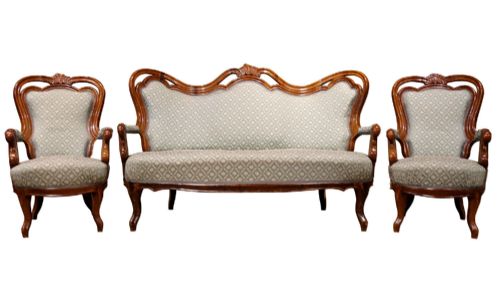
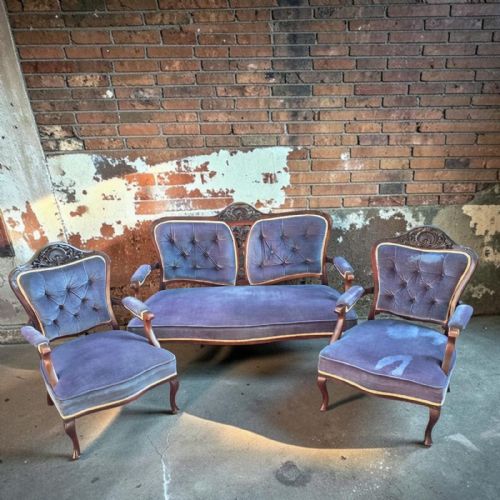
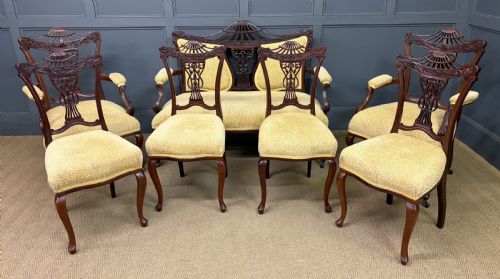
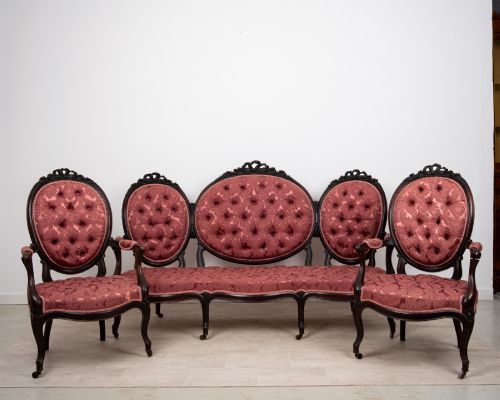
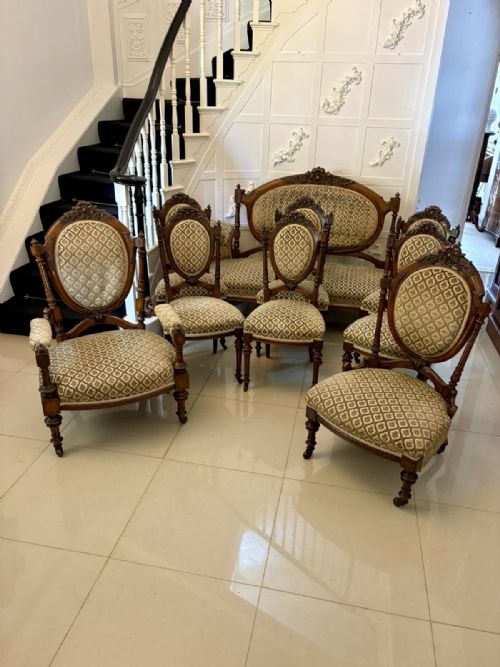
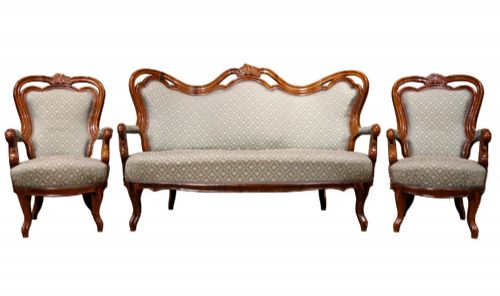
These walnut, mahogany and rosewood seating collections form a victorian parlour suite, bringing coordinated elegance and deep buttoned comfort to a formal reception room.
Victorian Parlour Suite
A victorian parlour suite brings together matching seating for the formal reception rooms of the nineteenth century, most commonly taking the form of a settee paired with armchairs and side chairs. These groupings range from modest three-piece arrangements to expansive multi-piece drawing room sets containing upwards of seven or eleven matching items.
The configurations vary across different decades, showing early Victorian spoon back settees alongside later Aesthetic period ebonised frames and elaborate Rococo Revival walnut suites. Sets frequently include specialised pieces such as chaise longues, footstools and drawing room chairs designed to furnish a unified interior.
Materials and construction
Frames rely heavily on dense hardwoods such as walnut, mahogany and rosewood, chosen for their strength and responsiveness to intricate hand carving. Cabinetmakers shaped these timbers into elaborate crest rails, cabriole legs and showwood frames that exposed the polished grain around the upholstered sections.
Upholstery relies on traditional textile coverings including velvet and varied fabric weaves, often secured with deep buttoning and brass detailing. Internal support structures incorporate metal springs and webbing to maintain the curved contours of the settees and chairs.
Victorian settees were engineered to accommodate heavy crinoline skirts without crushing the fabric.
Distinctions in quality
Quality rests upon the depth and precision of the wood carving, where crisp floral motifs and sculptural frames indicate superior craftsmanship. The choice of timber also dictates standard, with figured walnut and richly polished mahogany sitting above simpler local woods.
The integrity of the frame construction and the scale of the suite influence desirability, particularly in larger drawing room sets featuring numerous matching chairs and a central sofa. Complete sets that retain their original showwood polish and harmonious upholstery show higher levels of preservation.
Jas James Shoolbred
The Victorian Parlour Suite Glossary
- Showwood
- Timber framing left exposed around the upholstered portions of a chair or settee to display the polished grain and carving. It defines the visual character of nineteenth-century reception seating.
- Spoon back
- An oval chair or settee backrest carved with a concave indentation resembling the bowl of a spoon. This ergonomic shape became popular during the early Victorian period.
- Button back
- An upholstery technique where stitches pull the fabric tight against deep padding and secure it with covered buttons. This creates a geometric pattern of tufted indentations across the backrest.
Victorian Parlour Suite: Frequently Asked Questions
What pieces belong in a suite?
A standard grouping typically comprises a settee paired with a matching pair of armchairs or side chairs. Larger drawing room collections can expand to include seven, nine or eleven pieces with additional seating and footstools.
Smaller arrangements focus on a three-piece set consisting of a sofa and two chairs. These matched items were designed to furnish nineteenth-century reception rooms in a unified style.
How do I date these suites?
Dating relies on stylistic shifts and wood choices, moving from early Victorian mahogany and rosewood frames toward mid-century walnut Rococo Revival designs. Later decades introduced Aesthetic movement ebonised finishes and inlaid mahogany.
Form also guides the timeline, with spoon back settees appearing in earlier decades and buttoned multi-piece salon suites spanning the mid to late nineteenth century.
Were these seats used daily?
These pieces were primarily intended for formal reception rooms rather than everyday family lounging. They furnished parlours reserved for receiving guests and hosting visitors.
Because they saw intermittent use, many surviving frames and showwood structures retain their original structural integrity. The formal setting protected the delicate upholstery and polished timber surfaces.
What is showwood framing?
Showwood describes timber framing left visibly exposed around the upholstered areas of a chair or sofa. Cabinetmakers polished this wood to highlight the grain and carved ornamentation.
This technique allowed makers to combine decorative woodwork with padded comfort. The exposed sections often feature elaborate floral carvings characteristic of the period.