
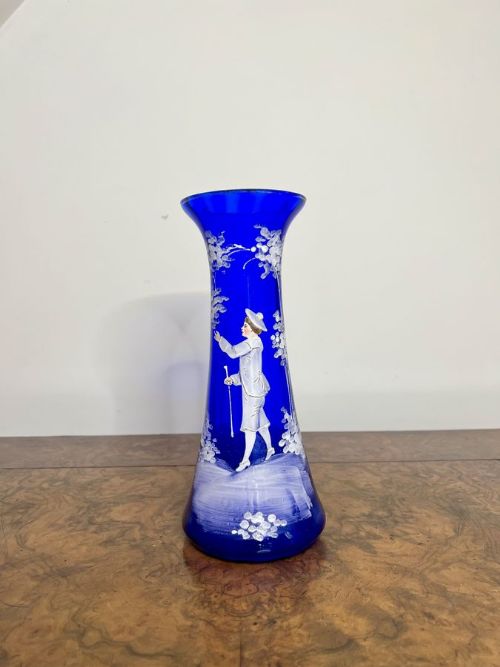


Victorian Painted Glass Urn
These Victorian painted glass urn pieces are decorative vessels defined by enamelling and glass work that bring colour and historic character to a room.
Victorian Painted Glass Urn
A victorian painted glass urn is a decorative vessel typically rendered in opaque glass, cranberry glass, or blue glass, often shaped as vases, ewers, or garniture sets. These items date from the nineteenth century, including periods around eighteen-eighty, eighteen-sixty, and eighteen-ninety, representing Victorian tastes.
The objects frequently display hand-painted enamel details, polychromatic finishes, gold leaf, and gilt highlights, sometimes featuring classical scenes, portraits, or figures in the style associated with Mary Gregory and Bohemian makers. While some examples appear as single statement pieces, others survive as matched pairs or trios.
Buyers will also encounter related decorative forms such as wall mirrors and doors bearing glass elements, though traditional vases and ewers remain the most common manifestations of the search phrase within the Victorian aesthetic movement and rococo revival styles.
How They Were Made
Makers utilised free-blown or mould-blown glass techniques to create the base vessel, incorporating specialised batches coloured with mineral oxides to achieve hues like cranberry, green, blue, amber, and peachblow. Opaque glass and crystal overlay methods provided a dense canvas for subsequent surface decoration.
Artisans applied enamel paint by hand, fixing the pigments through firing, and often added gold leaf or gilt details to accentuate rims, handles, and pictorial subjects. Etching and vitrification techniques further altered the surface texture and durability of the glass.
Some nineteenth-century glass decorators painted cheerful Victorian children onto cranberry vessels, accidentally launching a multi-generational guessing game about who Mary Gregory actually was.
What Varies in Quality
The skill of the hand-painting distinguishes finer examples, where crisp brushwork, expressive figures, and detailed classical scenes demonstrate superior draughtsmanship compared to simpler, repetitive motifs. The depth and clarity of the base glass colour, whether layered crystal overlay or rich opaque glass, also set superior pieces apart.
Preservation of fragile surface elements such as enamel and gold leaf dictates desirability, as does the presence of factory signatures or attribution to known workshops like Moser or Richardson. The survival of a true matching pair or garniture set enhances the architectural balance of the display.
Mary Gregory·Moser·Richardson
The Victorian Painted Glass Urn Glossary
- Mary Gregory
- A designation commonly applied to nineteenth-century glassware decorated with white enamel silhouettes of children amidst foliage. The attribution often encompasses work from various contemporaneous workshops.
- Opaque glass
- A non-translucent glass type that mimics porcelain, providing a solid background for polychromatic enamel painting. It was widely utilised across Victorian decorative arts.
- Garniture set
- A matching group of three or more ornamental vases or vessels designed to be displayed together on a mantelpiece or sideboard. They are typically centred on a taller primary piece.
- Vitrification
- A high-temperature process that fuses glass powder or enamel to a glass substrate, creating a permanent chemical bond. It increases the resilience of painted surface designs.
- Overlay
- A technique involving at least two distinct layers of glass of different colours, where portions of the outer layer are cut away to reveal the contrasting base colour.
Victorian Painted Glass Urn: Frequently Asked Questions
How do I identify a Victorian painted glass urn?
Look for characteristic nineteenth-century forms such as vases and ewers executed in coloured, opaque, or cranberry glass. Surface decoration typically involves hand-painted enamel work, gilt highlights, or classical motifs.
Examine the base and manufacturing traits for signs of period production methods, including pontil marks and nineteenth-century stylistic cues like Victorian rococo revival or aesthetic movement influences.
Were these glass pieces meant for daily use?
Most surviving examples functioned primarily as decorative garnitures, mantelpiece ornaments, or display items rather than utilitarian vessels. Their delicate enamel and gold leaf ornamentation made them unsuited for heavy practical service.
Display them on stable surfaces away from high-traffic areas to protect the painted glass and gilt surfaces from accidental impact.
How should I clean my antique glass vase?
Dust the surface gently with a soft, dry cloth to remove everyday particles without disturbing fragile enamel or gilt decoration. Avoid abrasive cleaners, harsh chemicals, or soaking the piece in water.
If washing is necessary, use lukewarm water with a mild, neutral soap and dry immediately with a lint-free cloth, taking care around hand-painted areas.
What does Bohemian glass mean in these listings?
Bohemian glass refers to wares produced in the historic Bohemia region, now part of the Czech Republic, known for centuries of advanced glassmaking tradition. These pieces often showcase rich colours, overlay techniques, and elaborate enamelling.
Nineteenth-century Bohemian workshops exported substantial quantities of decorative vases and ewers that align closely with Victorian tastes in Britain.