

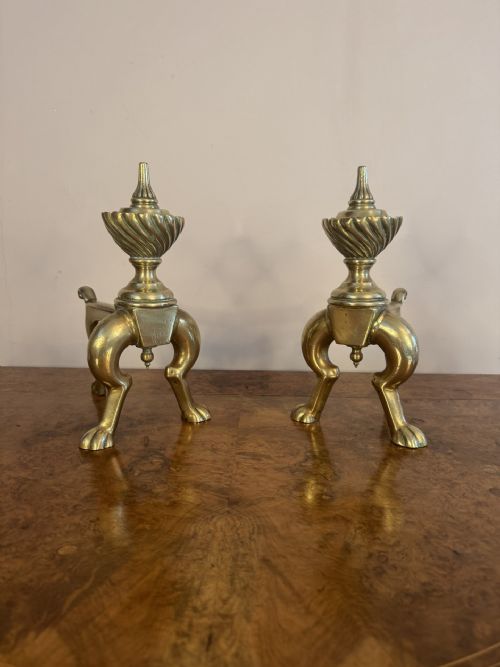
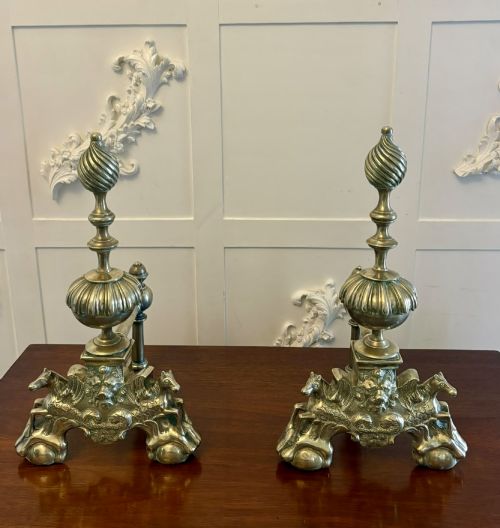


Victorian Ornate Firedogs
Victorian ornate firedogs bring heavy metal and bold nineteenth-century design to the hearth.
Victorian Ornate Firedogs
Victorian ornate firedogs are functional hearth furniture designed to support logs within an open fireplace, combining heavy metal construction with decorative casting. When searching for Victorian ornate firedogs, buyers encounter pairs formed from brass, iron, cast iron, wrought iron, and bronze, spanning dates from the middle of the nineteenth century into the early twentieth century. Most examples on this page adopt revival styles such as Victorian Gothic Revival, Neo-Classical, Baroque Revival, and Italian Renaissance Revival.
The objects take the form of fire dogs, andirons, and fire tool dogs, often paired with matching accessories. Forms range from substantial, large pieces intended for grand fireplaces to smaller domestic pairs, showing the variety produced across the period.
How they were made
Makers utilised casting techniques to shape brass, cast iron, and bronze into complex decorative profiles. Finer examples show crisp detailing from careful mould work, particularly on the prominent front standards of the fire dogs.
Iron and wrought iron provided the sturdy horizontal billets and structural bars necessary to bear the weight of burning logs. Brass and bronze components were frequently combined with iron frames to balance decorative appearance with structural strength.
Victorian Ornate Firedogs Retail Price Guide 2026
Typical asking prices for victorian ornate firedogs among the pieces listed under this phrase on Sellingantiques today, from the lower quarter to the upper quarter. They describe what is for sale here now, not the wider market.
Some fire tool dogs included fittings specifically designed to hold pokers and tongs close to the heat.
What varies in quality
Quality rests upon the crispness of the casting and the thickness of the metal used in the construction. Pieces described as finely cast or of outstanding quality exhibit sharper ornamentation and deeper relief on the decorative faces.
Substance and weight separate heavier domestic pairs from lighter productions. The choice of materials also influences character, with bronze and substantial brass assemblies sitting apart from simpler cast iron examples.
James Cartland & Sons
The Victorian Ornate Firedogs Glossary
- Andirons
- Supports for logs in an open fireplace, synonymous with firedogs. They typically feature an upright decorative front and a horizontal bar behind.
- Firedogs
- Another term for andirons used to keep logs raised above the hearth floor for better airflow. They date across various nineteenth-century revivals.
- Billet bar
- The horizontal iron bar extending backward from the front standard to support the firewood. It bears the direct heat and weight of the logs.
- Cast iron
- Iron poured into a mould to create rigid shapes and decorative surfaces. It appears widely across nineteenth-century hearth furniture.
- Gothic Revival
- An architectural and decorative style drawing inspiration from medieval forms. Pieces in this style utilise pointed arches and medieval motifs.
Victorian Ornate Firedogs: Frequently Asked Questions
What are firedogs used for?
Firedogs support logs inside an open fireplace to keep the wood elevated. This elevation allows air to circulate underneath for a cleaner burn.
Pairs stand at either side of the hearth, combining practical support with heavy metal decoration.
How do I spot revival styles?
Revival styles draw on distinct historical periods such as the Baroque, Gothic, or Italian Renaissance. Makers copied architectural and sculptural motifs from those eras.
Look at the cast ornamentation on the front standards to identify which historical period inspired the design.
Are brass and iron combined?
Many pairs combine brass fronts with iron or wrought iron structural bars. This mixture placed decorative brass where it could be seen while using tough iron for the load-bearing parts.
Examine the entire length of the object to see how the materials join together.
How do I date these pieces?
Dating relies on recorded periods, metal casting techniques, and stylistic clues from the nineteenth century. Pieces often date from the mid-nineteenth century up to nineteen-twenty.
Compare the weight, metal composition, and revival style against the listed periods to narrow down the decade.