


Victorian Oil Vinegar Bottles
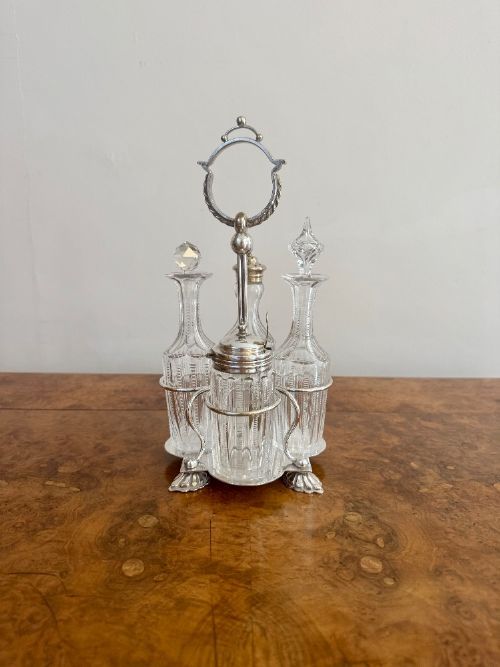
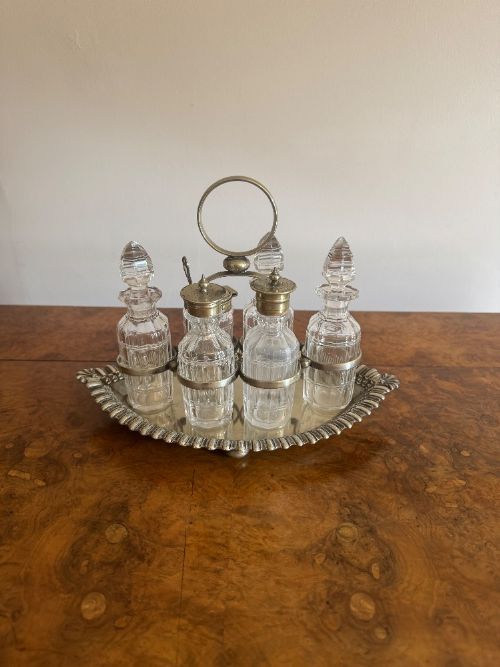
Victorian oil vinegar bottles are table vessels made to hold condiments, combining glass bodies with silver or silver plate mounts.
Victorian Oil Vinegar Bottles
Victorian oil vinegar bottles appear as individual pairs or as part of larger cruet and condiment sets designed for the dining table. These table vessels serve to dispense oil and vinegar during meals.
The pieces on this page span the nineteenth century and the Edwardian period, appearing either as standalone double gourd bottles or fitted within silver plated frames alongside other cruet bottles.
Materials and construction
Makers shaped glass into vessels using cut glass techniques to create faceted patterns that catch the light on the dining table. These glass bodies are then fitted with silver plate or sterling silver mounts.
Silversmiths constructed mounts and frames to hold the glass securely, occasionally incorporating ornate detailing into the metalwork of the Victorian and Edwardian periods.
Listings feature items spanning the nineteenth century into 1900, using cut glass, sterling silver, and silver plate.
Judging quality
Quality rests in the crispness of the cut glass facets and the weight of the silver plate or sterling silver mounts. Heavier metal fittings and well-defined glass cutting distinguish finer examples.
Maker attribution also lifts certain pieces, where marked work from known workshops demonstrates superior finishing in both the metal mounts and the glass bottles.
Walker & Hall·Elkington & Co·Wade Wingfield Wilkins
The Victorian Oil Vinegar Bottles Glossary
- Cruet set
- A fitted stand holding glass bottles for condiments such as oil, vinegar, mustard, and pepper.
- Sterling silver
- A silver alloy containing ninety-two point five percent pure silver by weight, used for the mounts on higher end pieces.
- Silver plate
- A layer of silver applied to a base metal core, commonly used for the frames and bottle collars across these listings.
- Cut glass
- Glass decorated by grinding facets into the surface using a wheel, creating decorative patterns across the body of the bottle.
Victorian Oil Vinegar Bottles: Frequently Asked Questions
What are victorian oil vinegar bottles used for?
These bottles hold and dispense oil and vinegar at the dining table during meals. They sit either independently or within a larger frame.
Pairs often feature matching stoppers to preserve the contents and keep the table setting neat during dining.
How do I date a cruet set?
Dating relies on the style of the silver mounts, the form of the glass, and any hallmarks stamped into the metalwork. Maker marks also help pin down the decade of production.
Pieces range from the mid nineteenth century into the Edwardian era, reflecting shifting tastes in dining table presentation.
Are the bottles always part of a set?
While many survive within six or seven bottle cruet sets, some examples appear as pairs of standalone oil and vinegar bottles. Double gourd shapes often occur as isolated pairs.
Frames vary in capacity, holding anywhere from two up to seven distinct glass vessels for various condiments.
What is the difference between silver plate and sterling?
Sterling silver is a solid precious metal alloy, whereas silver plate consists of a thin layer of silver bonded to a base metal. Both materials appear frequently across these listings.
Hallmarks on the metal mounts usually indicate whether a piece is solid sterling or silver plated.