

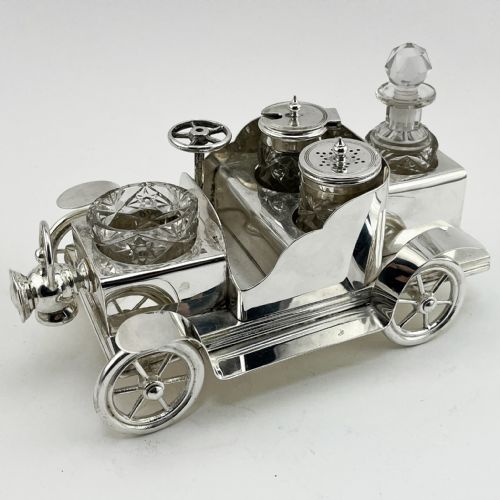


Victorian Novelty Decanter
These victorian novelty decanter pieces turn a simple pour into a talking point, bringing ingenious nineteenth-century wit to the sideboard.
Victorian Novelty Decanter
When you search for a victorian novelty decanter, you encounter functional drinkware fashioned into animals, transport, and plants. The items on this page span the Victorian era, reaching from the eighteen-sixties to the turn of the twentieth century.
Forms range widely across the evidence, taking shapes such as cats, dogs, monkeys, ducks, vintage cars, and Scottish thistles. Alongside single animal and plant vessels, you find spirit barrel sets on carriages and triple dispenser units with tot pails.
Most examples combine practical glassware with metal mounts or plating, creating humorous table ornaments that double as serving vessels. You also discover smaller items such as miniature champagne bottles and wine bottle stoppers.
How they were made
Maker construction combines silver, silver plate, and metal framework with cut glass, frosted crystal, and plain glass bodies. Artisans shaped metal into carriage frames, animal heads, and stoppers while blowing or cutting glass and crystal to form barrels, bottles, and jugs.
Victorian Novelty Decanter Retail Price Guide 2026
Typical asking prices for victorian novelty decanter among the pieces listed under this phrase on Sellingantiques today, from the lower quarter to the upper quarter. They describe what is for sale here now, not the wider market.
A cat wearing a sandwich board serves as a wine bottle stopper.
What varies in quality
Completeness also shifts, as sets with matching tot pails, original stoppers, and undamaged silver plating command greater technical interest. The integration between the glass vessel and its metal chassis determines the overall cohesion of the piece.
The Victorian Novelty Decanter Glossary
- Claret jug
- A vessel designed specifically for serving red wine, often featuring a hinged metal lid and handle. In novelty forms, the glass body is typically enclosed or mounted with animal or figural motifs.
- Frosted crystal
- Glass treated to produce a translucent, matte surface rather than a clear finish. This material appears on barrel dispensers to mimic wooden staves or textured surfaces.
- Tot pail
- A small bucket intended for holding measures of spirits, frequently accompanying barrel dispenser sets. These miniature vessels match the metal plating of the main carrier.
- Silver plate
- A layer of silver fused to a base metal foundation, widely utilised for nineteenth-century barware mounts and carriages. It provides the appearance of solid silver at a different manufacturing scale.
- Sandwich board
- A advertising board hung over the front and back of a figure, seen on cat stoppers from the period. This satirical device adds an extra layer of narrative humour to the bottle closure.
Victorian Novelty Decanter: Frequently Asked Questions
What drinks belong in a novelty decanter?
These vessels were historically made for spirits such as whiskey, gin, and brandy, alongside claret and champagne.
Today, you can use them to serve after-dinner drinks or simply display them as decorative barware on a sideboard.
How do I clean old silver plate?
Silver plate requires gentle treatment with a soft cloth and specialised cleaner to preserve the underlying metal.
Avoid harsh scrubbing that might wear away the plating on intricate animal and carriage details.
Are these decanters safe for daily use?
Most pieces remain structurally sound, though cork stoppers and older glass require careful handling during pouring.
Checking the fit of the stopper and the stability of the metal mount ensures safe use when entertaining guests.
How do I date a Victorian decanter?
Dating relies on registration marks, maker stamps, and stylistic cues associated with the nineteenth century.
Items in the evidence span from the eighteen-sixties through to nineteen-hundred, reflecting changing tastes in table ornamentation.