
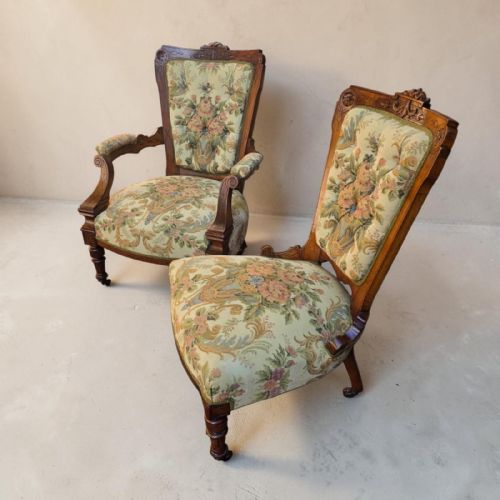
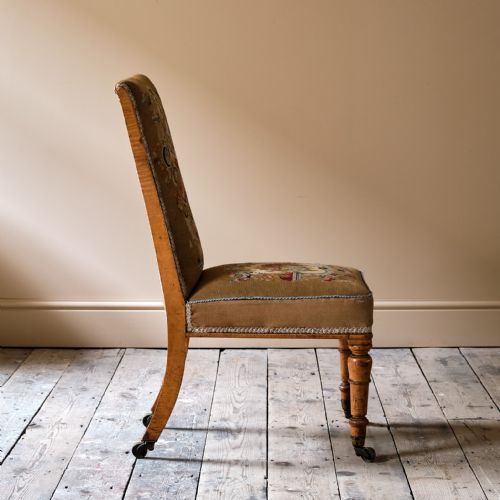


Victorian Needlepoint Slipper Chair
These Victorian needlepoint slipper chairs are low-seated bedroom and fireside chairs designed for comfort and ease.
Victorian Needlepoint Slipper Chair
A victorian needlepoint slipper chair is typically represented here by nursing chairs, side chairs, and occasional chairs originating from the nineteenth century. These low-slung seats often take the form of walnut or mahogany framed nursing chairs and fireside chairs designed for nineteenth-century domestic interiors.
Makers and workshops of the period produced these pieces in styles ranging from Victorian Rococo Revival to the Aesthetic Movement. The listings include related forms such as salon chairs, prie-dieu chairs, and bedroom chairs upholstered in wool tapestry and textile.
Buyers encounter frames constructed from walnut, mahogany, rosewood, and birds eye maple, frequently paired with floral tapestry upholstery. The low profile of these chairs characterises the form, making them suitable for bedroom and fireside placement.
How they were made
Cabinetmakers utilised hardwoods such as walnut, mahogany, rosewood, and birds eye maple to construct the timber frames of these chairs. Carved details adorn walnut and mahogany frames, particularly in Victorian Rococo Revival and Late Victorian examples.
Upholstery techniques involved wool tapestry and textile covers stretched over sprung or padded seats. Original floral tapestry upholstery survives on several pieces, secured with traditional methods onto low-slung frames.
Listings span the nineteenth century, with specific dates noted in 1850, 1870, and 1880 alongside broader Victorian and Aesthetic Movement examples.
What varies in quality
The refinement of the timber carving and the choice of primary wood distinguish the examples. Walnut and rosewood frames with intricate carving represent a higher standard than simpler structural timbers.
The preservation and artistry of the needlepoint tapestry upholstery alter the character of the piece. Original floral tapestry work executed with fine wool threads elevates the integrity of the chair.
R Whytock of Edinburgh·Gillows
The Victorian Needlepoint Slipper Chair Glossary
- Tapestry
- A form of textile art woven on a loom or worked with a needle on canvas, utilised here for upholstery. Wool tapestry covers feature prominently on nineteenth-century seating.
- Rococo Revival
- A nineteenth-century design style reviving the ornate, asymmetrical curves of the eighteenth-century Rococo movement. This style appears on carved walnut frames.
- Aesthetic Movement
- A late nineteenth-century design current emphasising art for art's sake and simplified forms. Pieces from this movement display distinct stylistic restraint compared to earlier Victorian work.
- Prie-dieu chair
- A devotional chair with a tall, narrow back and a wide seat rail, sometimes adapted for prayer or general occasional seating.
Victorian Needlepoint Slipper Chair: Frequently Asked Questions
What is a Victorian needlepoint slipper chair used for today?
These pieces serve primarily as accent or bedroom chairs in modern interiors, offering a low seating position suited to firesides or dressing rooms.
Their compact scale allows them to fit easily into smaller spaces while retaining nineteenth-century character.
How do I identify a nursing chair?
Nursing chairs are distinguished by their notably low seats, designed to allow comfortable sitting while tending to infants or dressing.
They frequently feature upholstered backs and are supported by timber frames of walnut or mahogany.
Are the tapestry covers original?
Some listings retain their original floral tapestry upholstery, whilst others feature later textile replacements.
Examining the wear and the method of attachment helps determine whether the needlepoint dates to the nineteenth century.
What woods were used for the frames?
Cabinetmakers of the period utilised walnut, mahogany, rosewood, and birds eye maple for the structural frames.
Walnut and mahogany are the most common timbers found among these nineteenth-century seats.
How do I distinguish between early and late Victorian styles?
Early Victorian and mid-century examples often display ornate Rococo Revival carving and scroll backs.
Late Victorian and Aesthetic Movement pieces shift towards cleaner lines and different decorative motifs.