




Victorian Nautical Diorama
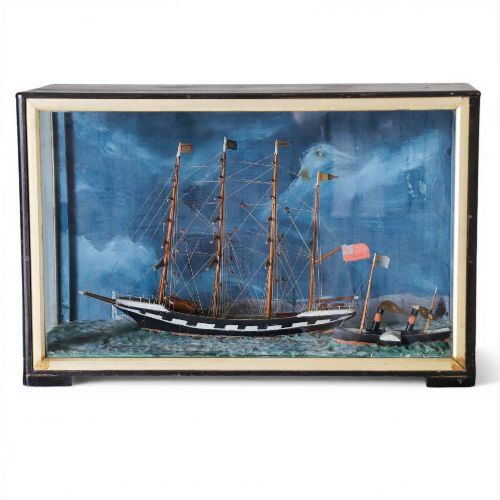
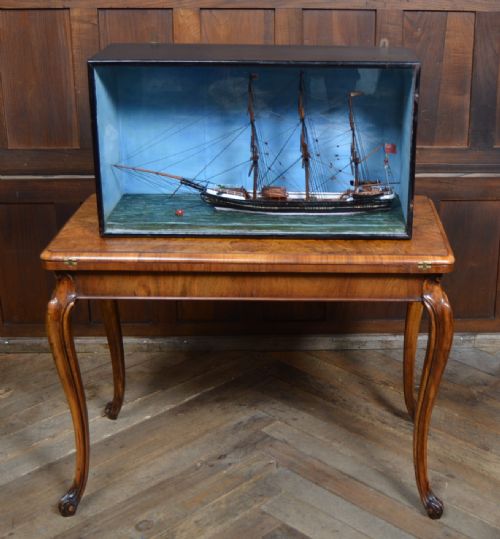
A Victorian nautical diorama brings the age of sail indoors through layered models set within glazed wooden boxes.
Victorian Nautical Diorama
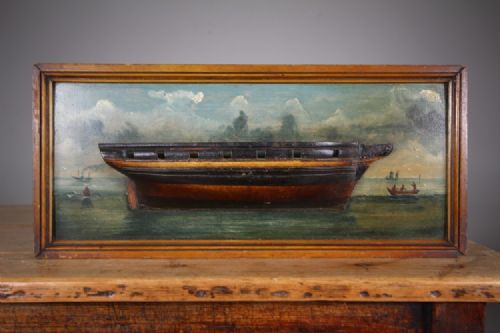
A victorian nautical diorama presents sailing vessels and marine scenes captured in three dimensions inside enclosed frames. These pieces merge model making with maritime art to depict named ships, racing vessels, and stormy seas.
Most examples found here date from the nineteenth century into the early twentieth century. They manifest as maritime folk art and shadow box dioramas created by sailors and local makers across English coastal regions.
Materials and construction
Makers constructed the primary enclosures from wood to form shadow boxes designed for wall hanging or shelf display. Glazed fronts protected the delicate interior scenes from dust and moisture.
The internal maritime scenes combine painted canvas and paper backgrounds with carved wooden ship hulls and fabric sails. Some maritime dioramas incorporate additional mediums such as plaster, oil paint, straw work, and shells.
Sailors occasionally passed idle hours at sea by gluing tiny pieces of straw into intricate ship portraits.
Distinctions in quality
Quality depends on the depth and perspective achieved within the shadow box rather than simple scale. Superior examples render rigging, waves, and sky with convincing realism and spatial depth.
The integrity of the original casing and the preservation of painted elements determine desirability. Pieces retaining undisturbed historic surfaces and detailed ship models command greater interest.
The Victorian Nautical Diorama Glossary
- Diorama
- A three-dimensional scene enclosed in a box with a glazed viewing window. It combines model elements in the foreground with a painted background.
- Shadow Box
- A deep framed box designed to display objects in relief. The internal depth allows for layered models and perspective.
- Folk Art
- Objects created by self-taught makers using traditional crafts methods. Maritime examples reflect vernacular coastal life and ship design.
- Barque
- A sailing vessel with three or more masts. The foremast and mainmast are square-rigged while the mizzenmast is fore-and-aft rigged.
- Clipper
- A very fast nineteenth-century merchant sailing ship with multiple masts and deep canvas sails. These vessels are frequent subjects in maritime art.
Victorian Nautical Diorama: Frequently Asked Questions
What is a nautical diorama?
A nautical diorama is a cased three-dimensional model of a ship at sea. It uses painted backgrounds and layered elements to create perspective.
These pieces were made to record specific vessels or general maritime scenes during the nineteenth and early twentieth centuries.
How should I display a diorama?
These pieces work best hung on walls or placed on sturdy shelves where the interior can be viewed through the glass. Keep them away from direct sunlight and damp conditions to protect the paper and painted canvas.
The glazed wooden cases protect the delicate rigging and straw work from handling.
How are different periods identified?
Periods are determined by the construction methods, materials, and ship types shown in the scene. Nineteenth-century examples often feature naive wooden hulls and oil paint, while later pieces move into the early twentieth century.
Specific named vessels can sometimes be cross-referenced with shipping records from the era.