
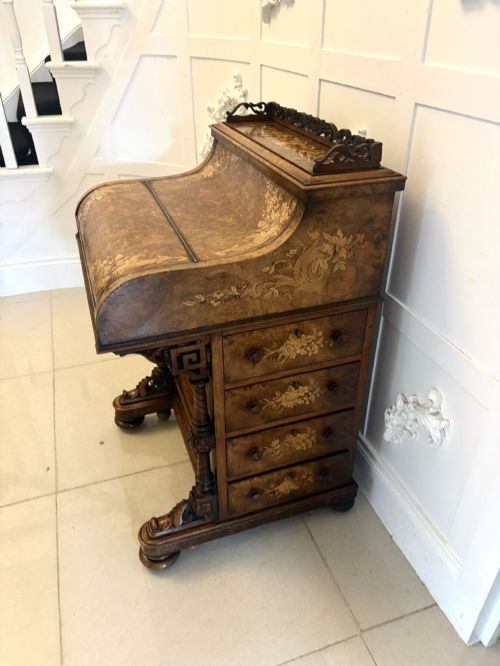
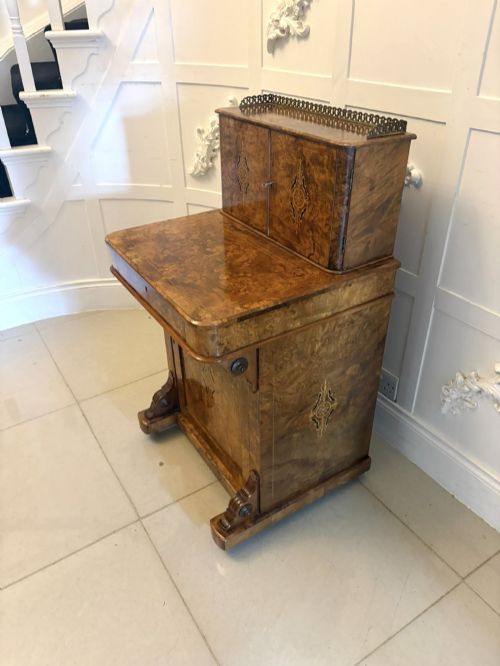


Victorian Marquetry Davenport Desk
A Victorian marquetry davenport desk is a compact writing cabinet housing clever stationary storage, offering collectors refined nineteenth-century craftsmanship and dense timber grain.

Victorian Marquetry Davenport Desk
A Victorian marquetry davenport desk brings together nineteenth-century compact cabinetry and decorative surface work, most frequently encountered in burr walnut or rosewood. These writing desks combine a sloping leather-lined writing surface with an upright drawer section or stationary compartment, often featuring side drawers and dummy drawers. Examples range from standard Victorian forms to Sheraton Revival interpretations and piano top cylinder variants dating across the nineteenth century.
The evidence shows forms spanning the decades from eighteen fifty to nineteen hundred, encompassing freestanding designs and tall bureau cabinet variations. Walnut and burr walnut dominate the pieces recorded here, accompanied by rosewood and olivewood examples. Makers and cabinetmakers of the period constructed these small desks to serve as practical writing furniture for the drawing room or boudoir.
Materials and construction methods
Cabinetmakers utilised figured timbers such as burr walnut and rosewood as primary veneers over solid foundational woods, creating rich patterned surfaces for the main body of the desk. These timbers were selected for their natural grain movement and colour depth, providing a stable canvas for subsequent inlay work.
Decoration relied on marquetry inlay and boxwood or satinwood inlay, contrasting sharply against the darker walnut and rosewood grounds. Brass hardware and leather writing inserts completed the construction, alongside specialised mechanical pop-up mechanisms and stationary compartments found in piano top variants.
Dating evidence spans the Victorian era from eighteen fifty through to nineteen hundred, encompassing standard pedestals and piano top forms.
The markers of quality in execution
Quality in a nineteenth-century davenport rests upon the precision of the marquetry inlay and the selection of the burr walnut veneer. Finer examples display meticulous botanical or geometric patterns executed in contrasting woods like satinwood and boxwood, set flush into the primary timber.
Structural sophistication also elevates certain pieces, distinguishing standard side-drawer configurations from complex pop-up mechanisms and piano top cylinder variations. The integration of brass fittings, freestanding finished backs, and well-figured secondary timbers further separates standard production from superior workshop output.
The Victorian Marquetry Davenport Desk Glossary
- Marquetry inlay
- A decorative technique where small pieces of veneer are fitted together to form pictorial or geometric designs on furniture surfaces. This creates contrasting patterns using lighter woods on dark grounds.
- Burr walnut
- A specialised timber harvested from walnut tree growths, prized for its swirling, highly figured grain pattern. It provides rich visual texture to nineteenth-century cabinet surfaces.
- Davenport desk
- A compact writing desk featuring a sloped, leather-lined writing surface above a pedestal of drawers. The form was developed during the nineteenth century for domestic correspondence.
- Sheraton Revival
- A late nineteenth-century design style drawing inspiration from eighteenth-century neoclassical furniture forms. It frequently incorporates delicate inlay and refined proportions.
- Stationary cabinet
- An upright compartment built into the upper portion of a davenport desk to hold paper and writing implements. These often feature hidden compartments or pop-up mechanisms.
Victorian Marquetry Davenport Desk: Frequently Asked Questions
What is a davenport desk?
A davenport desk is a small nineteenth-century writing cabinet featuring a sloping top and a pedestal of drawers. It was designed for domestic correspondence in spaces where a large partner's desk would prove impractical.
The form combines a writing surface with built-in stationary storage, often including side drawers that open away from the seated writer. Cabinetmakers built these pieces to occupy minimal floor space while offering maximum storage.
How do I date a davenport desk?
Dating relies on timber selection, decorative styles, and mechanical complexity recorded across the nineteenth century. Pieces utilising burr walnut and marquetry typically align with Victorian production between eighteen fifty and eighteen ninety.
Later nineteenth-century examples may display Sheraton Revival characteristics, while mid-century pieces often favor straightforward burr walnut veneers. Comparing the interior construction and secondary woods helps refine the period of manufacture.
Where were davenports used?
These compact desks served primarily as writing furniture in nineteenth-century domestic settings like drawing rooms and boudoirs. Their modest footprint allowed them to sit comfortably against walls or freestanding in open rooms.
Because many examples feature finished backs, they could stand away from walls in the centre of a room. Ladies used them for writing letters and managing household accounts.
What is a piano top davenport?
A piano top davenport is an advanced variation featuring a roll-top or cylinder mechanism that resembles a piano fall. Sliding this cover back reveals an interior arrangement of small drawers and pigeonholes.
Some variants include pop-up mechanisms that raise stationary compartments automatically as the main lid opens. These complex interior fittings represent the upper tier of nineteenth-century desk design.