

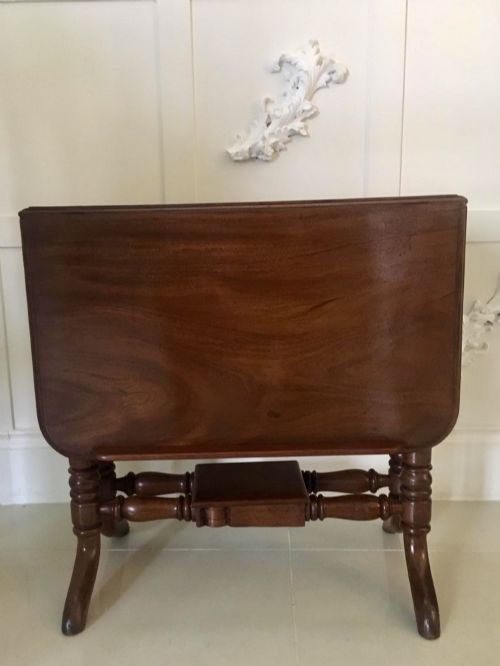
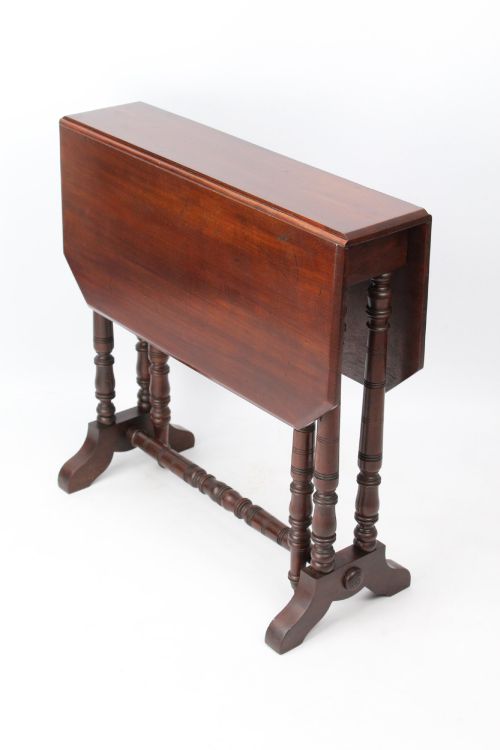


Victorian Mahogany Sutherland Table
These victorian mahogany sutherland table examples offer clever folding surfaces that fold flat against narrow legs when floor space is at a premium.
Victorian Mahogany Sutherland Table
A victorian mahogany sutherland table is a distinct type of drop-leaf table designed with hinged leaves that drop almost vertically, supported by swinging gate legs. When you search for this phrase, you meet compact occasional tables, side tables, and occasional dining tables built primarily during the nineteenth century.
The pieces on this page span from Georgian precursors through Victorian iterations up to Edwardian reinterpretations. You find oval tops, rectangular formats, and occasional reading or two-tier designs built to serve multiple functions in smaller domestic spaces.
Most examples rely on mahogany timbers, sometimes enhanced with satinwood inlay, brass fittings, or ceramic elements. The scale ranges from petite baby sutherland tables to larger folding dining surfaces.
Materials and Construction
Makers utilised solid mahogany and mahogany veneers over secondary hardwoods, shaping slender gate legs that pivot outward to support the folding leaves. Cabinetmakers balanced stability with a light frame so the leaves could drop cleanly.
Detailing often included satinwood inlay, brass castors, and turned supports such as bobbin turning or faux bamboo. Hinges and pivot joints required careful fitting to ensure the drop leaves operated smoothly without sagging.
Victorian Mahogany Sutherland Table Retail Price Guide 2026
Typical asking prices for victorian mahogany sutherland table among the pieces listed under this phrase on Sellingantiques today, from the lower quarter to the upper quarter. They describe what is for sale here now, not the wider market.
Occasional tables, side tables, and dining tables appear alongside reading and two-tier variants.
Judging Quality
Quality rests in the choice of timber and the precision of the gate leg mechanism. Better pieces display well-figured mahogany, sometimes plum pudding grain, and tight joinery that keeps the leaves level when raised.
Refined examples show careful decorative work like satinwood inlay or well-executed turned legs rather than plain, heavy framing. The overall proportion and stability when the leaves are open distinguish standard utility tables from finer parlor pieces.
Heals
The Victorian Mahogany Sutherland Table Glossary
- Sutherland table
- A narrow drop-leaf table with hinged flaps supported by pivoting gate legs. This design allows the table to fold down into a very slender footprint when not in use.
- Gate leg
- A hinged leg that swings outward from the frame to support a drop leaf. It provides structural support while remaining movable.
- Drop leaf
- A hinged section of a table top that can be folded down or raised up on brackets or gate legs. This feature allowed nineteenth-century households to adjust table sizes easily.
- Satinwood inlay
- Contrasting light wood veneers set into the mahogany surface for decorative effect. It appears frequently on late nineteenth-century pieces.
- Plum pudding mahogany
- A dense, highly figured mahogany grain pattern resembling small dots or swirls. Cabinetmakers reserved this timber for superior examples.
Victorian Mahogany Sutherland Table: Frequently Asked Questions
What is a sutherland table?
A sutherland table is a narrow drop-leaf table featuring exceptionally wide leaves supported by swinging gate legs. The design folds down to a slim profile that occupies minimal floor space.
First appearing in the nineteenth century, these tables served as versatile occasional pieces for tea, reading, or writing in Victorian drawing rooms.
How do you use a sutherland table?
You can position the table against a wall with both leaves dropped down, using the narrow top to display ornaments or books. Raising one or both leaves creates a larger surface for dining or working.
Because the gate legs swing out independently, setting up the table takes only a moment when extra surface area is needed.
How do I date a sutherland table?
Dating relies on timber characteristics, turning styles, and construction methods. Mid-nineteenth-century examples often feature simpler structural turns, while later Victorian and Edwardian versions incorporate satinwood inlay or distinct leg turnings like bobbin shapes.
Examining the hinges, secondary woods, and brass fittings also helps place the piece within the Victorian or Edwardian periods.
Are sutherland tables sturdy?
Despite their slender frames, well-built sutherland tables offer surprising stability when the gate legs are fully extended. The pivot mechanism transfers weight down through the swinging legs.
Heavier items can rest safely on the centre top, while the drop leaves handle lighter everyday uses such as tea services or books.