
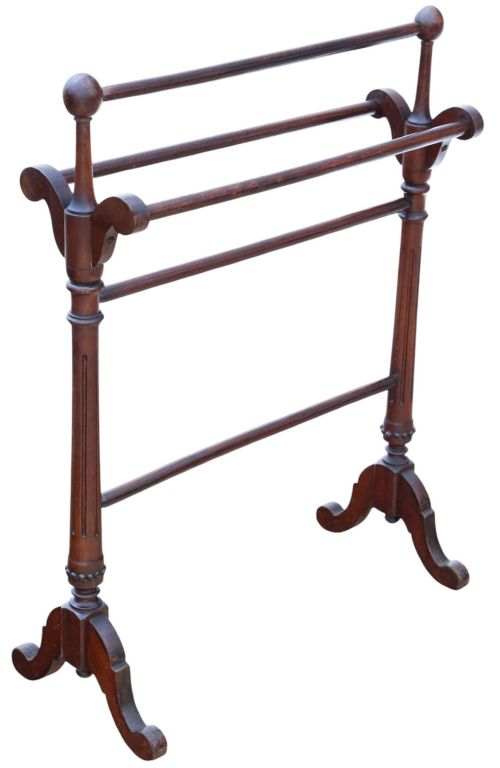
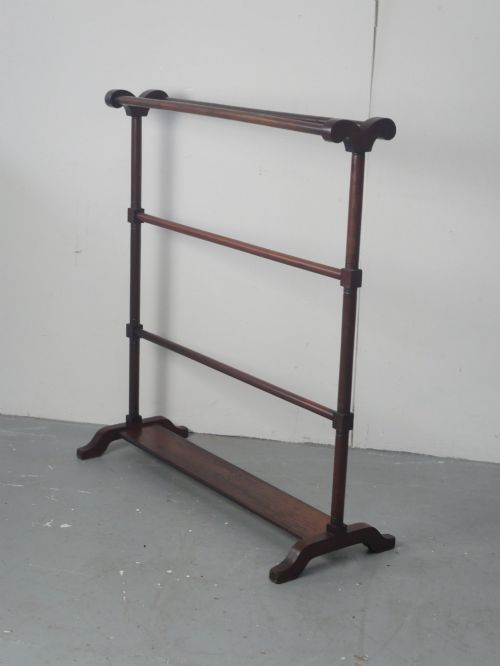
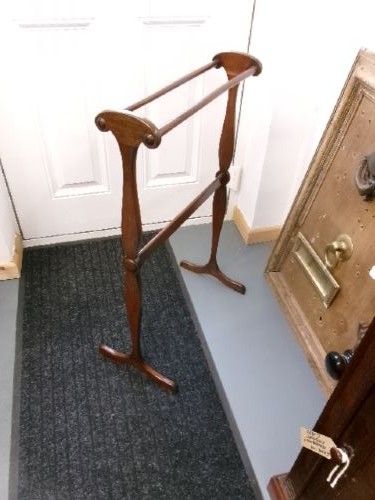
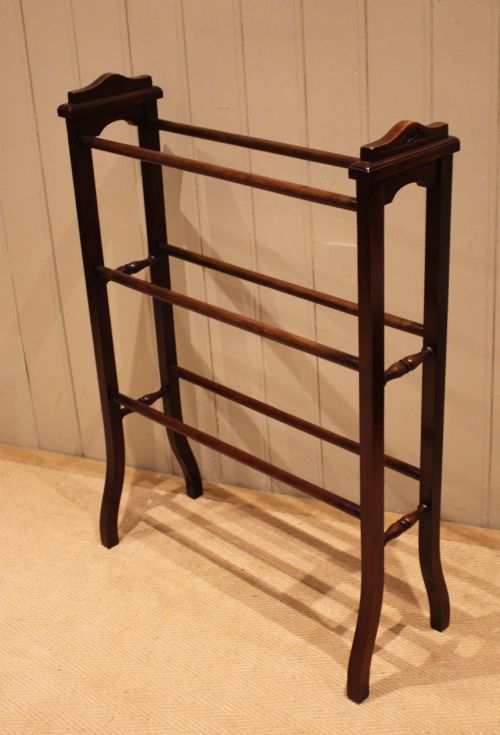
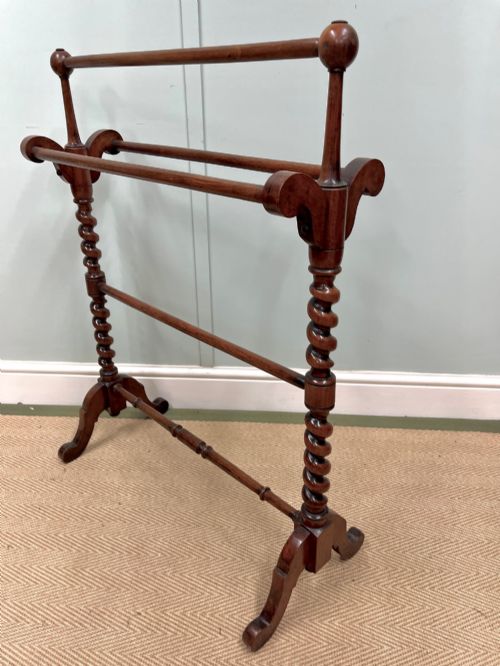
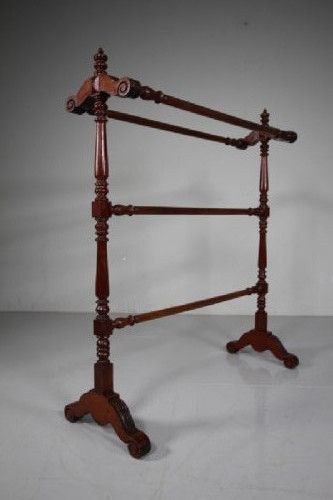


Victorian Mahogany Clothes Horse
These Victorian mahogany clothes horse pieces offer practical drying space with sturdy timber frames built for daily household laundering.
Victorian Mahogany Clothes Horse
A victorian mahogany clothes horse provides a functional wooden frame designed to hang garments and linens inside the home. These items appear primarily as towel rails and freestanding stands originating from the nineteenth century.
The pieces on this page span several decades of the eighteen hundreds alongside early twentieth century Edwardian examples. Forms range from simple folding designs to larger standing rails and three-fold configurations.
Makers utilised rich timber across various styles including William IV, Regency, and Early Victorian periods. Buyers encounter both compact rails suited for smaller spaces and large oversized items intended for substantial domestic use.
How they were made
Carpenters constructed these frames using solid mahogany and hardwood, ensuring the timber could support damp textiles without warping under normal conditions. Joinery relies on traditional framing techniques to allow folding action in multi-panel designs.
Metal components such as brass often appear in the hinges and fittings that connect the folding sections together. These brass elements provide both structural endurance and a subtle contrast against the dark polished mahogany surfaces.
What varies in quality
Quality rests in the weight of the timber and the rigidity of the assembled frame when extended. Finer examples maintain stability across multiple folding sections without excessive play in the joints.
The finish of the mahogany distinguishes standard utility items from more refined household furnishings. Rich grain patterns and careful turning on the upright supports elevate the visual presence of the piece.
The Victorian Mahogany Clothes Horse Glossary
- Mahogany
- A durable tropical hardwood known for its deep reddish-brown colour and fine grain. Cabinet makers favoured this timber for nineteenth century furniture.
- Cheval rail
- A freestanding pivoting or folding frame designed to hold towels or clothes. This form allows the wings to angle according to available space.
- William IV
- A design period spanning the early nineteenth century characterised by robust proportions and classical influence. Pieces from this era often display heavier timber sections.
- Edwardian
- A stylistic period covering the early twentieth century up to the First World War. Furniture from this time tends towards lighter construction.
Victorian Mahogany Clothes Horse: Frequently Asked Questions
How do you use a clothes horse?
These folding frames stand independently in a room to drape laundry, towels, or garments for air drying. The hinged sections adjust to fit the available floor space.
Folded flat, the stand stores neatly against a wall when not in active service around the home.
Are these pieces stable when loaded?
Sturdiness depends on the weight of the timber and the design of the base feet. Larger standing rails manage heavier textiles securely.
Heavier hardwood frames distribute weight evenly across the floor without tipping during daily use.
How do I date a towel rail?
Stylistic clues within the turning and joinery point toward specific decades of manufacture. William IV examples show heavier proportions.
Edwardian items often display lighter framing reflecting changing domestic tastes at the start of the twentieth century.
Do folding rails require much space?
Multi-fold designs adapt to room dimensions by angling the hinged panels inward or outward. A three-fold version creates a larger drying barrier.
Closed flat, the entire frame occupies minimal depth against a hallway or bedroom wall.