
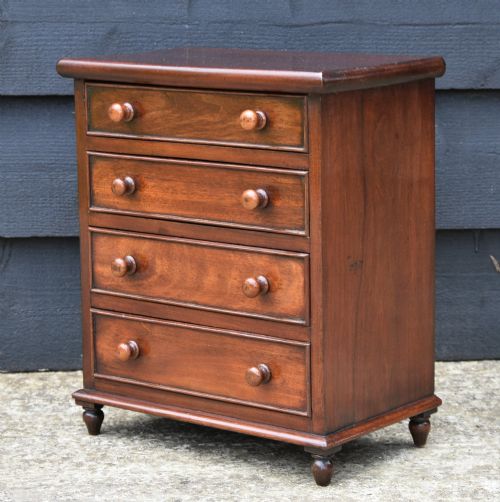
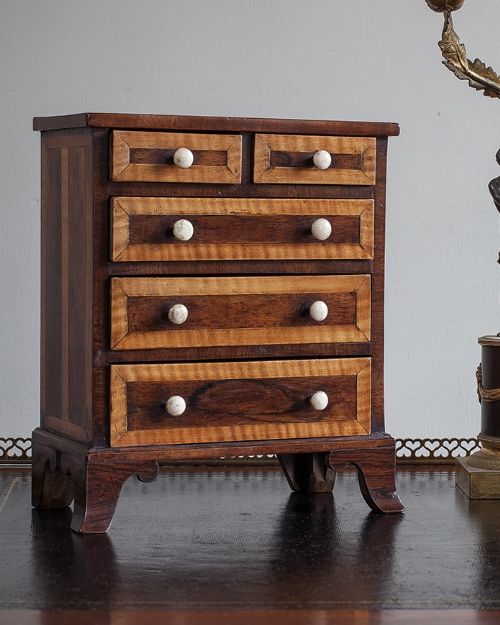
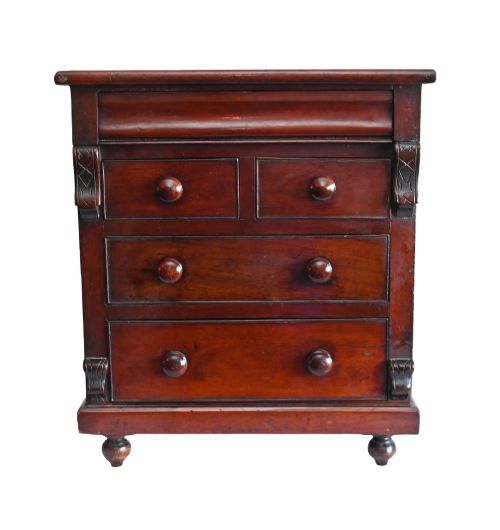
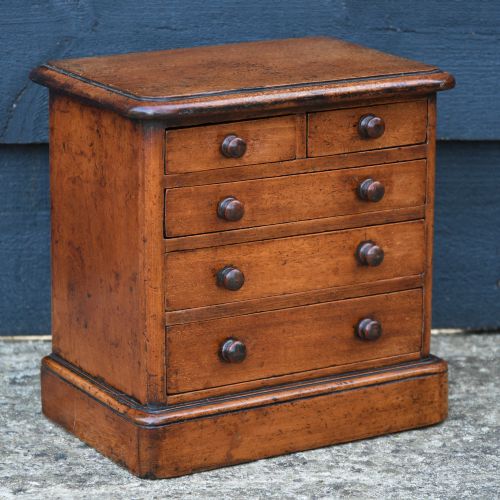
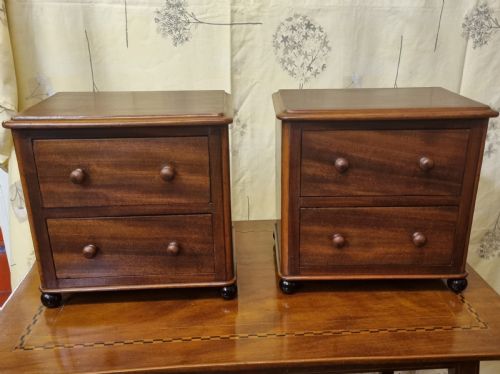
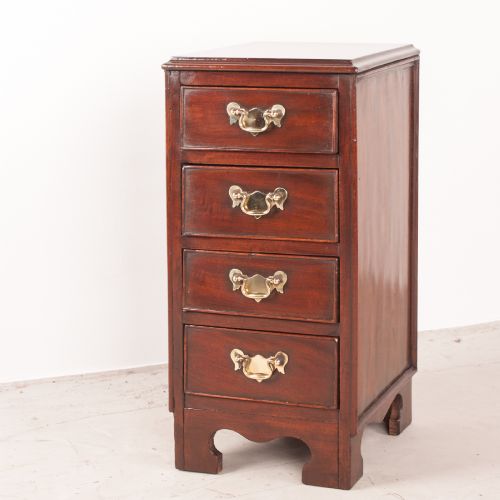
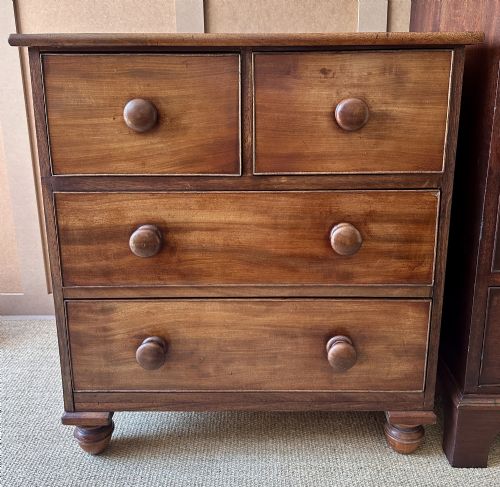
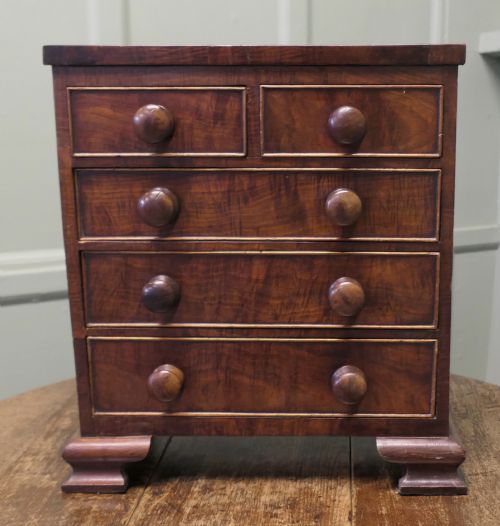
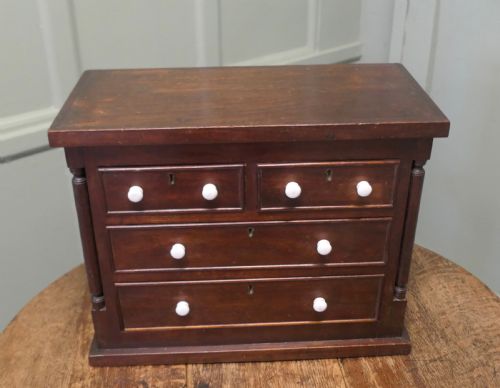
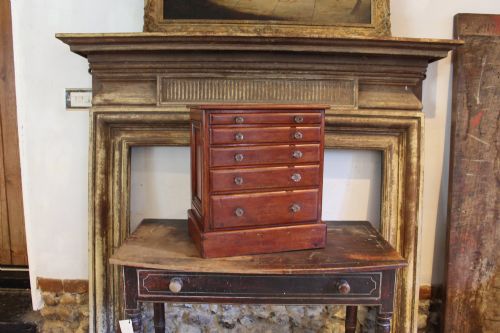
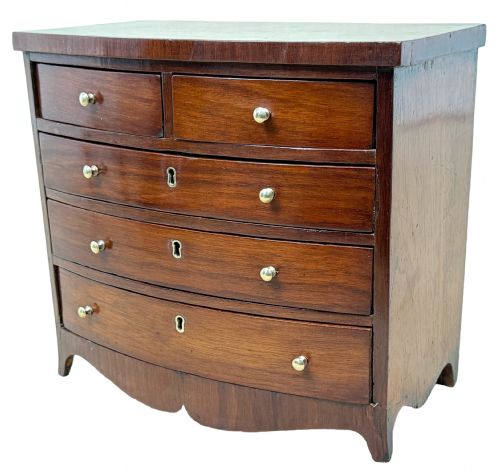

Victorian Mahogany Apprentice Chest
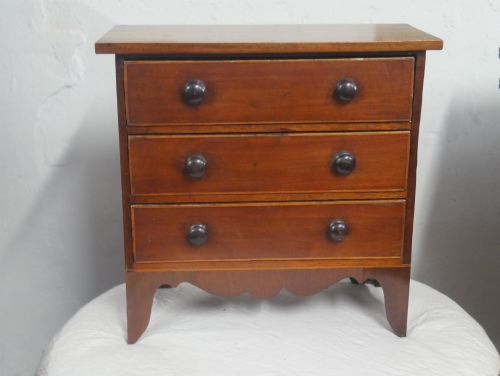
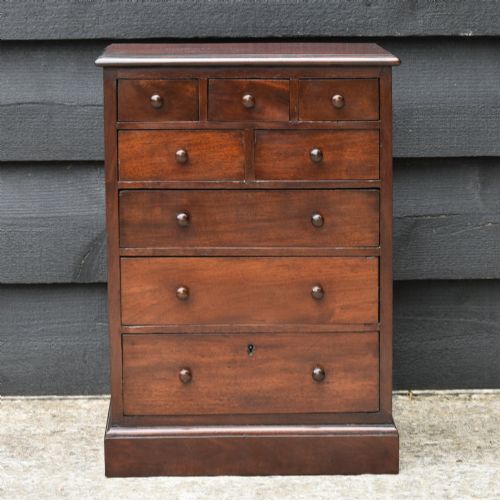
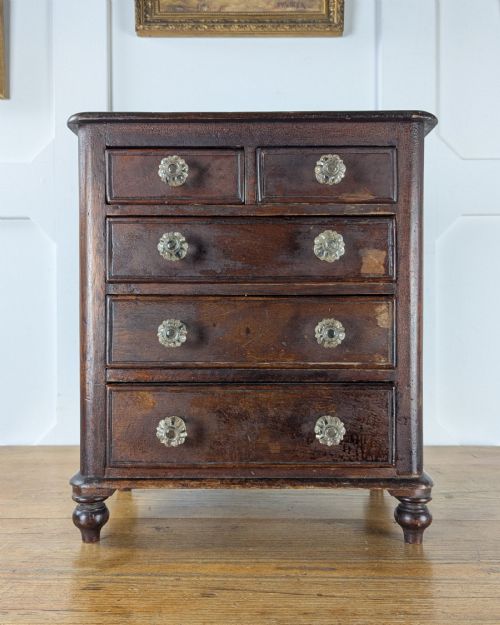
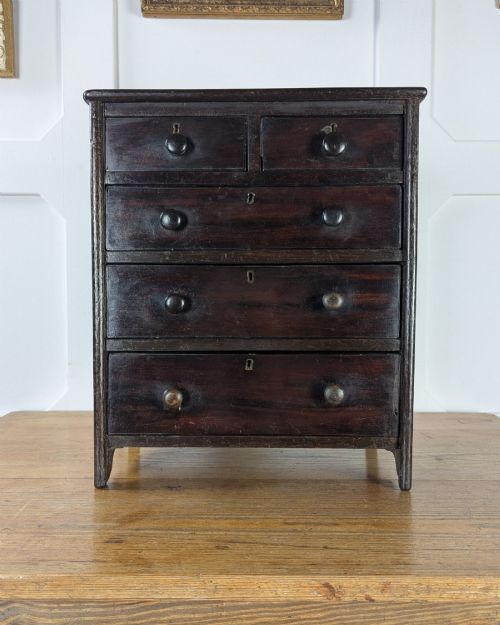
When you want a victorian mahogany apprentice chest, you are seeking a scale model of full-sized furniture made to demonstrate a cabinet maker's skill.
Victorian Mahogany Apprentice Chest
A victorian mahogany apprentice chest is a small-scale drawer unit created during the nineteenth century, often following the design of larger household chests. They appear frequently as miniature chests of drawers, bowfront chests, and tabletop cabinets originating from the Victorian period and earlier nineteenth century.
Makers constructed these scaled objects in regional British forms, including Scottish variations and English table chests, as well as distinct international styles like Anglo-Indian pieces. Alongside standard drawers, the forms extend to miniature dressers, Wellington chests, and specimen cases built for tabletop utility.
Collectors encounter these items performing roles as jewellery boxes, trinket storage, or collectors chests rather than full-scale domestic storage. The dimensions remain compact, designed for desktop placement or display while retaining the working drawer configuration of standard furniture.
How they were made
Makers built these pieces primarily from solid mahogany and pine, often incorporating secondary woods like boxwood for contrast or structural lining. Surfaces frequently display wood inlay, brass hardware, bone details, and glass elements.
Construction techniques mirror full-sized cabinet making, utilising dovetailed drawer joints and turned feet to support the miniature carcase. Artisans finished certain examples with mother of pearl inlay or polished the mahogany to achieve a deep patina.
Listings demonstrate materials including mahogany, brass, bone, pine, glass, boxwood, and wood inlay across Victorian and nineteenth-century periods.
What varies in quality
The degree of refinement in the cabinet work distinguishes simpler utility boxes from master-level demonstration pieces. Proportions matching full-scale furniture and careful alignment of drawer timbers indicate higher execution.
The presence of secondary materials such as bone stringing, specialised brass handles, or complex wood inlay elevates the decorative execution. A preserved surface patina and crisp turning on feet or columns reflect greater original craftsmanship.
The Victorian Mahogany Apprentice Chest Glossary
- Apprentice piece
- A small-scale item created by a craftsman to demonstrate mastery before admission to a guild or trade. These objects reproduce full-sized furniture designs in miniature.
- Bowfront
- A cabinet or chest design featuring a convex, curved front profile. This shape appears frequently among nineteenth-century miniature chests.
- Wellington chest
- A tall, narrow chest of drawers secured by a hinged locking side stile that fastens with a key. Examples in miniature maintain this vertical locking mechanism.
- Patina
- The surface sheen and coloration developed through age, handling, and polishing of wood over generations. A deep natural patina indicates long-term preservation of mahogany.
- Inlay
- The technique of embedding contrasting woods, bone, or shell into the primary surface to create decorative patterns. Boxwood and mother of pearl serve this purpose in these cabinets.
Victorian Mahogany Apprentice Chest: Frequently Asked Questions
What is an apprentice chest?
An apprentice chest is a miniature furniture model built by a woodworker to prove technical skill to master craftsmen. These small chests replicate the joinery and design of full-sized furniture.
They served as portable portfolios for journeymen or as specialised tabletop storage for jewellery and small collectables in nineteenth-century homes.
How old are these chests?
Most surviving examples date from the Victorian era and the broader nineteenth century, spanning roughly from eighteen hundred to nineteen hundred. Makers produced them using traditional hardwood construction methods of that period.
Certain pieces reflect earlier Georgian stylistic influences while retaining Victorian manufacturing techniques and materials.
Were these used to store jewellery?
While originally built as demonstrations of skill, owners repurposed many of these miniature chests for domestic storage. Their multiple small drawers suited the safekeeping of rings, trinkets, and watchmaker tools.
Fitted interiors and velvet linings added later in the nineteenth century often support this domestic use as jewellery boxes.
How do Scottish miniature chests differ?
Scottish miniature chests often incorporate regional design characteristics typical of nineteenth-century Scottish case furniture, such as specific drawer arrangements or column details. They reflect the local cabinet-making traditions of northern workshops.
These regional pieces share the compact scale of standard apprentice chests while displaying distinct aesthetic proportions.