


Victorian Livestock Art
Step into the pastoral world of Victorian livestock art, where prize bulls, resting sheep, and Highland cattle capture the agricultural heart of the nineteenth century.
Victorian Livestock Art
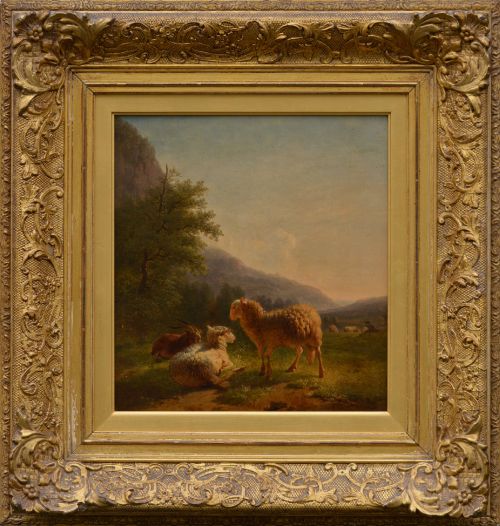
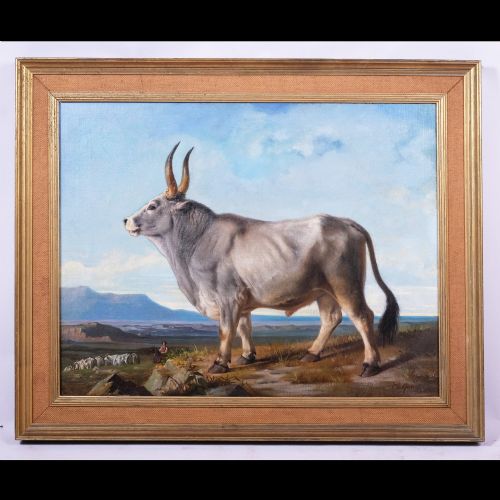
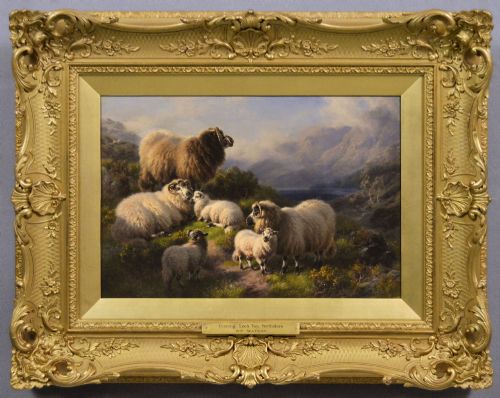
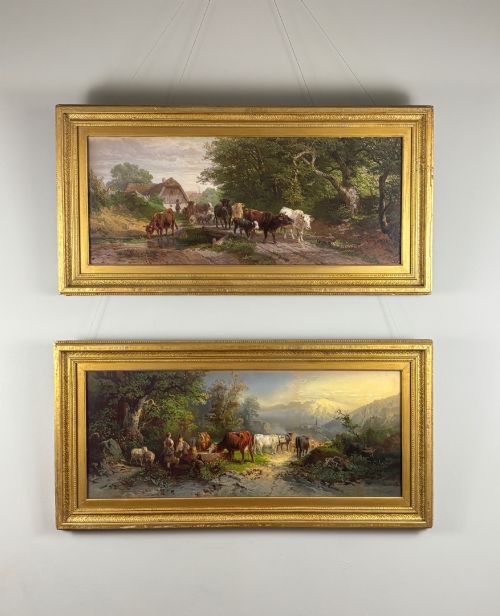
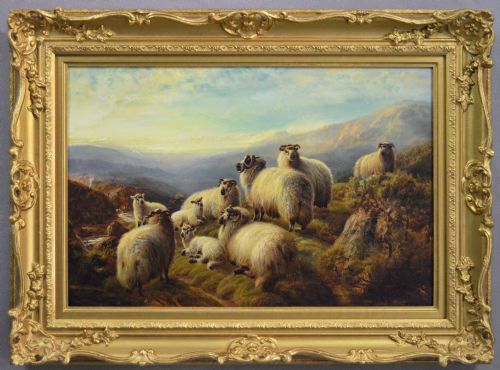
Victorian livestock art comprises oil paintings, watercolours, and drawings that celebrate agricultural animals, farmyard scenes, and pastoral landscapes. These works reflect a period of immense agricultural pride, capturing prized cattle, sheep, and horses in detailed realism.
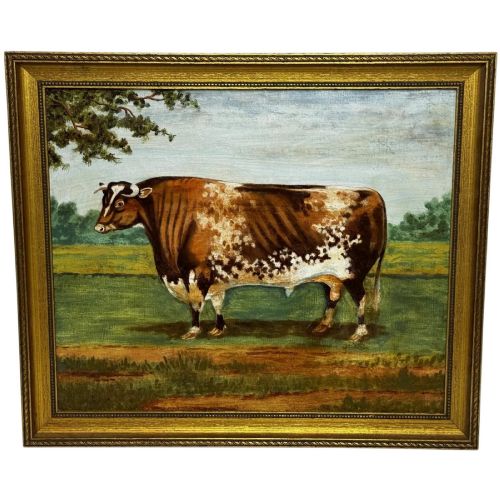
The pieces on this page are predominantly nineteenth-century oil paintings on canvas, framed in period materials such as giltwood and gesso. You will encounter both grand Scottish landscapes featuring Highland cattle and intimate portraits of individual shorthorn bulls and sheep.
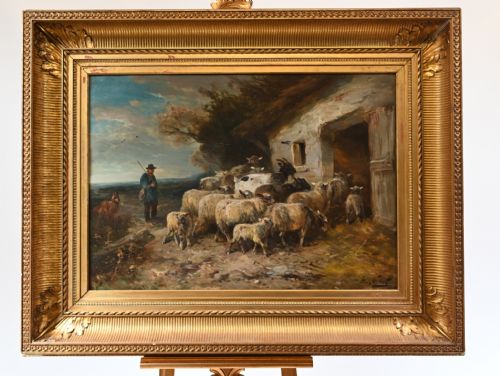
Works range from academic British and European animalier paintings to naive depictions of farm animals in stables. Common subjects include sheep resting in fields, cattle by rivers, and rural farmyard scenes populated by poultry and livestock.
Materials and Techniques
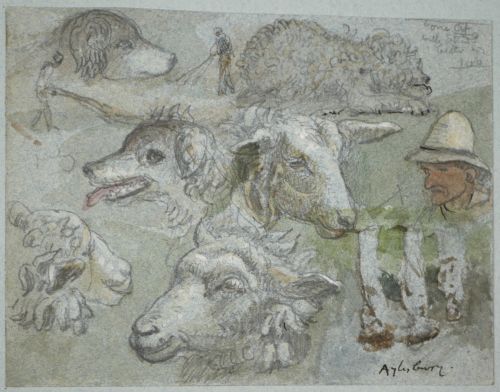
Artists relied primarily on oil paint applied to canvas, capturing the texture of animal coats and the play of light across rural landscapes. Paper supports and watercolours also appear frequently, particularly for detailed studies and drawings.
Frames are constructed from wood, embellished with moulded gesso and finished with gold leaf or giltwood. These traditional framing materials provide the heavy, ornate borders characteristic of nineteenth-century presentation.
Listings span the nineteenth century, utilising oil on canvas, watercolour, and paper supported by gesso and giltwood frames.
Distinctions in Quality
Quality rests upon anatomical precision, handling of light, and the artist's ability to render the texture of wool, hide, and feather. Superior works demonstrate a deep understanding of animal form and believable integration within a natural landscape.
The distinction between a skilled professional animalier and a follower or naive painter lies in depth of perspective and brushwork control. Master hands create convincing atmosphere and individual character in their subjects, whereas lesser pieces rely on stiff repetition and flat backgrounds.
Eugène Verboeckhoven·James Smetham·William Watson Jnr·Johann Friedrich Voltz·Robert Watson·Henry Schouten·A M Gauci·William Henry Mander·Thomas Sidney Cooper·Franz van Severdonck·Andre de Moller·Basil Bradley·Charles Jones·Arthur Charles Dodd·Claude Cardon·John W Morris·Frederick Richard Lee·Henry Brittan Willis·Edgar Hunt·Henry Cheadle·William Sidney Cooper·W A Clark·William Huggins·A Davis·H Strafford
The Victorian Livestock Art Glossary
- Animalier
- An artist who specialises in the realistic depiction of animals. This term encompasses sculptors and painters alike during the nineteenth century.
- Gesso
- A plaster-like mixture applied to wooden frames before gilding. It provides a smooth surface for intricate moulded decorative details.
- Giltwood
- Wood that has been coated with gold leaf or gold paint. It forms the classic ornate framing seen on nineteenth-century oil paintings.
- Pastoral
- A genre of art depicting rural life, shepherds, and farm animals in idealized or natural country settings. These scenes emphasise a peaceful connection to the land.
- Shorthorn
- A prominent breed of cattle frequently depicted in Victorian agriculture and art. Painters often recorded prize-winning specimens for wealthy landowners.
Victorian Livestock Art: Frequently Asked Questions
What subjects feature in victorian livestock art?
Paintings focus on farm animals, including prizewinning bulls, sheep flocks, Highland cattle, and horses. Artists placed these animals within detailed rural landscapes, riverbanks, or farmyard stables.
Scenes frequently incorporate human figures such as shepherds, farmers, or women tending to calves and poultry. The emphasis remains firmly on rural productivity and pastoral tranquility.
How do I identify the period of a painting?
Examine the materials, stretcher frames, and canvas types alongside the stylistic approach to realism. Nineteenth-century works often bear signatures, dates, or framing techniques consistent with the Victorian era.
Subject matter also offers strong clues, as agricultural improvement societies during the nineteenth century commissioned specific portraits of prized livestock breeds.
Where should I hang these paintings?
These works suit traditional dining rooms, studies, or hallways where their rich giltwood frames and earthy palettes can shine. They pair naturally with wood panelling and classic interior decor.
Keep canvases away from direct sunlight and excessive humidity to protect the oil paint and sensitive gesso frames over time.
What is an animalier painting?
An animalier painting focuses specifically on the realistic portrayal of animals as the primary subject. In nineteenth-century art, this genre gained immense popularity among collectors valuing biological accuracy.
Artists studied anatomy intently to render cattle, sheep, and horses with distinct individual character rather than generic forms.