


Victorian Hunting Hound Art
Victorian hunting hound art captures the athletic power and intense focus of sporting dogs through period oil paintings and watercolours.
Victorian Hunting Hound Art
Victorian hunting hound art encompasses oil paintings, watercolours, and framed works depicting dogs in sporting and landscape settings. These pieces celebrate the central role of hounds in nineteenth-century country pursuits.
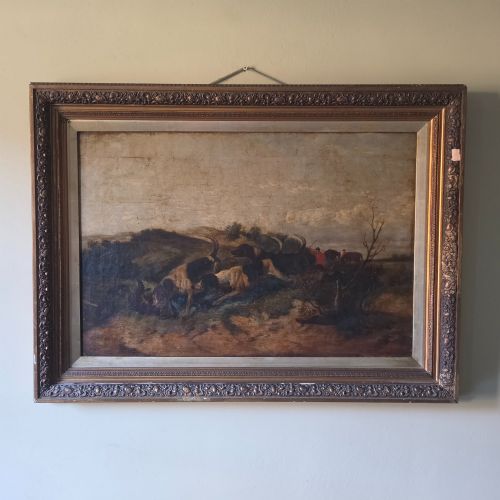
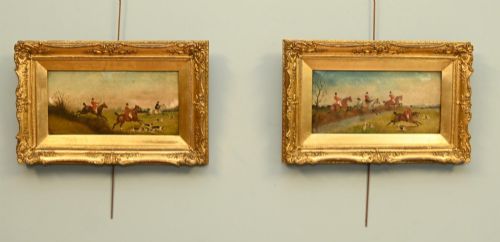
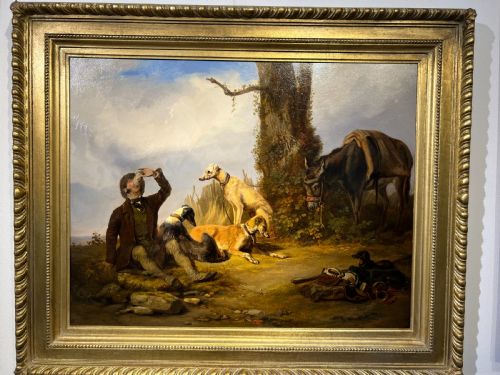
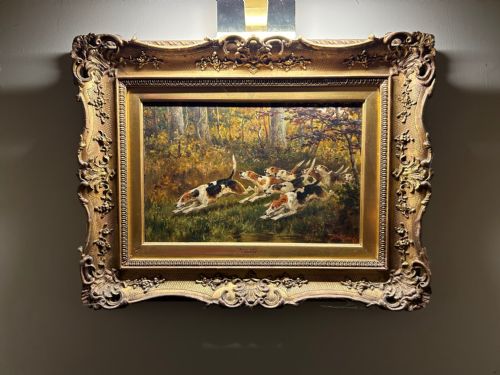
You will most frequently encounter nineteenth-century oil paintings on canvas and board, alongside watercolours that portray individual hounds, pack scenes, and hunt participants.
The works span the Victorian era, particularly the later decades of the nineteenth century, reflecting a period of intense interest in animal portraiture and sporting traditions.
Materials and Techniques
Artists worked primarily with oil paint on canvas or board, applying pigments to capture the texture of a hound's coat and the atmosphere of winter landscapes. Watercolour on paper provides lighter, more fluid depictions of dogs in motion.
Many works retain their period framing, utilising wood and gold leaf or giltwood to complement the visual depth of the paintings.
Listings feature works from the nineteenth century utilising oil on canvas, oil on board, and watercolour on paper.
Judging Quality
Quality rests upon the artist's ability to render the anatomy, muscle structure, and distinct expression of the hound with anatomical precision. Stronger compositions handle movement and pack dynamics convincingly within the landscape.
The handling of light, particularly in winter snow scenes and woodland settings, separates skilled observation from formulaic studio production.
Sir Edwin Henry Landseer·Arthur Wardle·Colin Graeme Roe·Fannie Moody·Jules Chardigny·Alfred Duke·Heywood Hardy·George Goodwin Kilburne·Thomas Blinks·Henry Frederick Lucas-Lucas·Edward B Herberte
The Victorian Hunting Hound Art Glossary
- Victorian Sporting Art
- A genre of nineteenth-century painting dedicated to field sports, horses, and hounds. It records the traditions of the British countryside during the period.
- Oil on Canvas
- Pigments bound in drying oil applied to a stretched woven fabric surface. This combination allows for rich colour blending and layered depth.
- Giltwood
- Wood carved and surfaced with a thin layer of gold leaf. It provides traditional framing for nineteenth-century paintings.
- Watercolour
- A painting method where fine pigment is suspended in a water-based solution on paper. It creates transparent washes of colour.
Victorian Hunting Hound Art: Frequently Asked Questions
What subjects appear in these paintings?
The works portray bloodhounds, greyhounds, lurchers, and various hunt packs engaged in field sports or resting in landscapes.
Scenes range from individual dog portraits to dynamic winter fox hunts involving huntsmen and horses.
How do I date a piece?
Dating relies on stylistic evidence, artist signatures, framing materials, and nineteenth-century canvas supports.
Most pieces date from the Victorian era between the mid-nineteenth century and nineteen hundred.
Where should I hang these works?
These framed paintings suit traditional studies, hallways, and living spaces with classic country house aesthetics.
Direct sunlight should be avoided to protect oil paint and paper watercolours over time.
How are different dog breeds shown?
Artists emphasised the distinct physical traits of hounds, such as the heavy jowls of bloodhounds or the lean frames of greyhounds.
Individual portraits capture distinct facial expressions while pack scenes focus on group movement.