


Victorian Hearth Dog Statues
These Victorian hearth dog statues bring character to a fireplace, offering the enduring charm of Staffordshire poodles, spaniels, and terriers.
Victorian Hearth Dog Statues
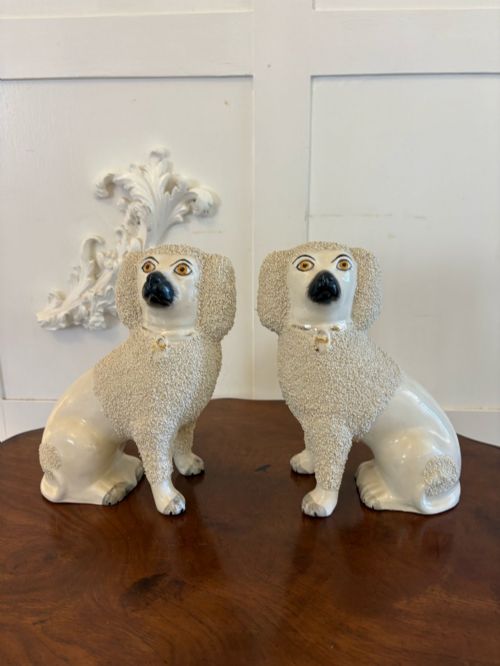
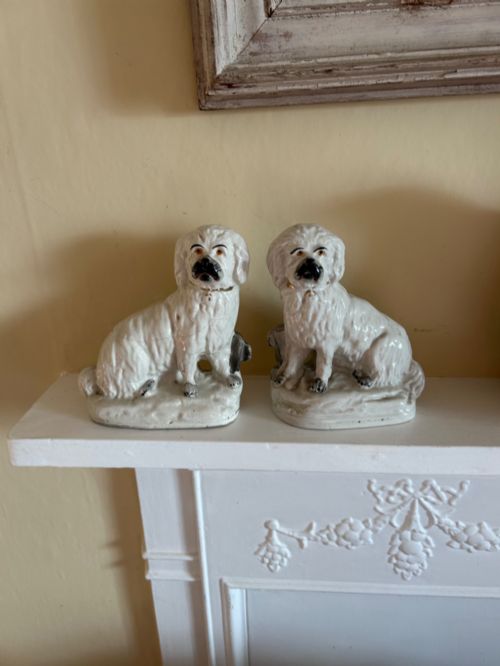
Victorian hearth dog statues are decorative ceramic figurines made in pairs to sit either side of a fireplace. The examples on this page date from the nineteenth century, encompassing Victorian and English traditional styles.
Originating predominantly from Staffordshire potteries, these figures capture the domestic animal portraiture favoured during the nineteenth century. They function purely as mantelpiece and hearth ornaments rather than working objects.
How they were made
Makers utilised earthenware and glazed ceramics as the primary base materials for shaping these Staffordshire figures. Artisans applied lead glaze to seal the clay body and create a smooth surface.
Object types include decorative figurines of poodles, spaniels, and terriers presented in traditional English styles.
What varies in quality
Quality in Victorian hearth dog statues rests upon the precision of the hand painting and the crispness of the moulded details. Softer brushwork and blurred enamel lines indicate a standard commercial output.
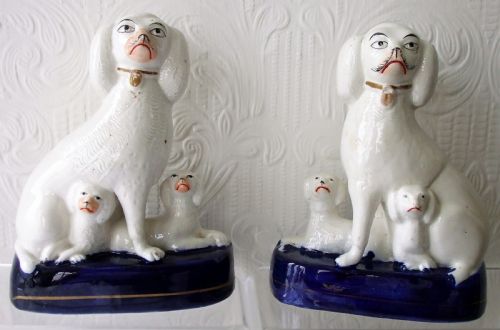
The presence of secondary elements, such as accompanying pups or intricate encrusting on cushions, generally distinguishes more ambitious models. Potteries like Beswick represent specific shifts in production standards across the span of the nineteenth and early twentieth centuries.
Beswick
The Victorian Hearth Dog Statues Glossary
- Earthenware
- A porous pottery fired at lower temperatures, commonly used for nineteenth-century decorative figures before being glazed. It forms the structural body beneath the painted surface.
- Lead glaze
- A glossy coating applied to ceramic ware to give a shiny finish and waterproof the porous clay body underneath. This treatment creates the characteristic sheen seen on Staffordshire dogs.
- Enamel
- Opaque glass-like paint applied over the glaze and fired again to fuse the colour permanently to the ceramic. It provides the bright reds, blacks, and golds on the dogs.
- Encrusting
- Applied clay particles or slip work used to create textured details such as curly fur or decorative padding on cushions. This technique adds tactile depth to the figurine.
Victorian Hearth Dog Statues: Frequently Asked Questions
Where did people display these dogs?
Owners traditionally placed these ceramic figures in pairs upon the mantelpiece or directly on the hearth stones flanking an active fireplace. They faced inward toward each other to frame the domestic fire.
Over time, collectors moved them to side tables, bookcases, and cabinets throughout the home to enjoy their decorative presence away from coal soot.
Why were they made in pairs?
Victorian interior design favoured symmetry, particularly around the central focal point of a room such as the fireplace. Facing pairs created a balanced arrangement on either end of the mantel.
Mirror-image moulding allowed potteries to sell matched sets intended to sit in specific left-and-right orientations.
How do I date a Staffordshire dog?
Dating relies on examining the clay body, the style of the hand painting, and the type of glaze utilised by the pottery. Nineteenth-century examples often feature heavier earthenware bodies and simpler enamel palettes compared to later twentieth-century reproductions.
Backstamps, where present, can also indicate the specific era of manufacture and the pottery responsible.
What breeds appear most often?
King Charles spaniels dominate the Staffordshire figures, followed closely by poodles, sometimes modelled with small pups at their sides. Terriers and Maltese dogs also appear within nineteenth-century production.
These particular breeds reflected popular Victorian pets and sporting animals of the era.