


Victorian Green Decanter
These Victorian green decanters offer deep colour and heavy nineteenth-century presence, prized for dressing a sideboard or serving wine with period character.
Victorian Green Decanter
A victorian green decanter brings rich hue and functional nineteenth-century design to a dining table or serving tray, often taking the form of a claret jug, spirit flagon, or wine bottle.
Buyers meet examples ranging from plain vessels to matched pairs housed in silver-plated stands, frequently bearing dates through the middle and late decades of the nineteenth century.
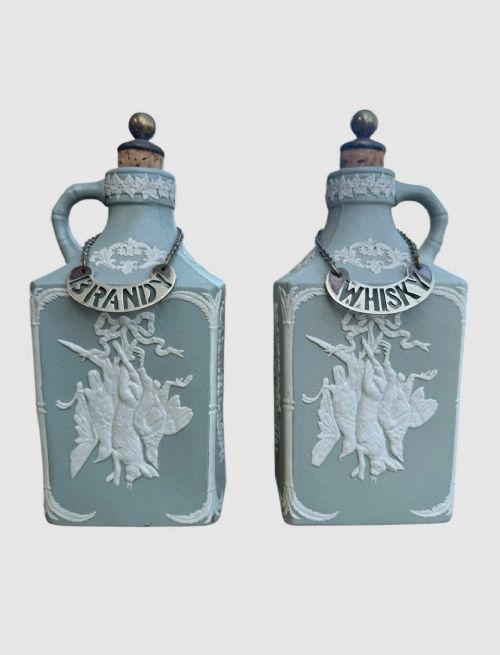
The selection includes tall overlay glass hock pieces and enamel-painted jugs alongside classic Bristol green serving bottles fitted with cork or silver mounts.
How they were made
Glassmakers shaped these pieces by hand-blowing molten metal into rich green tones, sometimes applying clear glass overlaid with green or cutting back the surface to reveal contrasting depths.
Many vessels incorporate fitted mounts, collars, and hinged tops fashioned from silver plate or solid silver, secured to necks with cork stoppers.
Decoration often extends to surface enamel painting or fine etched detailing, combining the glassmaker's craft with silversmithing work.
Listings feature materials including glass, enamel, silver plate, cork, overlay glass, walnut, marble, and jasperware.
What varies in quality
Quality rests in the depth and saturation of the green glass itself, alongside the crispness of any hand-cut facets or enamel detailing applied to the body.
The presence of original silver or silver-plated mounts, hallmarked fittings, and matched companion pieces or fitted frames elevates a piece above standard utility items.
Henry Wilkinson & Co
The Victorian Green Decanter Glossary
- Bristol green
- A strong, dark green glass colour traditionally associated with West Country production centres during the eighteenth and nineteenth centuries.
- Overlay glass
- A technique where a layer of coloured glass is fused over a clear or contrasting base before being cut away to expose the underlayer.
- Claret jug
- A specialised pouring vessel designed for red wine, frequently featuring a handle and a hinged metal lid.
- Flagon
- A large vessel with a handle and sometimes a lid, used for holding and pouring spirits or wine.
Victorian Green Decanter: Frequently Asked Questions
How do I clean a vintage green decanter?
Wash these vessels by hand in warm soapy water using a bottle brush, avoiding harsh abrasives that might scratch the old glass or damage silver mounts.
Allow them to dry completely upside down before storing with the stopper resting loosely to let air circulate inside.
Can I still serve wine in them?
These pieces function well for serving wine or port at the table, provided the interior is clean and free from old sediment.
Check that any cork stopper remains intact and clean before pouring beverages for guests.
How do I date a green glass decanter?
Look for hallmarks on silver mounts, pontil marks on the base, and stylistic clues in the cutting and shape to narrow down the decade.
Mid-century examples often display simpler hand-blown profiles, while late pieces frequently feature overlay work or specific registry marks.
What is overlay glass?
Overlay involves fusing a skin of green glass over a clear or contrasting body, creating decorative contrast when cut.
This method allowed makers to achieve striking patterns by grinding through the outer layer to expose the material beneath.