



Victorian Gold Opal Ring
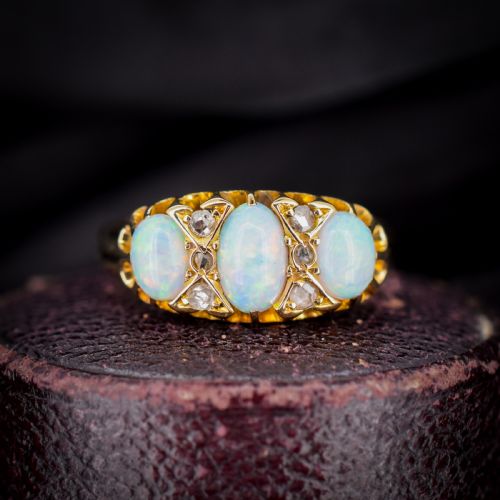
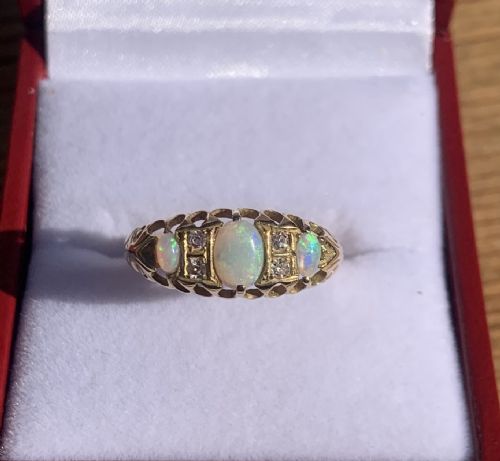
A victorian gold opal ring brings together shifting play-of-colour and nineteenth-century craftsmanship in a single hand ornament.
Victorian Gold Opal Ring
A victorian gold opal ring combines nineteenth-century design with the characteristic spectral flash of natural opal stones. Pieces span solitary cabochons, multi-stone settings, and cluster arrangements paired alongside diamonds or other gemstones.
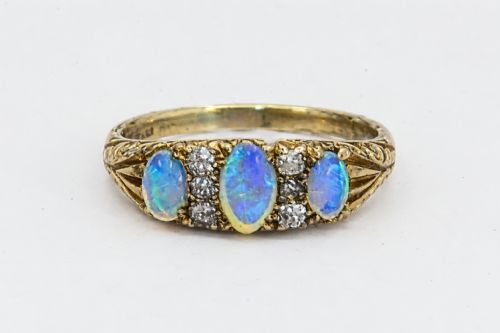
Most examples found in daily trade date from the Victorian era through to the early twentieth century, incorporating periods like the Edwardian years alongside later mid-century revivals. The dominant forms rely on yellow gold bands carrying central opals flanked by small diamonds or structured in traditional boat and trilogy layouts.
Materials and construction
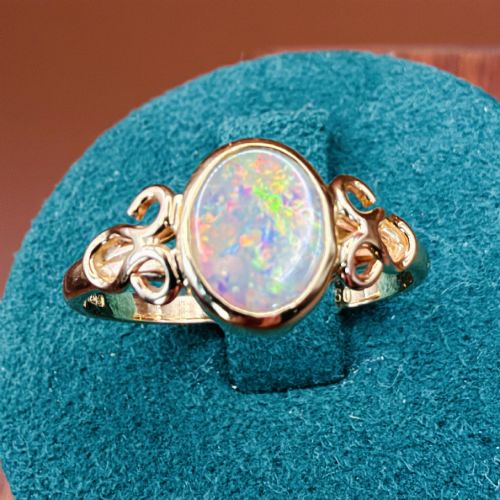
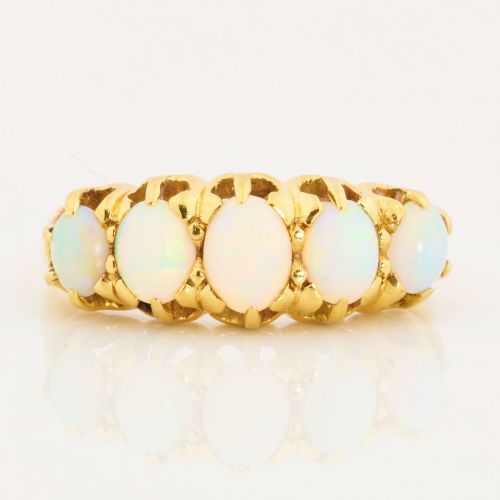
Goldsmiths utilised 18ct yellow gold, 15ct gold, and 9ct gold to construct mountings ranging from substantial claw settings to smooth bezel surrounds. Platinum was less common, leaving gold as the primary metal framework for securing fragile stones.
Stones were typically cut as rounded cabochons rather than faceted gems to maximise the internal play-of-colour within the opal body. Metalsmiths integrated silver details in select cluster designs to brighten the surrounding diamond melee.
The archive records styles stretching from nineteenth-century Victorian through Edwardian work to mid-century Continental Art Nouveau.
Evaluating the pieces
Quality rests heavily on the intensity and distribution of the opal flash, where stones showing vibrant spectral play across multiple angles command stronger attention. The structural integrity of the setting and the preservation of the original gold claws also dictate the standing of an individual ring.
The integration of supporting diamonds, whether old-cut or rose-cut, influences the overall composition and historical weight of the piece. Hallmark clarity, denoting assay offices such as Birmingham, Chester, or London, provides verifiable context for the date of manufacture.
The Victorian Gold Opal Ring Glossary
- Cabochon
- A gemstone shaped and polished with a smooth, rounded surface rather than faceted edges. This style displays the optical phenomena of opals most effectively.
- Trilogy ring
- A ring featuring three primary stones set in a row across the finger. In these pieces, an opal is frequently flanked by two diamonds.
- Doublet
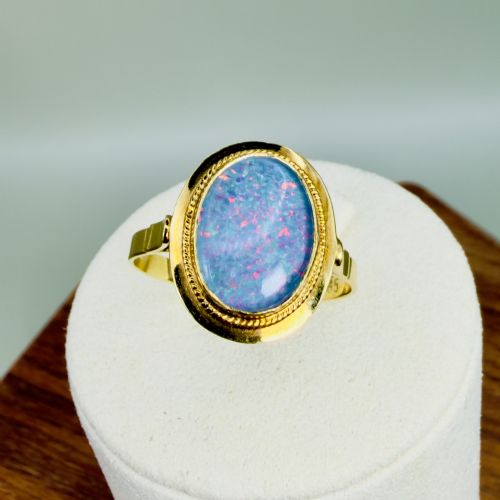
- A composite stone made of a thin layer of opal glued to a darker backing material like ironstone. This method enhances the apparent depth of the colour flash.
- Play-of-colour
- The optical effect where spectral colours shift and flash across the surface of an opal as the angle of light changes. This property defines the visual appeal of the stone.
Victorian Gold Opal Ring: Frequently Asked Questions
How do I care for a victorian gold opal ring?
Opals contain natural water content and require gentle handling away from harsh chemicals, ultrasonic cleaners, and sudden temperature shifts. Store them individually to prevent surface scratching from harder gems.
Regular cleaning should involve only a soft, damp cloth without prolonged immersion in water. Inspect the claws periodically to ensure the stone remains secure within its gold setting.
Were opals popular during the nineteenth century?
Opals experienced a significant surge in popularity during the later decades of the nineteenth century, particularly after sources were discovered in Australia. Queen Victoria herself favoured the stone and gifted opal jewellery to her family.
This royal patronage influenced widespread production among British workshops, leading to the varied cluster and trilogy designs seen today.
What is the difference between a solid opal and a doublet?
A solid opal consists of a single piece of natural opal material cut from the rough. These stones display optical properties entirely native to the mined piece.
A doublet layers a thin slice of genuine opal over a supporting base, such as dark potch or ironstone, to strengthen the material and deepen the visible colour.
How can I tell if a ring is genuinely Victorian?
Authentic nineteenth-century pieces often feature hand-stamped British hallmarks indicating specific assay offices and date letters corresponding to Chester, Birmingham, or London. Construction techniques, such as closed-back settings or hand-cut old mine diamonds, also point to period manufacture.
Stylistic cues like boat-shaped settings and repoussé band decoration further separate nineteenth-century work from later twentieth-century revivals.