
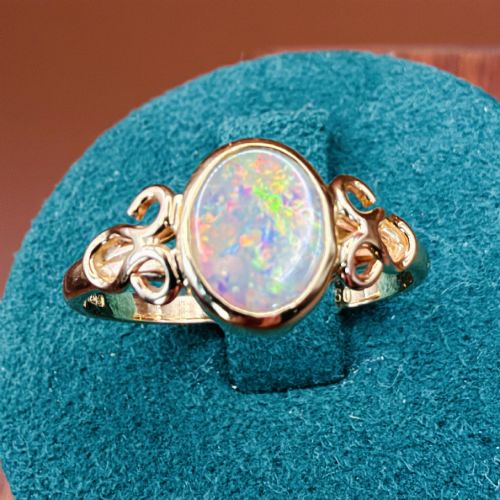
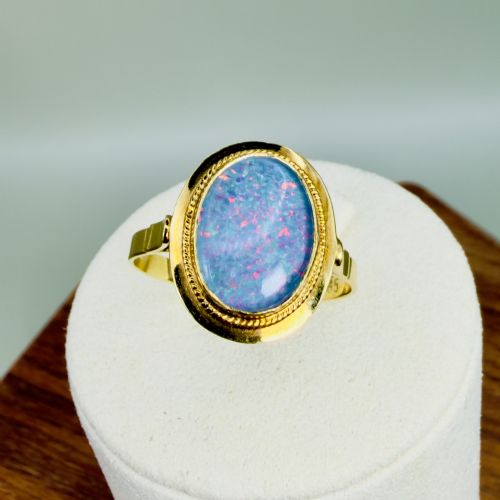
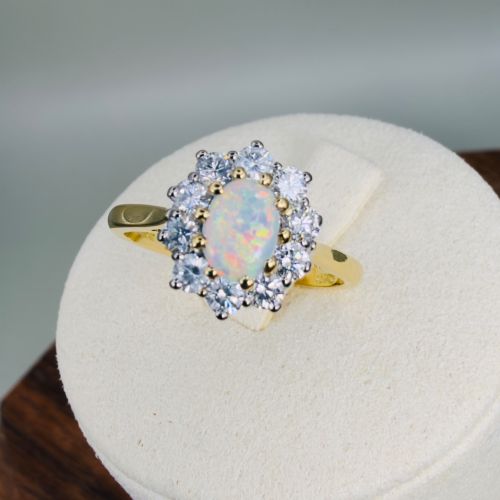
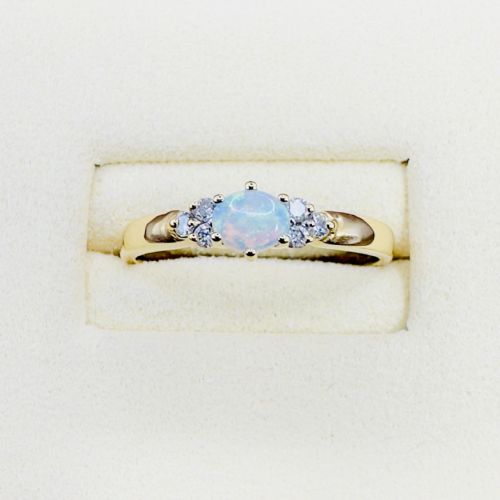
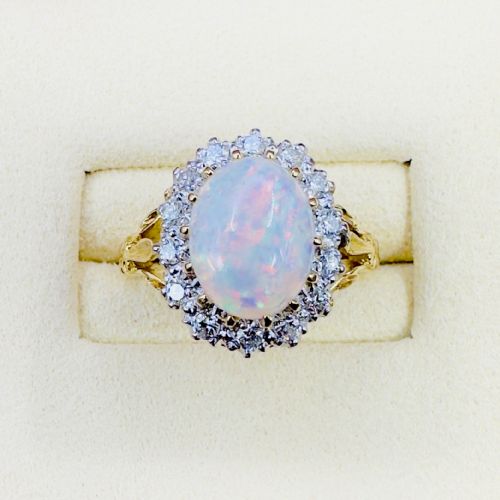


Oval Opal Ring
An oval opal ring brings together shifting play-of-colour and gold settings across periods from the Victorian era to the mid-twentieth century.
Oval Opal Ring
An oval opal ring is a finger ornament centred on an oval-cut gemstone displaying an internal play-of-colour, set within gold rings that span the Victorian period, Art Deco style, and mid-century decades. Buyers seeking this search phrase encounter solitaire formats, cluster arrangements bordered by diamonds or sapphires, and dress rings.
The pieces appearing on this page stretch from nineteenth-century Victorian examples through the nineteen-twenties and nineteen-thirties up to nineteen-sixties modern interpretations. Settings incorporate yellow gold, white gold, and distinct carat weights including nine carat, fourteen carat, and eighteen carat gold alongside platinum elements.
Solitaires dominate the simpler designs, whilst cluster rings surround the central oval stone with smaller diamonds or sapphires. Variations in stone variety include white opal, black opal, boulder opal, water opal, and black boulder opal.
How they were made
Goldsmiths constructed these rings using nine, fourteen, and eighteen carat gold, shaping mountings via casting, bezel settings, and claw settings to secure the gems. Black boulder opal and solid opals appear alongside diamond and sapphire accents set around the central stone.
Cabochon cutting forms the standard method for shaping the opals to highlight their play-of-colour without flat facets. Master jewellers matched East-to-West orientations and raised cluster galleries to support the stones.
Materials recorded across the inventory include white opal, black opal, boulder opal, water opal, diamonds, sapphires, and varying purities of gold.
What varies in quality
Quality rests in the intensity and distribution of the play-of-colour across the opal face, combined with the weight and clarity of accompanying diamonds. Solid stones and black opals command distinct attention compared to standard white varieties.
The precision of the gold setting, whether a smooth bezel or secure claw mount, determines the structural integrity of the piece across Victorian and twentieth-century examples.
The Oval Opal Ring Glossary
- Cabochon
- A gem cut with a smooth, rounded surface rather than flat facets. This style highlights the optical phenomena within opals.
- Solitaire
- A ring featuring a single gemstone as the main focal point. In these listings, solitaires highlight the natural play-of-colour without distraction.
- Cluster ring
- A ring design featuring a central stone surrounded by a ring of smaller gems, typically diamonds or sapphires. This arrangement magnifies the visual impact on the hand.
- Play-of-colour
- The optical phenomenon where internal flashes of spectral colours shift as the stone moves under light. This property defines the visual appeal of every opal.
- Bezel setting
- A method where a thin metal collar wraps around the perimeter of the stone to hold it securely in place. This technique offers clean lines particularly favoured in Art Deco pieces.
Oval Opal Ring: Frequently Asked Questions
How do I care for an opal ring?
Opals contain natural water content and require gentle handling away from harsh chemicals and sudden temperature shifts.
Store the ring in a padded box and clean it simply with a soft, damp cloth rather than ultrasonic cleaners.
Can I wear an opal ring daily?
Daily wear is possible with mindful care, noting that opals have a moderate hardness compared to diamonds.
Removing the ring during heavy manual tasks protects the gold setting and the stone surface from abrasion.
How do I date a vintage opal ring?
Dating relies on stylistic markers such as Victorian claw settings, Art Deco geometric layouts, or mid-century cluster forms.
Gold hallmarks stamped inside the band also offer specific clues to the manufacturing period.
What is a boulder opal ring?
A boulder opal ring incorporates a gemstone formed naturally within ironstone matrix, leaving part of the host rock attached at the back.
This natural backing often enhances the depth of the play-of-colour and adds structural strength to the stone.