



Victorian Glastonbury Chair
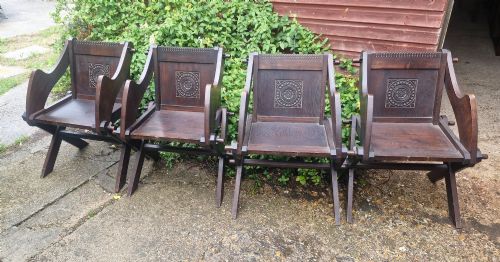
These Victorian Glastonbury chairs are distinctive folding armchairs built in the Gothic Revival taste.
Victorian Glastonbury Chair
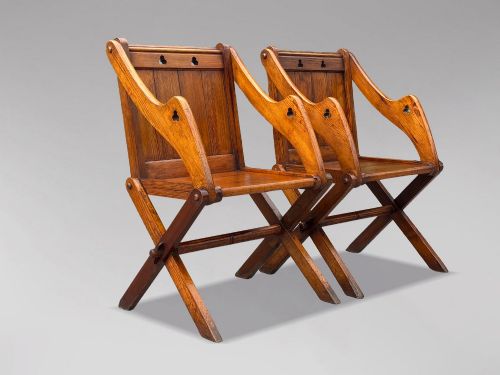
A victorian glastonbury chair is a sturdy armchair defined by its X-frame construction and sloping armrests. When you search for this phrase, you find armchairs originating from the nineteenth century, including pieces dated around eighteen eighty and nineteen hundred.
The versions most commonly met on this page are constructed from oak or pitch pine. They appear as single elbow seats as well as matched pairs, often bearing Gothic Revival styling and ecclesiastical character.
Materials and construction
These chairs are fashioned primarily from solid timbers like oak and pitch pine, reflecting the robust requirements of the Gothic Revival taste. Artisans utilised durable wood to shape the characteristic interlocking X-frame supports and broad elbow rests.
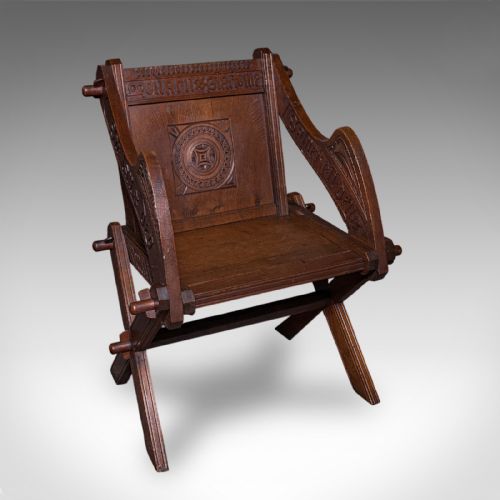
Detailing on these pieces frequently includes carved motifs such as the crown of thorns. The construction relies on traditional joinery that allows the structural frame to support the sloping seat and high back.
Victorian Glastonbury Chair Retail Price Guide 2026
Typical asking prices for victorian glastonbury chair among the pieces listed under this phrase on Sellingantiques today, from the lower quarter to the upper quarter. They describe what is for sale here now, not the wider market.
Some chairs bear the crown of thorns carved directly into the wood, proving that Victorian furniture makers took their symbolism very seriously.
Assessing quality and character
Quality in these armchairs rests upon the crispness of the carved details and the choice of timber. Pieces featuring intricate carving, such as the crown of thorns, demonstrate a higher level of workshop execution.
The grain and condition of the oak or pitch pine further distinguish the examples. Uniformity in the folding X-frame and the integrity of the joined timber separate standard regional work from finer decorative seating.
The Victorian Glastonbury Chair Glossary
- Glastonbury chair
- A type of folding armchair with an X-frame, sloping arms, and a panelled back. It is traditionally associated with medieval ecclesiastical designs revived during the nineteenth century.
- Gothic Revival
- An architectural and decorative style popular during the Victorian period. It draws inspiration from medieval forms, pointed arches, and heavy timber construction.
- Pitch pine
- A durable softwood with a prominent grain utilised by Victorian cabinet makers. It provides a robust alternative to oak for structural seating.
- Elbow seat
- An alternative term for an armchair. The phrase highlights the prominent flat armrests characteristic of these vernacular forms.
- Ecclesiastic
- A descriptor relating to the church or clergy. In furniture, it denotes pieces influenced by medieval church furnishings and choir stalls.
Victorian Glastonbury Chair: Frequently Asked Questions
What is a victorian glastonbury chair?
A victorian glastonbury chair is a distinctive nineteenth-century armchair built with an interlocking X-frame base and sloping armrests. These pieces draw heavily on medieval church seating traditions.
They are most commonly found in solid oak or pitch pine, reflecting the heavy craftsmanship of the Gothic Revival movement.
How were these chairs used originally?
These armchairs served as sturdy seating in domestic libraries, studies, and ecclesiastical settings during the nineteenth century. Their solid construction made them durable for daily use.
The distinctive folding X-frame design also allowed for relative portability within larger historic interiors.
Where were these chairs made?
The pieces seen here originate from English and Welsh workshops operating during the Victorian period. Regional makers utilised local timbers such as oak.
Workshop production spanned from the late nineteenth century into the turn of the twentieth century.
How do I style a glastonbury chair at home?
These armchairs work well as statement accent pieces in a study, hallway, or living room. Their architectural lines pair effectively with both traditional and minimalist interiors.
Because they feature solid timber and deep grain patterns, placing them in a well-lit space highlights the carved details.