


Victorian Glass Scent Flacon
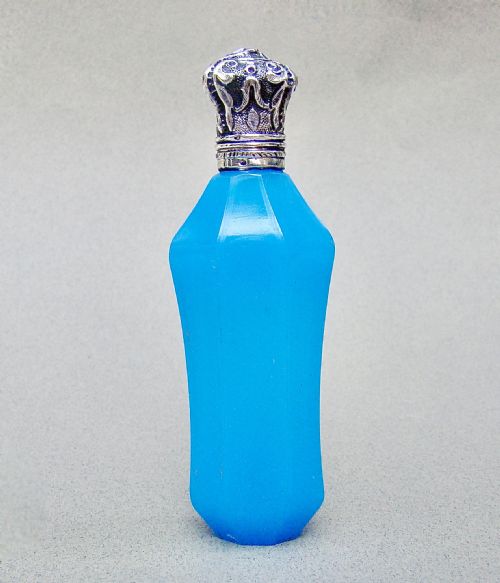
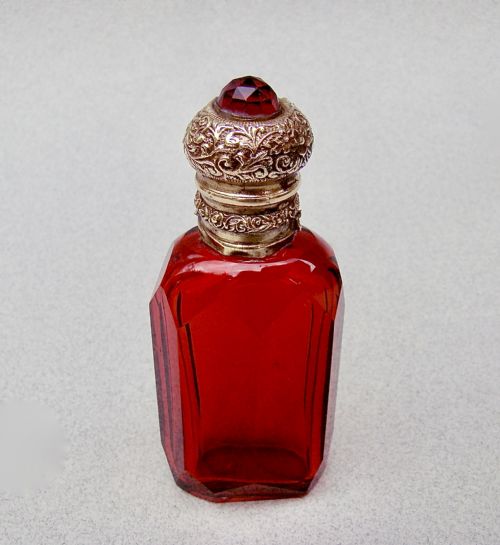
A victorian glass scent flacon is a small pocket vessel designed to hold perfume, offering portable luxury from the nineteenth century.
Victorian Glass Scent Flacon
When you search for a victorian glass scent flacon, you look at small portable vessels designed to carry perfume during the nineteenth century. The examples on this page span from the middle of the nineteenth century into the early twentieth century, showing both English and French origins.
Most pieces you meet here combine glass bodies with metal mounts, often featuring sterling silver collars or hinged caps. Forms range from miniature pocket bottles to larger dresser decanters, including paired sets and cased editions.
How they were made
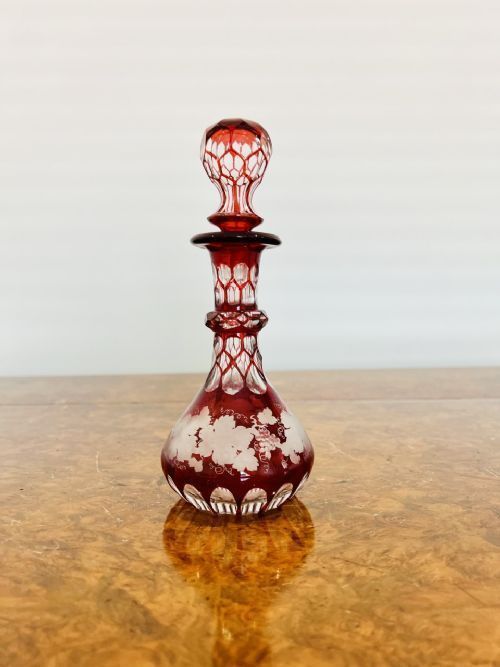
The body of a victorian glass scent flacon relies on blown and cut techniques, producing heavy lead crystal or coloured glass vessels. Makers utilised cased glass, overlay methods, and surface engraving to create depth and texture.
Mounts are formed from silver, silver-gilt, or ormolu, fitted closely to the glass neck and secured with stoppers. Leather and velvet occasionally appear as exterior casing materials for travel protection.
Miniature bottles were made small enough to slip inside a evening purse, ready for a Victorian theatre outing.
What varies in quality
Quality rests in the precision of the glass cutting and the richness of the coloured metal oxides used in cranberry, ruby, or turquoise pieces. Heavier lead crystal and deeply layered overlay glass demonstrate superior manufacture.
The refinement of the metal mounts, including the weight of the sterling silver or ormolu and the tightness of the hinged collar, separates standard production from finer examples.
The Victorian Glass Scent Flacon Glossary
- Cranberry glass
- A transparent red glass produced by adding gold chloride to the molten batch. It gained popularity during the Victorian era for tablewares and small scent bottles.
- Overlay glass
- A technique where a layer of coloured glass is fused over a clear or contrasting inner body. The outer layer is then cut away to reveal the contrasting colour beneath.
- Ormolu
- A finely ground high-zinc brass alloy used to simulate gold. It provides decorative mounts and collars on nineteenth-century French scent bottles.
- Clichy glass
- Glassware associated with the nineteenth-century French factory famous for colour techniques and paperweights. Pieces attributed to this source show particular skill in layered and opaline effects.
- Sterling silver
- An alloy of silver containing 92.5 percent pure silver by mass. It forms the fitted collars and hinged caps found on many English and French perfume bottles.
Victorian Glass Scent Flacon: Frequently Asked Questions
How do I clean a scent bottle?
Wash the interior gently with warm water and a mild detergent, avoiding harsh abrasives on the metal mounts.
Allow the bottle to dry completely with the stopper removed before storage.
Are these bottles safe to use?
While these vessels were made to hold liquid perfume, historic stoppers may not form a modern airtight seal.
Display them upright to prevent leakage if you choose to fill them.
How do I tell English from French pieces?
French pieces often feature ornate ormolu mounts, opaline glass, or complex cased layers.
English examples tend toward simpler sterling silver collars paired with cut lead crystal or cranberry glass.
What is cased glass?
Cased glass consists of two or more distinct layers of glass fused together during the blowing process.
This method allows artisans to cut through the exterior layer to create contrasting patterns.