
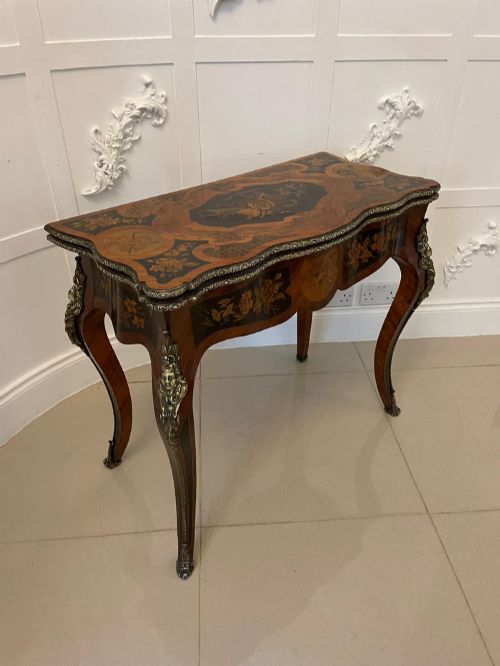
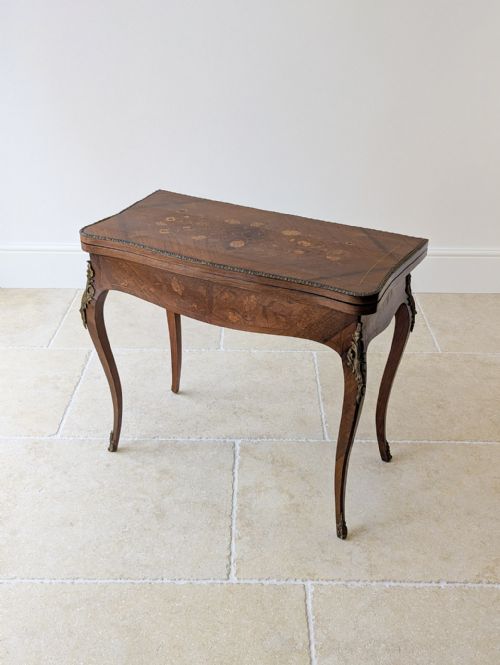
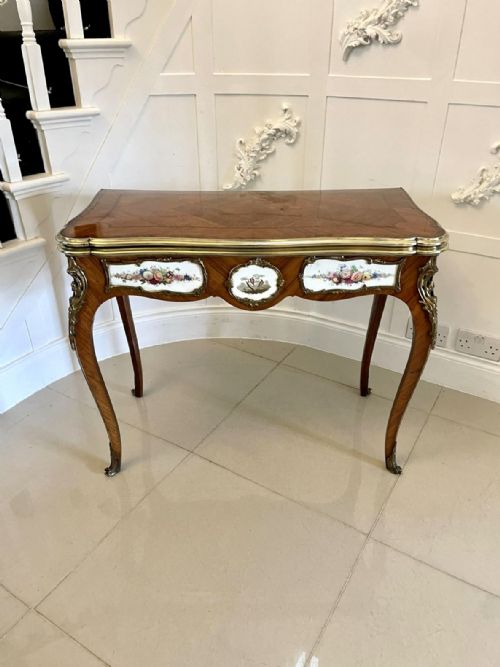
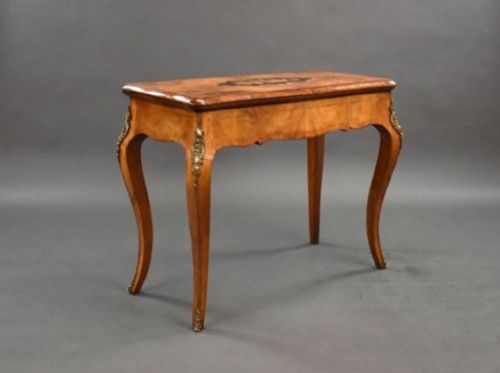


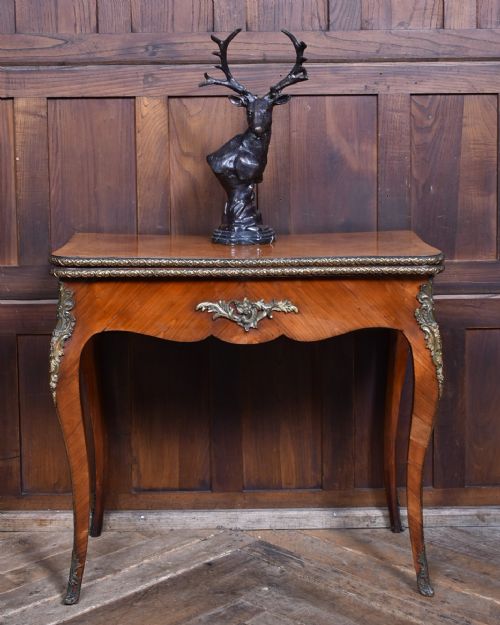

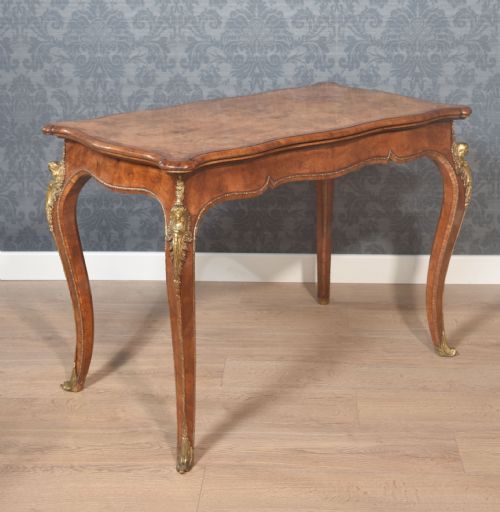
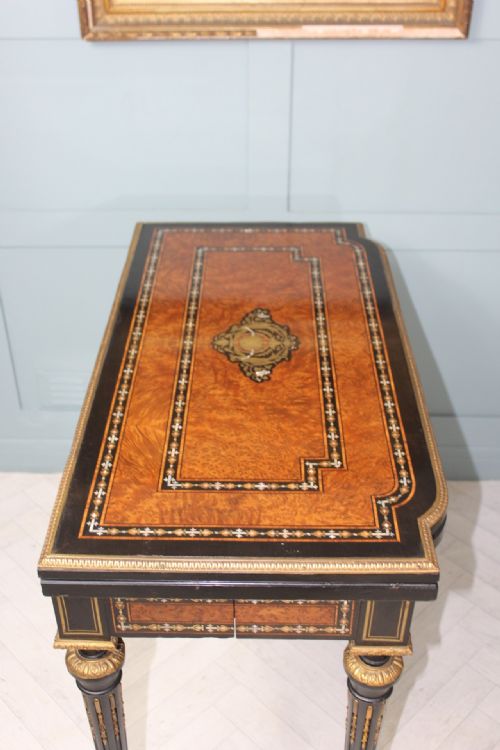
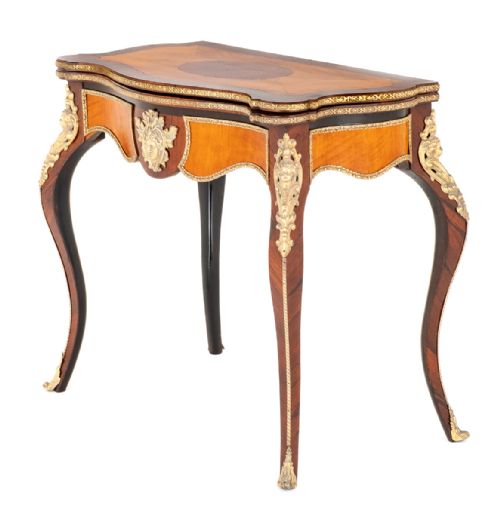


Victorian French Card Table
A victorian french card table brings the opulent flourish of continental reception rooms into nineteenth-century British interiors.
Victorian French Card Table
A victorian french card table serves as a dual-purpose piece, functioning primarily as a console or side table before unfolding to reveal a baize-lined surface for evening pastimes. These objects bridge British domestic furniture traditions with continental design aesthetics, notably the revival of eighteenth-century French courts.
The pieces appearing on this page span the nineteenth century, with strong representation from the mid-Victorian decades alongside later interpretations up to nineteen hundred. Makers adopted forms such as Louis XV revival curves, sweeping console configurations, and fold-over games tables designed to sit against a drawing room wall.
Timbers dominate the construction, with kingwood, walnut, burr walnut, and rosewood forming the primary carcasses. Many examples incorporate marquetry detailing, brass stringing, and elaborate mounts to achieve the desired visual weight.
Distinctions in Standard
The precision and complexity of the marquetry work dictate much of the upper tier of quality, where floral and geometric patterns align seamlessly across the folding leaves. Lesser examples rely on simpler timber grains or minimal inlay without the same depth of pictorial composition.
The weight and chasing of the ormolu mounts separate standard production from exhibition pieces, with superior hardware displaying sharp relief and careful finishing by hand. Plain or lightly cast brass mounts indicate a more commercial workshop output.
The integration of the folding mechanism and the stability of the timber hinges reveal the underlying carpentry standards. High-grade tables maintain a flush, level surface when opened, with robust pivot actions that prevent warping over decades of use.
The listings show walnut, burr walnut, rosewood, and kingwood as the primary timber choices for these tables.
G T Morant·Edwards and Roberts·Henry Dasson
The Victorian French Card Table Glossary
- Ormolu
- Gilded bronze used for decorative mounts and accents on furniture. This technique provides a bright metallic finish that resists tarnishing.
- Marquetry
- Inlaid patterns of wood veneers applied to a furniture carcass to create pictures or geometric designs. Craftsmen cut various coloured timbers to fit tightly together.
- Kingwood
- A dense, richly figured exotic timber favored in fine cabinetmaking. Its distinct grain variations made it a primary choice for nineteenth-century veneered surfaces.
- Boulle
- A style of marquetry utilising brass and tortoiseshell inlay developed in seventeenth-century France and revived later. The technique creates a striking contrast between metallic shine and dark organic material.
- Console table
- A wall-mounted or freestanding table designed to sit flat against a vertical surface. Many card tables double as console tables when folded shut.
Victorian French Card Table: Frequently Asked Questions
How do I use a card table daily?
These tables function as side tables or console furniture against a wall when the top is folded shut. You can open them up whenever you need a flat surface for games or writing.
Ensure you support the folding leaf properly from the pivot mechanism to avoid straining the hinges. Placing them out of direct sunlight protects the delicate veneers and polished timber finishes.
Were these made in France or Britain?
Makers in Britain produced the vast majority of these pieces, drawing heavily upon French design vocabulary and aesthetic preferences. Some items reflect direct French manufacture, while others represent British interpretations of continental styles.
The use of specific cabinetmakers' stamps and regional construction methods helps clarify the workshop origin of individual pieces.
How do I identify a revival style?
Nineteenth-century revival pieces appropriate the curved cabriole legs, asymmetrical cartouches, and floral motifs popularized during the reign of Louis XV. Cabinetmakers combined these historical forms with contemporary Victorian engineering for folding mechanisms.
Examining the internal secondary timbers and the style of the ormolu mounts typically reveals the nineteenth-century date of manufacture.
What is champleve enamel?
Champleve enamel involves carving troughs into a metal base and filling them with vitrified glass paste before firing. This technique produces colourful decorative patterns set flush within the metal surface.
On these tables, enamel work appears alongside ormolu mounts and porcelain plaques to enrich the decorative scheme.