






Victorian Footstool Brass Castors
These Victorian footstool brass castors bring solid timber frames and sturdy metal wheels together for genuine period comfort in any room.
Victorian Footstool Brass Castors
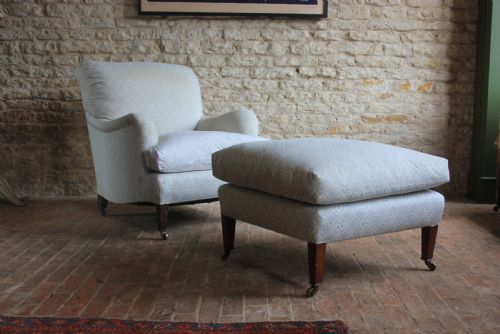
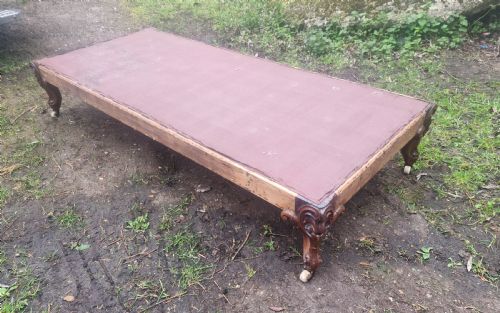
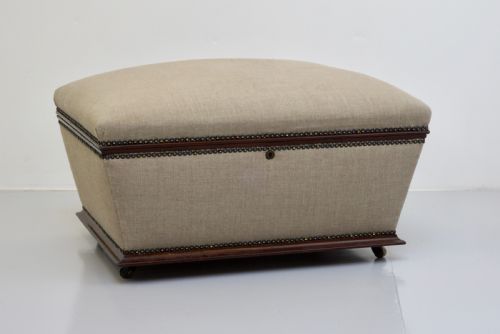
Victorian footstool brass castors cover a range of low seating forms, from compact gout stools to large country house ottomans and window seats. The pieces on this page span the nineteenth century, taking in both mid-Victorian carved rosewood centre stools and later Edwardian designs.
Most examples rely on generous upholstery over timber frames, resting on short legs finished with metal wheels. Buyers will encounter both simple buttoned stools and larger matched pairs designed for grander reception rooms.
How they were made
Frames are constructed from dense hardwoods like mahogany, walnut, and rosewood, often featuring carved detail around the rails or legs. Metal castors are fitted to the base of each leg to allow smooth movement across heavy carpets.
Traditional upholstery techniques build up deep padding using fabric coverings, sometimes finished with traditional buttoning to secure the interior stuffing firmly to the wooden base.
Victorian Footstool Brass Castors Retail Price Guide 2026
Typical asking prices for victorian footstool brass castors among the pieces listed under this phrase on Sellingantiques today, from the lower quarter to the upper quarter. They describe what is for sale here now, not the wider market.
The listings on this page include walnut, mahogany, and rosewood frames paired with various upholstery fabrics.
What varies in quality
The distinction between standard output and finer work lies in the timber selection and the precision of the frame carving. Finer pieces show crisp detail in the woodwork and retain well-cast metal fittings.
Proportion and scale also dictate quality, as larger country house examples and pieces by recognised makers demonstrate more ambitious structural design than simpler domestic stools.
Howard and Sons·James Shoolbred
The Victorian Footstool Brass Castors Glossary
- Castor
- A small wheel mounted on a swivel at the base of a leg, allowing heavy furniture to move easily across the floor. They are commonly made of brass on nineteenth-century seating.
- Gout stool
- A specialised low footrest with an adjustable sloping top designed to support a foot affected by gout or mobility issues. These usually date from the mid-nineteenth century.
- Ottoman
- A low, fully upholstered seat or footstool without a back or arms, often built on a large scale for country house interiors. Some versions include an internal storage box.
- Buttoning
- An upholstery method where deep indentations are created across the padded surface using tight stitches or buttons. This technique keeps the internal stuffing evenly distributed.
Victorian Footstool Brass Castors: Frequently Asked Questions
How do I date a Victorian footstool?
Dating relies on timber choices, leg profiles, and upholstery styles, moving from mid-century rosewood and walnut frames to later Edwardian forms. The presence of specific maker stamps or labels also helps pinpoint the decade of manufacture.
Simpler vernacular pieces often retain traditional hand-carved details that reflect regional cabinet-making trends of the nineteenth century.
Can I use these stools daily?
These nineteenth-century pieces are built on sturdy timber frames designed for robust everyday use in domestic settings. Many surviving examples remain structurally sound and ready for regular placement in living spaces.
Buyers planning heavy daily use should check the underlying frame stability and consider whether the current upholstery requires reinforcement.
Are brass castors original?
Original brass castors show appropriate signs of age and wear that match the timber frame above them. They are securely fitted into the base of the legs using traditional socket or plate fixings.
Replacements are common due to heavy floor use, so matching patination between the metal and the wood is a useful indicator.