


Victorian Floral Glass Vase
These Victorian floral glass vase examples bring rich colour and detailed enamel painting straight from nineteenth-century interiors into modern rooms.
Victorian Floral Glass Vase
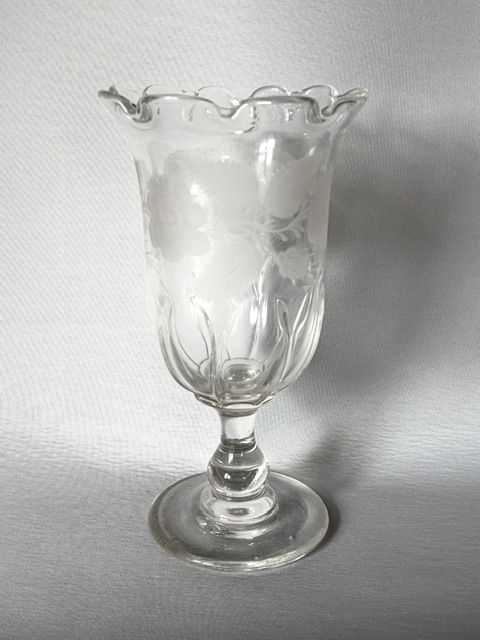
A victorian floral glass vase stands as a decorative vessel from the nineteenth century, often featuring hand-painted enamel flowers or applied gilding upon coloured glass surfaces. These pieces emerge in forms such as bulb vases, trumpets, and epergnes across the Victorian period.
The pieces appearing on this page span styles from standard Victorian and Victorian Rococo Revival through to Art Nouveau and Arts & Crafts aesthetics. Collectors encounter glass bodies in shades of green, blue, cranberry, amethyst, and white opaline.
How they were made
Maker workshops utilised coloured and clear glass as the primary foundation, shaping vessels through free-blowing or mould-blowing techniques. Many examples incorporate casing methods, fusing distinct layers of glass together to achieve deep tonal variation.
Decoration relied heavily on surface application, where artisans painted floral motifs using enamel and oil paint, sometimes adding gold leaf or engraving directly into the glass body. Firms such as Moser and Harrach utilised these intricate enamelling and gilding methods on bohemian glass.
Listings feature pieces spanning from eighteen-fifty to nineteen-ten, recording materials from opaline glass to gold leaf and oil paint.
What varies in quality
The refinement of the hand-painted enamelling and the precision of the gilding separate standard production from exceptional work. Pieces featuring delicate, multi-coloured floral detail demonstrate superior artisan skill compared to simpler, uniform decoration.
The choice of glass body and depth of colour also determine the character of each piece, with cased opaline and rich cranberry or amethyst hues showing greater complexity. Maker attribution, such as work linked to Stuart for Liberty or Baccarat, elevates the standing of an individual vase.
Stuart for Liberty·Baccarat·Harrach·Moser
The Victorian Floral Glass Vase Glossary
- Opaline glass
- An opaque or translucent glass developed in pale tints of white, blue, or pink, often serving as a canvas for painted enamel flowers.
- Epergne
- A large table centrepiece featuring a central trumpet vase surrounded by smaller hanging or attached vessels.
- Enamel
- A decorative vitreous substance fused to the exterior glass surface to create raised floral and botanical patterns.
- Mantel lustre
- A decorative glass vase hung with crystal prisms, designed to sit upon a fireplace mantelpiece.
- Cameo glass
- A luxury technique involving layers of different coloured glass carved to produce a contrasting raised design.
Victorian Floral Glass Vase: Frequently Asked Questions
Where should I display these glass vases?
Place vases in locations that receive natural daylight to highlight the rich colours and translucent qualities of the nineteenth-century glass. Windowsills or well-lit mantelpieces allow the enamel floral details to catch the light effectively.
Keep pieces away from direct heat sources and unstable ledges to prevent accidental knocks. Grouping pairs or matching forms creates a balanced visual display.
How do I identify opaline glass?
Opaline glass presents a distinctive milky, translucent appearance that blocks direct transparency while glowing softly when held to the light. This pale body provides an ideal contrasting background for hand-painted floral motifs.
It appears frequently in nineteenth-century production across white, soft blue, and pink shades. The surface feels smooth and dense to the touch.
What is the difference between an epergne and a standard vase?
An epergne functions as a multi-part centrepiece featuring a main trumpet-shaped vessel surrounded by smaller detachable hanging baskets or side vases. Standard vases consist of a single continuous body designed to hold floral arrangements.
Both forms utilise coloured glass and enamel decoration during the Victorian period. Epergnes served primarily for formal dining table decoration rather than mantel display.