
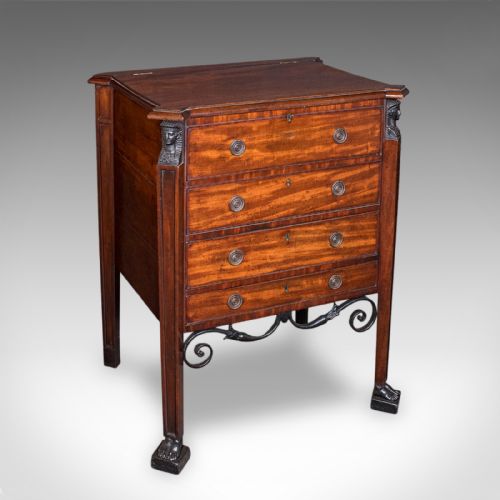
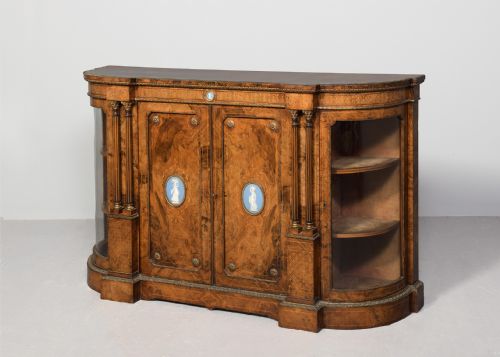


Victorian Exhibition Cabinet
A victorian exhibition cabinet brings high-style display and rich timbers into a room, made to show off prized possessions.
Victorian Exhibition Cabinet
A victorian exhibition cabinet spans credenzas, side cabinets, display cabinets, and pedestals created in the nineteenth century. The examples on this page run from the mid-nineteenth century through the 1920s, drawing on revival styles including French, Egyptian, Italian, and Renaissance tastes.
Credenzas and pier cabinets dominate the forms, frequently featuring glass doors, mirrored backs, and marquetry. Buyers encounter timber carcasses in burr walnut, kingwood, amboyna, mahogany, and satinwood, often heightened with ormolu mounts and porcelain panels.
Materials and construction
Cabinet makers utilised choice veneers such as burr walnut, kingwood, and thuya over stable secondary timbers, applying intricate marquetry and hand-carved details. Structural elements integrate glass, mirror plates, and brass hinges to support heavy display doors.
Ormolu mounts, porcelain plaques, and gold leaf enrich the timber surfaces, reflecting the decorative ambitions of the period workshops. Marquetry panels display complex floral and geometric inlays executed with contrasting woods.
Cabinets were built so solidly that moving them requires a team of four and a sturdy floor.
Assessing quality
The distinction lies in the depth of timber selection, such as heavily figured burr walnut or exotic hardwoods like purple heart and amboyna. Finer pieces demonstrate superior marquetry execution and heavier, more crisply chased ormolu mounts.
Construction standards separate standard production from exhibition pieces through internal framing, hand-carved mounts, and the integration of porcelain panels or mirrored backs.
Maple & Co·Wilkinson & Sons
The Victorian Exhibition Cabinet Glossary
- Credenza
- A low-standing cabinet or sideboard, frequently fitted with central doors and curved side cupboards. These pieces often feature mirror backs and extensive marquetry.
- Ormolu
- Gilt-bronze mounts applied to furniture for decorative enrichment. Makers cast and chased these metal ornaments to accent corners and doors.
- Marquetry
- The art of applying veneer pieces in wood, ivory, or metal to form decorative patterns. Craftsmen utilised this technique on cabinet doors and top surfaces.
- Pier cabinet
- A narrow display cabinet designed to fit wall spaces between windows. They typically incorporate glass doors and velvet-lined interior shelves.
Victorian Exhibition Cabinet: Frequently Asked Questions
What is a victorian exhibition cabinet used for?
These cabinets serve to display porcelain, glassware, and decorative objects behind glass doors or upon open shelves. They function as focal points in reception rooms and drawing rooms.
Interior spaces often include mirrored backs to reflect light through displayed items. The surfaces provide additional display area for smaller ornaments on top.
How do I care for burr walnut veneer?
Keep exhibition cabinets away from direct sunlight and heat sources to prevent the wood and veneer from drying out or cracking. Maintain stable room humidity.
Dust gently with a dry, soft cloth and avoid chemical polishes. Professional wax can be applied sparingly to nourish the timber.
How do I identify french revival style?
French revival pieces incorporate serpentine shapes, elaborate ormolu mounts, and symmetrical marquetry inspired by Louis periods. Walnut and exotic veneers often receive high-gloss polishing.
Carved details tend to be more florid, drawing on Rococo or Louis XVI motifs rather than strict English classical lines.
Where were exhibition cabinets placed?
Victorian houses positioned these cabinets in principal reception rooms, salons, and dining rooms where guests gathered. Pier cabinets specifically occupied the wall space between windows.
Larger credenzas stood against main interior walls to anchor the room's decorative scheme and provide surface display.