


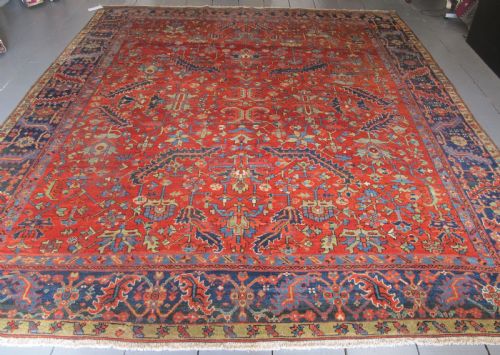


Victorian Era Carpet
These Victorian era carpet examples bring substantial nineteenth-century weave work into modern rooms, spanning Persian, Anatolian, and Indian origins.

Victorian Era Carpet
When you search for a victorian era carpet, you encounter heavy floor coverings produced during the nineteenth century, largely originating from Persian, Anatolian, and Indian workshops. The pieces span regional tribal formats such as Baluch, Fereghan, and Ushak productions alongside substantial court and commercial commissions like Agra carpets.
You are most likely to meet room-sized carpets and smaller rugs dated around eighteen-eighty to eighteen-ninety, rendered in wool and cotton foundations with traditional dyeing methods. These floor coverings bridge diverse cultural weaving traditions that circulated through British and European markets during the Victorian period.
Distinctions in quality
Quality rests upon the fineness of the knotting density, the clarity of the design drawing, and the integrity of the original materials. Finer knots permit intricate curves and precise geometric rendering, separating standard utility pieces from master-weaver commissions.
The choice of dye stuffs heavily dictates visual longevity, as natural dyes age with harmonious patination while inferior treatments degrade unevenly. Surviving pile depth and structural soundness across the foundation further separate museum-grade survivals from heavily restored examples.
The Victorian Era Carpet Glossary
- Warp
- The vertical foundation threads stretched lengthwise on the loom before knotting begins. These provide the primary structural skeleton for the entire carpet.
- Weft
- The horizontal threads passed across the warp strands after each row of knots to secure the pile in place. Their tension determines the flatness and rigidity of the rug.
- Pile
- The upright ends of yarn that form the usable surface of the carpet. This layer is sheared to a uniform height after knotting.
- Medallion
- A central ornamental design motif placed in the middle of the field. It anchors the geometric symmetry of many traditional Persian and Anatolian compositions.
- Foundation
- The underlying grid of warp and weft threads that supports the decorative pile. Its material composition dictates the weight and flexibility of the textile.
Victorian Era Carpet: Frequently Asked Questions
How do I clean a nineteenth-century carpet?
Professional specialist cleaning remains essential for fragile nineteenth-century wool textiles, avoiding harsh chemical immersion or abrasive scrubbing.
Regular gentle surface vacuuming without a beater bar removes embedded grit safely between professional maintenance visits.
Can I place these rugs in high-traffic hallways?
Sturdy wool construction allows these antique textiles to handle moderate domestic movement when paired with a quality cushioned underlay.
Runners and denser tribal weaves tolerate hallway placement particularly well, provided direct abrasive friction is minimised.
How do I distinguish regional weaving styles?
Regional identification relies on observing distinct palette choices, border structures, and specific motif vocabularies unique to tribal or city workshops.
Comparing structural knot counts alongside wool characteristics helps isolate Persian Fereghan origins from Anatolian Ushak or Indian Agra production.
Do these carpets suit modern interior spaces?
The rich vegetable-dyed hues and geometric patterns integrate seamlessly with contemporary minimalist or traditional furnishings alike.
Substantial room-sized formats anchor seating areas effectively, while smaller tribal rugs function well as accent pieces on wooden floors.