




Victorian Equestrian Ceramic Figurines
Victorian equestrian ceramic figurines bring figures on horseback into the home, capturing notable personalities and folk subjects in glazed pottery.
Victorian Equestrian Ceramic Figurines
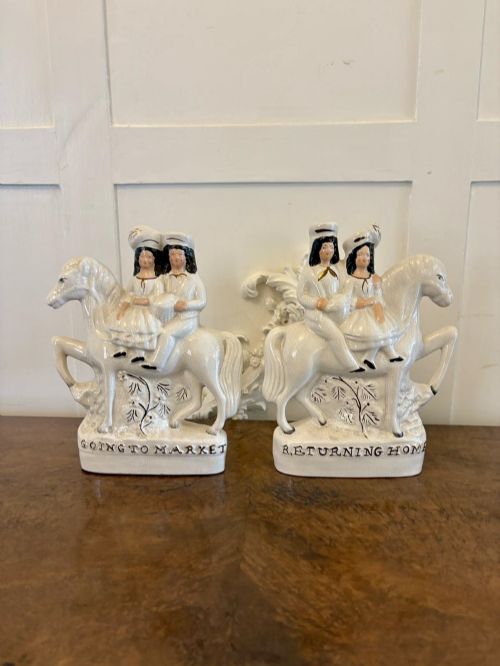
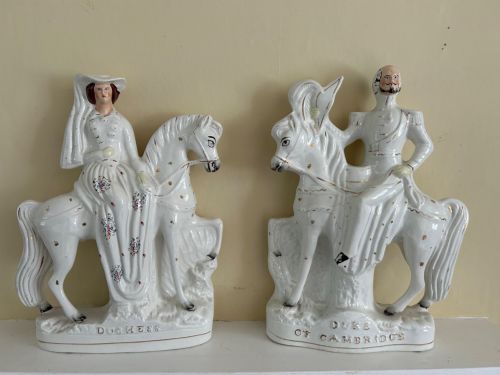
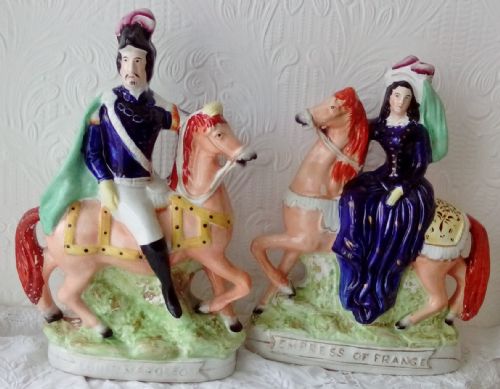
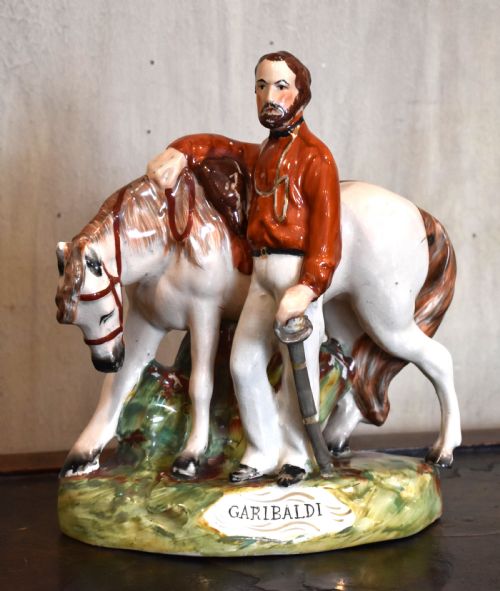
Victorian equestrian ceramic figurines are nineteenth-century pottery pieces depicting riders, historical figures, and mounted subjects. These works include figures of the Duke and Duchess of Cambridge, Louis Napoleon, Empress of France, Joan of Arc, and Garibaldi.
The versions most commonly met on this page are Staffordshire flatback figures, which were designed to be viewed from the front on a mantelpiece. Examples range from Scottish highlanders and highwaymen to pairs of jockeys and children with horses.
Makers also produced primitive folk art pieces, such as Scottish Portobello figures, alongside more refined Staffordshire models. Each piece presents a distinct character, whether depicting a leopard hunter or musicians on horseback.
How they were made
Potters shaped these items from earthenware and pottery using traditional moulding techniques before applying a glaze. Lead glaze provided a protective surface finish to the clay body.
Workshops hand-painted the details using enamel colours and added gilt highlights to enhance the costumes and horses. The flatback construction method kept the reverse side unglazed or simply finished while saving material.
Materials recorded across the inventory include earthenware, pottery, lead glaze, enamel, and gilt.
What varies in quality
Pairs often show greater consistency when both figures survive together without extensive restoration. The definition in the modelling of the horses and riders distinguishes standard production pieces from superior works.
The Victorian Equestrian Ceramic Figurines Glossary
- Flatback
- A figure moulded with a finished front and a flat, unadorned reverse designed for placement against a wall. This construction method was standard for nineteenth-century mantelpiece ornaments.
- Earthenware
- A porous pottery body fired at lower temperatures and coated with a glaze to ensure it holds form. It served as the primary material for Staffordshire figures.
- Enamel
- A durable vitreous paint applied over the glaze to provide bright surface colours. It allowed potters to render military uniforms and elaborate Victorian dress.
- Lead glaze
- A shiny coating containing lead compounds that produced a glossy finish on pottery. This technique gave nineteenth-century figures their characteristic reflective sheen.
Victorian Equestrian Ceramic Figurines: Frequently Asked Questions
What are flatback figures?
Flatback figures are ceramic pieces with a fully detailed front and a flat back. They were made to sit flush against walls on mantelpieces.
Pottters used this design to save clay and reduce weight while ensuring the display side presented a complete scene.
How do I identify a Victorian equestrian figure?
These pieces typically depict riders on horseback, ranging from historical leaders to jockeys and folk subjects. They often date from the nineteenth century and show Staffordshire characteristics.
Look for earthenware bodies, hand-painted enamel decoration, and flat backs intended for wall placement.
Were these figurines made in pairs?
Potters frequently produced these figures in pairs to flank a fireplace or centrepiece. Surviving pairs often depict matching subjects such as jockeys or royal figures.
Finding both pieces together preserves the original balanced arrangement intended by the maker.
What subjects appear on these horses?
Makers modeled a wide variety of riders, including military figures, royalty, and literary or criminal characters. Subjects range from Joan of Arc and Garibaldi to highwaymen and children.
These topics reflected popular interest in contemporary news, history, and folklore during the Victorian era.