
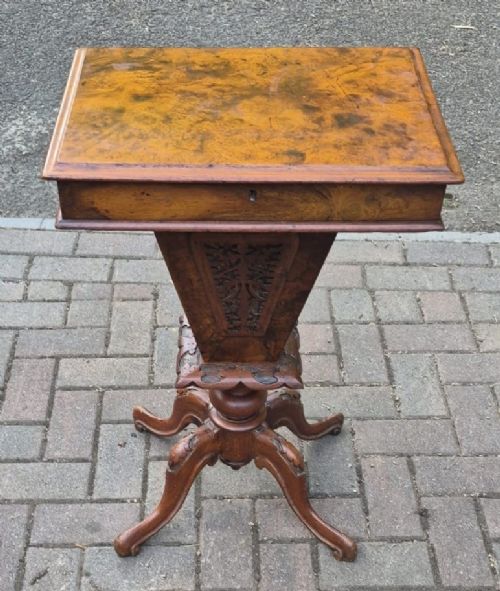


Victorian Embroidery Table
These victorian embroidery table examples are practical sewing stands and occasional pieces that bring refined nineteenth-century craftsmanship into a modern room.

Victorian Embroidery Table
When you search for a victorian embroidery table, you are looking at functional nineteenth-century furniture designed specifically for needlework, sewing, and crafting. These pieces function equally well as compact occasional tables in a modern drawing room or study.
Forms range from traditional freestanding sewing tables and cradle base designs to clever metamorphic pieces that combine an embroidered fire screen with an occasional table. Most examples date from the Victorian era, alongside related William IV and Edwardian variations.
How they were made
Cabinetmakers utilised dense hardwoods such as mahogany and rosewood alongside highly figured burr walnut veneers to construct these sewing stands. Boxwood inlay frequently appears as a decorative contrast on top surfaces and friezes.
Internal compartments require precise joinery to house fabric bags, sewing boxes, and small wooden dividers for crafting tools. Glass elements and brass hardware are integrated into handles, hinges, and occasional support structures.
Some tables double as fire screens, proving that Victorians expected every piece of furniture to multitask while looking charming.
What varies in quality
The grade of timber veneer dictates much of the visual appeal, with richly figured burr walnut and well-matched rosewood sitting at the upper end. Finely executed boxwood inlay and crisp carving on pedestals also distinguish superior examples.
Internal complexity matters significantly; tables with intact, original fabric compartments and sophisticated compartmentalised sewing boxes demonstrate higher craftsmanship than simpler utility pieces.
The Victorian Embroidery Table Glossary
- Burr walnut
- A prized timber veneer showing swirling, knotty grain patterns. It was frequently utilised on the top surfaces of mid-nineteenth-century tables.
- Metamorphic
- Furniture designed to transform from one object into another. In this category, a fire screen converts into an occasional table.
- Needlepoint
- A form of counted thread embroidery stitched onto canvas. It appears on the panels and screens integrated into these tables.
- Frieze
- The horizontal band situated directly beneath the tabletop. This area often houses the drawer or sliding bag for sewing materials.
- Cradle base
- A curved or rocking support structure resting on feet. It allows the main body of the sewing table to pivot or remain steady.
Victorian Embroidery Table: Frequently Asked Questions
What is a victorian embroidery table used for?
These tables served as dedicated workstations for domestic needlework, embroidery, and crafting during the nineteenth century. They provided a designated surface alongside internal compartments to store threads, needles, and fabric.
Today, they function well as decorative occasional tables in living spaces while retaining their original charm and utility for small storage.
How do I identify a Victorian sewing table?
Look for characteristic nineteenth-century timber choices such as burr walnut, rosewood, and mahogany. Many feature a hinged top opening to reveal a fitted interior or an attached fabric work bag.
Dates generally fall within the Victorian period or slightly earlier under William IV influence, often displaying traditional pedestal bases or turned legs.
What is a metamorphic embroidery table?
A metamorphic piece combines two distinct household objects into a single item of furniture. In this context, an embroidered fire screen adapts to serve as an occasional table.
These clever designs allowed nineteenth-century homeowners to maximise space and utility in formal rooms.
How should I care for a burr walnut table?
Protect the polished wooden surface by keeping it away from direct sunlight and heat sources that can dry out veneer. Regular dusting with a soft, dry cloth maintains the finish without needing harsh polishes.
Treat the internal fabric components gently, especially if the piece retains its original nineteenth-century needlework or silk linings.