
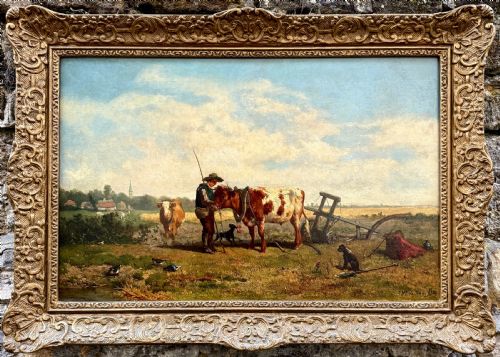


Victorian Dutch Landscape Painting
These Victorian dutch landscape painting works capture atmospheric canals, bustling towns and quiet rural scenes through the skilled brushwork of nineteenth-century artists.
Victorian Dutch Landscape Painting
A victorian dutch landscape painting transports the viewer to nineteenth-century waterways, windmills and village streets through detailed realism and romanticism. Collectors search for these scenes to bring historical maritime and rural charm into their homes.
The selections available here include oil paintings on canvas and delicate watercolour paintings executed during the nineteenth century. Common subjects feature canal windmills, frozen winter lakes with figures, fishing boats by the shore and traditional townscapes.
Many of these works originate from established European hands, including pieces dated to specific years like 1860, 1870 and 1880. Buyers frequently encounter framed works housed in ornate giltwood and gilded wood surrounds.
Materials and technique
Artists of this period applied oil paint to stretched canvas or watercolour pigments to paper, capturing light and atmosphere with precision. These traditional mediums allowed painters to render fine details in architecture, water reflections and winter skies.
Frames play an integral role in the presentation of these artworks, utilising carved wood finished with giltwood and gilded wood. Protective layers of glass frequently safeguard delicate watercolours from environmental moisture and damage.
Listings feature oil paint, watercolour, canvas, paper, and giltwood frames across various nineteenth-century realists and schools.
Assessing quality and execution
The distinction between standard works and finer examples lies in the artist's ability to manipulate light, shadow and atmospheric depth within the composition. Superior canvases demonstrate confident brushwork and precise anatomical or architectural proportions.
The condition and period integrity of the original giltwood frame significantly influence the overall appeal of a piece. Works retaining their authentic nineteenth-century framing materials command greater appreciation among serious collectors.
Johannes de Haas·Thomas Bush Hardy·Cornelis Christian Dommersen·William Raymond Dommersen·Jan van Couver·Alexis De Leeuw·Karel Frans Philippeau·Anthonij Anton Mauve·Laurens Plas·Pieter Cornelis Dommersen·Alfred Montague
The Victorian Dutch Landscape Painting Glossary
- Oil on Canvas
- Pigments bound in a drying oil medium applied to a woven fabric surface. This combination provided artists with rich colour depth and durability.
- Giltwood
- Wood carved and finished with a thin layer of gold leaf or metallic powder. It provides traditional ornate framing for nineteenth-century fine art.
- Watercolour Painting
- Pigments suspended in a water-based solution applied to paper. This technique yields translucent washes of colour favoured for maritime and topographical scenes.
- 19th Century Realism
- An artistic movement focusing on everyday subjects and scenes in a naturalistic manner. It avoids artificial dramatic embellishment in favour of truthful observation.
Victorian Dutch Landscape Painting: Frequently Asked Questions
What subjects appear in these paintings?
These artworks predominantly depict canals, windmills, winter landscapes, and coastal scenes with fishing boats. Townscapes and rural pastoral views also feature heavily across the selection.
Many compositions incorporate human figures engaged in daily activities, such as Dutch fisherwomen or farmers working in the countryside.
How do I care for a nineteenth-century oil painting?
Keep the canvas away from direct sunlight and dramatic fluctuations in room temperature and humidity. Dust the surface and the giltwood frame gently with a dry, soft brush.
Avoid using liquid cleaners or moisture directly on the paint or the wooden frame.
Are watercolours framed differently from oils?
Watercolour paintings require protective glass and mount board to keep the paper away from the glazing. Oil paintings on canvas are typically displayed open to the air within a heavy wooden frame.
Both presentation styles rely on nineteenth-century framing traditions using giltwood and carved wood.
How can I tell the period of a painting?
Examine the canvas preparation, stretcher bars, and the construction methods of the accompanying giltwood frame. Nineteenth-century works often bear artist signatures, historical exhibition labels, or date inscriptions.
Stylistic movements like realism and romanticism offer further clues regarding the decade of creation.