

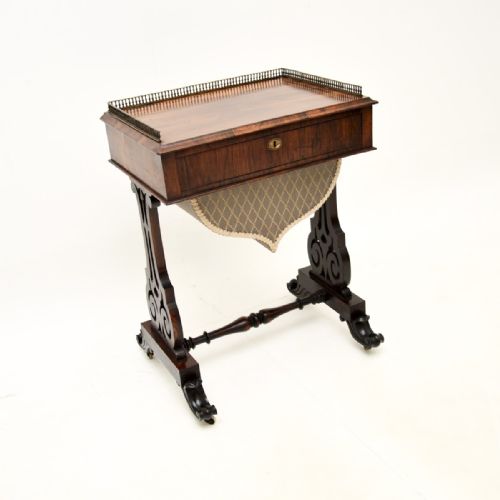


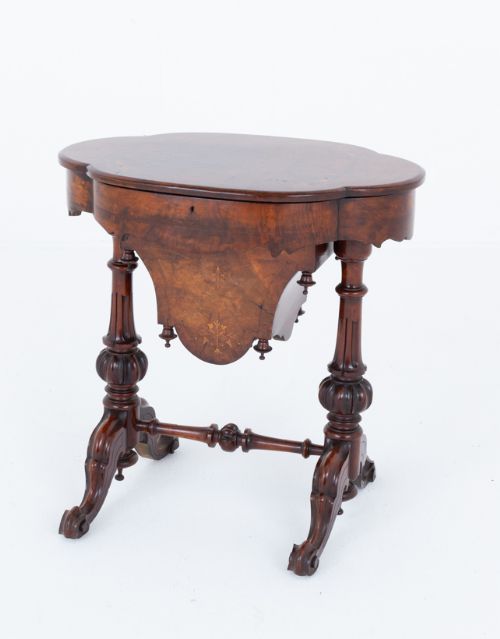


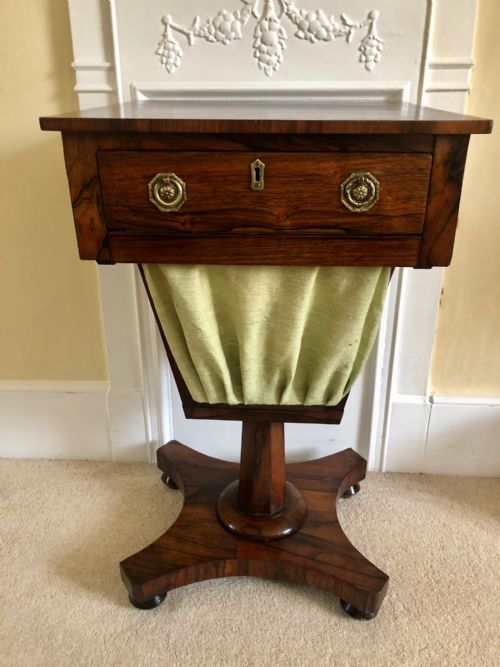
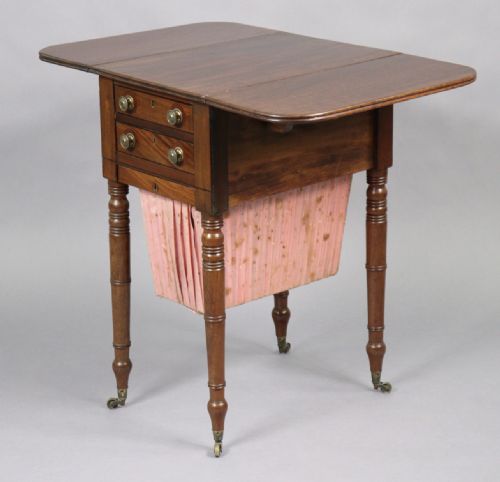
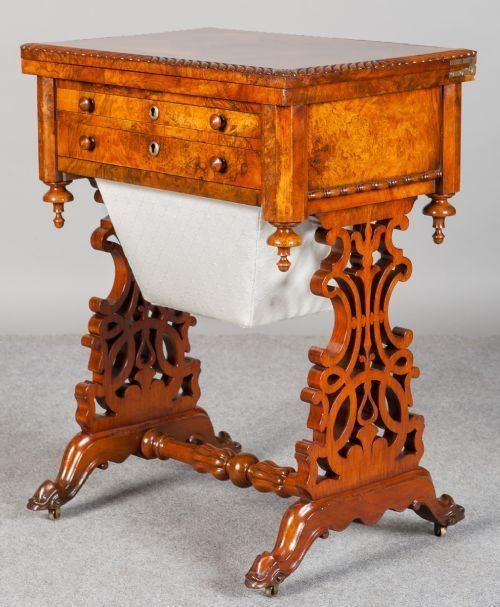
Victorian Drop Basket Table
These Victorian drop basket tables combine domestic utility with fine timber, offering a practical surface and a suspended receptacle for needlework.
Victorian Drop Basket Table
A Victorian drop basket table serves as a dual-purpose occasional piece, functioning primarily as a sewing or work table alongside its role as a side table. These items emerge from the nineteenth century, specifically appearing across the Victorian era around eighteen fifty and eighteen sixty.
The form typically incorporates a freestanding wooden structure fitted with a fabric bag or basket suspended below the top for storing textiles and sewing paraphernalia. English country house interiors often housed these furnishings, which double as lamp tables or compact side surfaces in sitting rooms.
Rosewood, mahogany, and burr walnut dominate the examples found on this page, often paired with drop leaves or hinged tops. The suspended receptacle, frequently made of fabric, defines the utility of the form while the timber frame provides stability.
How they were made
Cabinet makers utilised dense hardwoods such as rosewood, mahogany, and burr walnut to construct the primary frames of these tables. Boxwood inlay occasionally appears as a decorative addition to the polished wooden surfaces.
Drop leaves and hinged lids required precise carpentry to ensure smooth movement, while internal compartments organised small sewing implements. Fabric was gathered and fitted carefully to create the suspended drop basket beneath the main work surface.
Victorian Drop Basket Table Retail Price Guide 2026
Typical asking prices for victorian drop basket table among the pieces listed under this phrase on Sellingantiques today, from the lower quarter to the upper quarter. They describe what is for sale here now, not the wider market.
Materials used across these items include rosewood, burr walnut, mahogany, and boxwood inlay, paired with fabric and brass.
What varies in quality
The choice of timber underpins the distinction between standard and superior pieces, with figured burr walnut and richly grained rosewood commanding greater visual presence. The sophistication of the inlay work and the execution of boxwood detailing also elevate certain examples above plain mahogany versions.
Construction intricacy separates simple occasional tables from metamorphic or multi-functional work tables that incorporate clever internal storage compartments. The condition and original retention of the fabric drop basket further influence the overall integrity of the piece.
The Victorian Drop Basket Table Glossary
- Drop leaf
- A table top featuring hinged flaps that fold down to save space when not in use. This mechanism allows the furniture to adapt to smaller rooms.
- Work table
- A nineteenth century piece designed specifically to hold sewing materials and needlework supplies. These items usually contain internal compartments and a suspended bag.
- Burr walnut
- A prized timber veneer showing swirling knot formations and rich patterns. Cabinet makers selected this wood for decorative impact on primary surfaces.
- Boxwood inlay
- Contrasting pale wood inserted into a darker surface to create linear or geometric patterns. It provides crisp definition to table edges and friezes.
- Metamorphic
- A descriptive term for furniture that transforms or conceals secondary functions through clever mechanical design. These pieces alter their configuration for specific domestic tasks.
Victorian Drop Basket Table: Frequently Asked Questions
What is a Victorian drop basket table used for?
These pieces functioned primarily as work tables for holding sewing equipment, yarn, and needlework projects during the nineteenth century. The suspended fabric bag kept textiles out of sight while keeping them close at hand.
Today, they serve well as compact side tables or lamp tables in a living room, offering a small surface alongside concealed storage beneath.
How do I identify a Victorian work table?
Look for characteristic nineteenth-century timbers such as rosewood, mahogany, and burr walnut. The presence of a hinged top covering compartments or a suspended fabric basket underneath points directly to this form.
Dates typically range from eighteen fifty to eighteen sixty, reflecting the height of the Victorian period in English country house interiors.
Are these tables sturdy enough for daily use?
Constructed from dense hardwoods like mahogany and rosewood, these tables were built to withstand active domestic environments. Their solid frames handle everyday placement of lamps and small decorative items reliably.
The drop leaves and hanging fabric baskets require gentle handling, but the main wooden structures remain robust and stable.
What is the difference between a work table and a sewing table?
The terms are largely interchangeable within nineteenth-century furniture, both describing pieces equipped to hold needlework and textile supplies. Some variations feature specific internal partitions for spools and thimbles alongside the hanging basket.
Both forms utilise similar decorative woods like burr walnut and rosewood, fulfilling the same functional role in the Victorian parlour.