


Victorian Cylinder Music Box
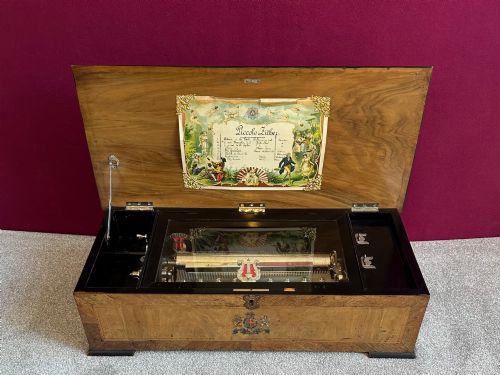
These Victorian cylinder music box examples bring mechanical melody into the room, built from rosewood and burr walnut with pinned steel cylinders.
What They Are
A victorian cylinder music box is a mechanical instrument housing a pinned steel cylinder that plucks the teeth of a tuned comb to play recorded airs. You will most frequently encounter these items dated to around eighteen seventy-five, alongside examples from eighteen sixty.
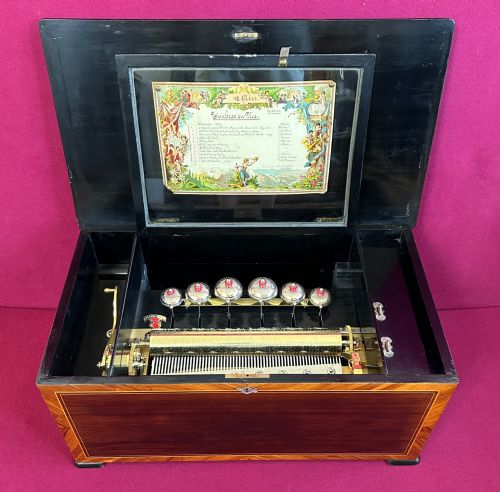
The objects take the form of tabletop boxes constructed in the Victorian style. Some pieces incorporate visible bells, drums, harps, piccolos, or zithers alongside the standard comb mechanism.
Origins include Swiss production, reflecting the strong association between Swiss makers and cylinder musical boxes of the period. The range spans simple single-comb arrangements to complex mechanisms playing multiple airs with auxiliary percussion.
How They Were Made
Cases utilise rosewood, ebonised wood, and burr walnut, frequently enhanced with boxwood and marquetry inlay to the exterior surfaces. Glass panels protect the internal movements while allowing visual access to the rotating cylinders and combs.
The internal mechanics rely on steel for the tuned combs and the pinned cylinders that govern the musical arrangement. Brass components support the gear trains and lever assemblies, working alongside auxiliary elements like drums and bells.
Retail Price Guide 2026
Typical UK retail prices for victorian cylinder music box, calculated from the Sellingantiques database of over a million retail prices indexed since 2003. This retail price guide relies exclusively on Sellingantiques data; no external sources or auction records are used, so the figures do not describe the wider market.
Some cylinders sport tiny brass pins placed with such precision they can squeeze eight distinct airs into a single rotation.
What Varies in Quality
The distinction between standard and superior pieces rests on the complexity of the musical arrangement and the presence of additional instrumentation. Boxes featuring visible bells, drums, harps, piccolos, or zithers represent a more elaborate tier of production than basic single-comb movements.
Cabinetry execution similarly defines the hierarchy, where finely figured burr walnut and detailed marquetry inlay distinguish the finer enclosures from plain ebonised or rosewood boxes. The clarity and resonance of the sound produced by the steel comb and cylinder complete this separation of grade.
Nicole Freres
The Victorian Cylinder Music Box Glossary
- Cylinder
- The rotating metal barrel set with tiny pins that dictate the notes played by the comb. Pins strike individual steel teeth in precise sequence.
- Comb
- The tuned flat plate of steel containing a series of teeth that vibrate when plucked by the cylinder pins. Each tooth corresponds to a specific musical note.
- Air
- A distinct musical tune or melody recorded upon the cylinder. Mechanisms often play multiple airs in rotation.
- Marquetry inlay
- Decorative patterns formed by fitting contrasting veneer woods into the box lid. Boxwood elements frequently appear within these designs.
- Zither
- An attachment that modifies the tone of the comb to mimic a stringed instrument. This creates a shimmering effect on selected airs.
Frequently Asked Questions
What is a cylinder music box?
A mechanical instrument that plays tunes automatically using a pinned metal cylinder and a tuned steel comb.
The rotating barrel plucks the teeth to produce the recorded melodies.
How many tunes do they play?
Individual boxes vary, with some arrangements accommodating specific sets of multiple airs.
Simpler models play standard repertoires whilst complex versions handle extended programmes.
What materials make the case?
Enclosures utilise dense hardwoods including rosewood and burr walnut.
Many examples feature decorative boxwood and marquetry inlay across the exterior.
Where were they made?
Production centred heavily in Switzerland during the nineteenth century.
Swiss workshops supplied many of the musical movements housed in these Victorian cases.