


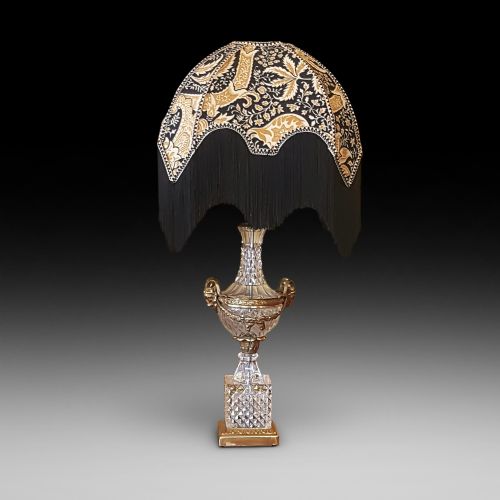
Victorian Crystal Urns
Victorian crystal urns are decorative glass vessels of substance, bringing nineteenth-century brilliance and refined weight to a room.
Victorian Crystal Urns
Victorian crystal urns encompass lidded jars, covered sweetmeat dishes, and structural vases made primarily during the nineteenth century. The examples met on this page span from the middle decades of the Victorian era into the Edwardian period, often reflecting classical revival tastes.
The dominant forms are lidded jars and vases that rely on deep facets or contrasting coloured glass layers. Buyers frequently encounter pieces associated with Bohemian workshops alongside domestic British production, demonstrating varied stylistic influences.
These vessels function primarily as decorative centrepieces or mantel ornaments rather than utilitarian tableware. Their presence combines considerable glass thickness with meticulous decorative cutting.
Materials and manufacture
Makers utilised heavy lead crystal and cut glass, often blowing the vessel before applying wheel-cut facets. Coloured glass variants incorporate cobalt blue and cranberry hues, sometimes overlaid onto clear crystal to allow cutting through the top layer.
Surface ornamentation extends to delicate etching and enamel work, frequently paired with gilt metal mounts or Dutch silver fittings. Lidded jars and vases require precise cold-work finishing to ensure covers fit heavy rims cleanly.
Victorian Crystal Urns Retail Price Guide 2026
Typical asking prices for victorian crystal urns among the pieces listed under this phrase on Sellingantiques today, from the lower quarter to the upper quarter. They describe what is for sale here now, not the wider market.
Current listings feature pieces spanning the mid-nineteenth century to the Edwardian era, incorporating lead crystal, cobalt glass, and silver mounts.
Judging quality and craftsmanship
Quality rests upon the crispness of the glass cutting and the depth of the wheel work across facets. Superior pieces display sharp, clean geometric edges and perfectly balanced proportions between base, body, and lid.
The choice of raw material also dictates grade, with heavier lead crystal and successful colour overlays marking out finer examples. Metal mounts, where present, reveal distinction through secure attachment and refined finishing rather than perfunctory assembly.
The Victorian Crystal Urns Glossary
- Cut glass
- Glass decorated by holding it against a rotating abrasive wheel to carve patterns into the surface. This technique produces characteristic deep facets that catch ambient light.
- Lead crystal
- Glass containing a high proportion of lead oxide, increasing the weight, brilliance, and refractive index of the material. It allows for deeper and sharper cutting without fracturing.
- Cobalt glass
- Deep blue glass created by adding cobalt oxide to the molten batch. It provides a rich ground for cut-to-clear decorative techniques.
- Sweetmeat jar
- A covered vessel originally intended for holding small confections or dried fruits. These pieces frequently feature substantial lids and generous bowl capacities.
- Overlay
- A manufacturing method where a layer of coloured glass is fused over a clear body. Cutting through the outer coloured layer reveals the clear crystal beneath.
Victorian Crystal Urns: Frequently Asked Questions
What were Victorian crystal urns used for?
These vessels served primarily as decorative ornaments on mantelpieces, sideboards, and drawing-room tables during the nineteenth century. Lidded examples also held sweetmeats or functioned as covered jars within formal interiors.
Their substantial weight and decorative cutting made them statements of household status and taste. Today, they remain largely ornamental centrepieces that anchor a room's interior scheme.
How do I date a glass urn?
Dating relies on observing stylistic markers, manufacturing techniques, and the presence of specific design revivals like classical or Regency motifs. Mid-nineteenth-century pieces often exhibit heavy lead crystal with deep wheel cutting.
Later Victorian and Edwardian examples may incorporate alternative mounts, such as gilt metal or silver fittings. Comparing the sharpness of the cut and the colour palette helps place a piece within its proper decades.
How do I care for antique glass?
Antique glass requires gentle hand washing in lukewarm water using mild detergent, avoiding sudden temperature changes that can stress old material. Metal mounts or silver fittings should be kept dry to prevent tarnishing or corrosion.
Displaying pieces away from direct, intense sunlight protects any coloured glass and gilt details from fading. Placing them on stable surfaces prevents accidental tipping of heavy lead crystal.
What is cut-to-clear glass?
Cut-to-clear is a technique where a coloured glass layer coats a clear crystal core. Artisans cut through the outer coloured layer to expose the transparent glass underneath, creating high-contrast patterns.
This method is particularly evident in cobalt and cranberry wares from nineteenth-century Bohemian and Victorian makers. The resulting design relies on the sharp contrast between rich colour and sparkling clear crystal.