


Victorian Claw Footstool
A victorian claw footstool brings carved timber and upholstery together to anchor a traditional room with solid nineteenth-century presence.
Victorian Claw Footstool
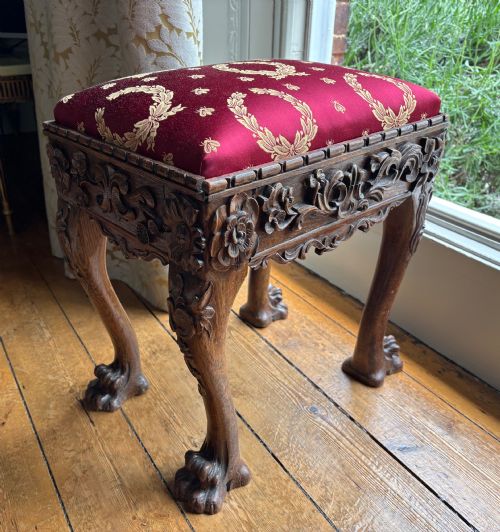
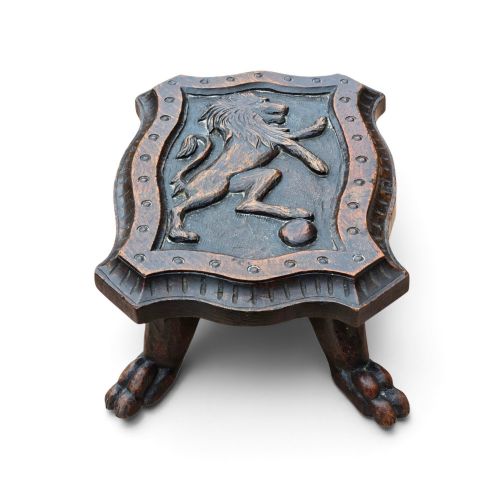
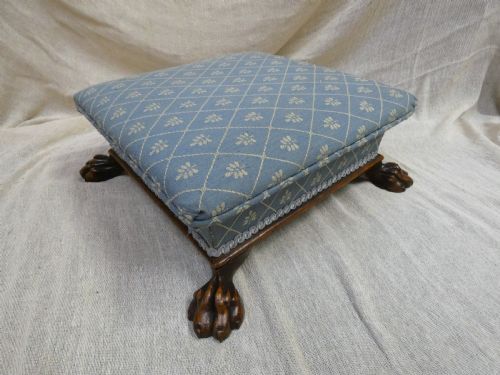
A victorian claw footstool takes many forms across the nineteenth century, ranging from simple occasional stools to substantial footstools and ottomans. You will frequently encounter carved mahogany, oak, and walnut frames decorated with motifs like the heraldic lion rampant and supported by claw-and-ball feet.
Makers drew on earlier design vocabulary, resulting in revival styles that span Chippendale, George II, Rococo, and Victorian Gothic. These pieces often feature textile upholstery, including cream damask and leather tops, reflecting the varied tastes of the period from the Regency era into the early twentieth century.
How they were made
Frames are constructed from dense timbers such as mahogany, walnut, oak, and rosewood, selected for their strength in supporting carved details. Craftsmen shaped these woods using traditional hand-carving techniques to produce elaborate feet and structural supports.
Upholstery completed the piece, utilising fabrics like damask, textile, and leather stretched over padded foundations. Brass elements sometimes appeared in mounts or detailing, complementing the dark timber frames.
Some industrious Victorian lions apparently spent their centuries guarding footstools with unusually fierce grip.
What varies in quality
The distinction between standard and superior pieces rests on the depth and crispness of the timber carving. Elaborate details like heraldic motifs or well-defined claw-and-ball feet require greater skill than plain turnings.
Proportion and the selection of cabinet wood dictate the overall success of the piece. Dense, well-figured mahogany or walnut paired with sympathetic upholstery elevates a stool far above a plain utility frame.
The Victorian Claw Footstool Glossary
- Claw-and-ball foot
- A furniture foot carved to resemble a bird's talon or animal paw grasping a spherical ball. This form originates from Chinese motifs and became popular in English revival furniture.
- Damask
- A reversible figured fabric traditionally woven on a jacquard loom with patterns formed by contrasting warps and wefts. It provides a formal texture frequently used for period upholstery.
- Occasional stool
- A small movable seat designed for intermittent use rather than primary seating. These pieces were easily shifted around nineteenth-century reception rooms.
- Heraldic motif
- A design incorporating armorial bearings or symbolic animals like the lion rampant. Such carvings denote specific family lineage or decorative commemoration.
Victorian Claw Footstool: Frequently Asked Questions
Where were footstools placed?
These stools sat directly in front of armchairs or sofas in nineteenth-century reception rooms to support the feet during periods of rest.
They were also utilised as occasional seats around the room when larger gatherings required extra places to sit.
How do I clean timber frames?
Dust the carved wooden surfaces regularly with a soft, dry cloth to prevent dirt accumulation in the recessed details of the claw feet.
Apply a microcrystalline wax periodically to nourish the mahogany, walnut, or oak without building up a heavy, sticky residue.
Are these stools comfortable?
Nineteenth-century footstools were built with firm internal stuffing designed to support the legs rather than offer deep lounging comfort.
The upholstery materials, such as leather or damask, provide a taut surface that pairs well with traditional upright seating.
How do I identify revival styles?
Look at the primary decorative vocabulary, as nineteenth-century pieces frequently emulate eighteenth-century Chippendale or George II proportions.
Details like carved claw-and-ball feet combined with Victorian timber patination point directly to these later revival periods.