





Victorian Cattle Watercolour
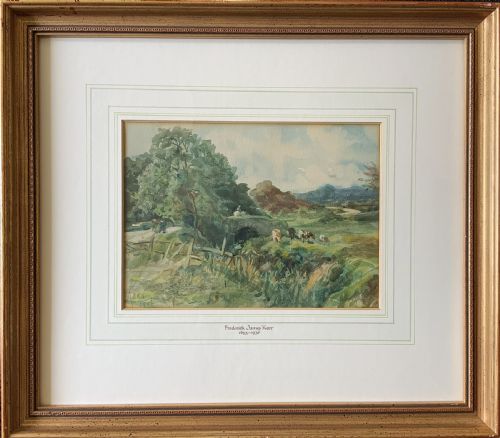
These Victorian cattle watercolour paintings capture rural pastoral life on paper through the careful hands of nineteenth-century artists.
Victorian Cattle Watercolour
When you search for victorian cattle watercolour, you are looking at nineteenth-century paintings executed on paper using watercolour pigments. The pieces on this page span the Victorian and Edwardian periods, capturing rural scenes, pastoral landscapes, and river views.
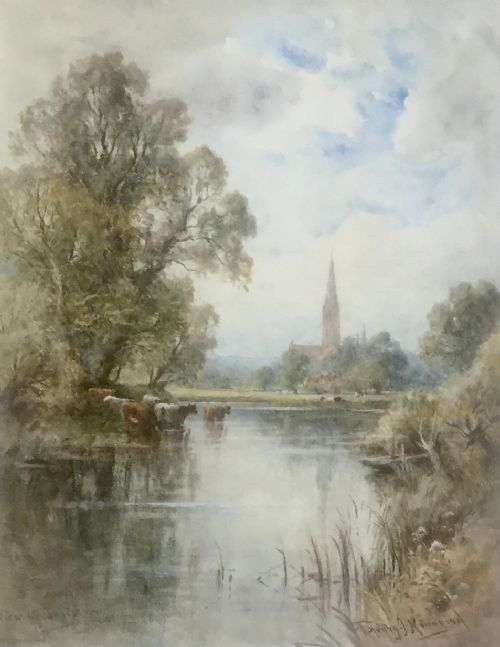
Most examples depict herds of cattle resting by rivers, grazing in farmlands, or watering in pools alongside figures and other livestock. These works range from tightly detailed topographical views to broader atmospheric landscapes.
The objects appear as framed paintings, utilising wood, gilt wood, and glass to protect the delicate paper surfaces. They represent a distinct period of British and Irish fine art focusing on pastoral harmony.
How they were made
Artists applied watercolour pigment onto paper using fine brushes to build transparent washes and opaque details. These works were then framed behind glass, often set within wooden or gilt wood frames to protect the paper from moisture and handling.
The creation relied on precise control of water and pigment to render natural light, atmospheric skies, and the texture of animal hides. Painters balanced wet-into-wet techniques for soft backgrounds with controlled dry-brush marks for the foreground cattle and foliage.
Victorian Cattle Watercolour Retail Price Guide 2026
Typical asking prices for victorian cattle watercolour among the pieces listed under this phrase on Sellingantiques today, from the lower quarter to the upper quarter. They describe what is for sale here now, not the wider market.
The collection includes rural landscape paintings originating from British and Irish artists active between eighteen-fifty and nineteen-thirty.
What varies in quality
Quality rests in the fidelity of the draughtsmanship and the artist's command of light across the paper. Finer paintings show anatomical precision in the cattle and a convincing sense of atmosphere in the landscape, whereas lesser works rely on formulaic compositions and stiff figures.
The condition of the paper and the preservation of the original pigments also dictate the standing of a piece. Works that retain their original colour intensity without heavy fading or foxing command greater appreciation.
Frederick James Kerr·Thomas Hunn·Robert Thorne Waite·Alfred Grey·Harold Lawes·Bernard Walter Evans·Basil Bradley·Thomas Sydney Cooper·Henry Earp Senior·Henry Birtles·Henry John Kinnaird·Aster Richard Chilton Corbould
The Victorian Cattle Watercolour Glossary
- Watercolour
- A painting method in which the paints are made of pigments suspended in a water-based solution. The paper underneath remains visible, lending a luminous quality to the finished work.
- Gilt Wood
- Wood that has been coated with a thin layer of gold leaf or metallic gilt. This finish frames many nineteenth-century paintings.
- Pastoral
- A genre of art depicting the rural countryside, farms, and agricultural life. These scenes often feature domestic animals such as cows and sheep.
- Topographical
- Relating to the accurate representation of specific places in art. Many Victorian watercolourists recorded exact riversides, valleys, and heaths.
Victorian Cattle Watercolour: Frequently Asked Questions
What subjects do these watercolours show?
These paintings primarily depict rural landscapes, riverbanks, and farmlands inhabited by cattle, sheep, and herdsmen.
Many works capture specific British and Irish locations, ranging from Salisbury views to Welsh valleys and Surrey heaths.
How should I frame and hang these?
Keep them behind glass and away from direct sunlight to prevent the watercolour pigments from fading over time.
Ensure they hang in rooms with stable humidity levels to protect both the antique paper and the wooden frames.
How do I identify the date of a piece?
Look for artist signatures, dates inscribed on the painting or mount, and stylistic markers typical of the nineteenth century.
Framing materials such as older wood moulding and backing boards also offer clues to the period of creation.
Are these works signed by the artists?
Many examples bear the signature or monogram of the nineteenth-century painter either within the image or on the margin.
Some pieces follow the manner or style of prominent artists rather than carrying an original signature.