
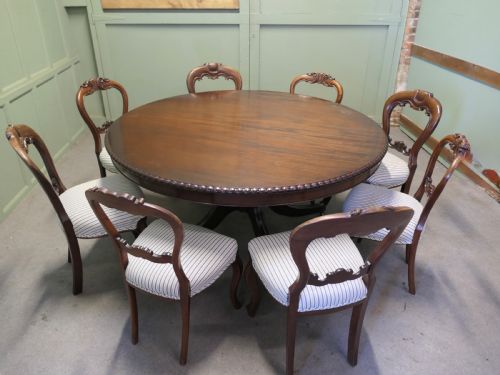


Victorian Carved Top Chairs
Victorian carved top chairs bring striking timberwork and period character to a room, offering both sturdy everyday seating and distinct historic presence.
Victorian Carved Top Chairs
Victorian carved top chairs encompass a variety of seating forms designed for parlours, dining rooms, and reception spaces during the nineteenth century. When searching for victorian carved top chairs, buyers encounter pieces ranging from side chairs and dining sets to devotional prie-dieu chairs and adjustable piano stools.
The selection on this page demonstrates broad stylistic influences, spanning standard Victorian designs alongside Victorian Gothic, William IV, Jacobean Revival, and Victorian Renaissance Revival pieces. Materials vary across these examples, incorporating traditional timbers such as oak, mahogany, walnut, rosewood, elm, and pitch pine.
Forms include single accent chairs, pairs, and larger dining sets alongside less common items like monks benches and corner armchairs. Buyers are most likely to meet sturdy oak and walnut side chairs or dining seats bearing carved upper rails from the Victorian era.
Materials and construction methods
Makers utilised solid hardwoods, predominantly oak, mahogany, and walnut, selecting dense timbers capable of holding deep relief carving along the top rails and frames. Joined construction methods such as mortise and tenon ensured structural rigidity for daily use in nineteenth-century interiors.
Upholstered elements frequently involved textiles, leather, fabric, and occasional brass decorative tacks or adjustable mechanisms, particularly on piano stools and devotional kneeling seats. Timber surfaces were shaped with hand tools, creating distinct panels, turned supports, and fretted crests.
Listings feature items spanning the Victorian era alongside pieces dated to the nineteenth century, William IV period, and nineteen-thirties.
Distinctions in quality and execution
Quality in these seating pieces rests upon the crispness of the timber carving and the selection of dense, well-figured woods such as rosewood or walnut. Superior examples exhibit balanced proportions, cleanly jointed frames, and harmonious integration of decorative motifs like Gothic tracery or revival detailing.
Lesser pieces display simpler turned elements and softer, shallower relief work on the crest rail, utilising more utilitarian timbers like pine or elm. The integrity of the original construction and the retention of period textiles or appropriate upholstery materials further separate standard workshop output from finer cabinet work.
The Victorian Carved Top Chairs Glossary
- Prie-dieu chair
- A low devotional chair featuring an elevated backrest designed for kneeling and prayer during the nineteenth century. These pieces often incorporate rich upholstery and carved upper rails.
- Gothic Revival
- An architectural and decorative style that draws inspiration from medieval design, featuring pointed arches, tracery, and robust carved timber elements. This aesthetic appears frequently in Victorian church and parlour seating.
- Side chair
- An upright chair without arms, intended for general placement around a dining table or against a room perimeter. These form a large proportion of surviving Victorian seating.
- Crest rail
- The top horizontal member of a chair back, which frequently carries the decorative carving that defines this group of seating.
Victorian Carved Top Chairs: Frequently Asked Questions
What is a prie-dieu chair?
A prie-dieu chair is a specialised Victorian devotional seat featuring a low, padded base and a tall, narrow backrest. It was designed for kneeling during private prayer in the home.
These pieces often display careful timber framing and upholstered panels, reflecting the pious domestic habits of the nineteenth century.
How do I identify Victorian Gothic seating?
Victorian Gothic seating is distinguished by architectural motifs borrowed from medieval buildings, such as pointed arches, trefoils, and heavy structural timbers. Pitch pine and oak are common woods used in these sturdy forms.
The carved top rails often echo church woodwork rather than domestic parlour styles of the same decade.
Where were side chairs placed?
Side chairs served versatile roles in Victorian interiors, positioned in reception halls, parlours, and around large dining tables. Their lack of armrests allowed them to be tucked easily against walls when not in use.
They offered convenient extra seating for guests during gatherings.
Are piano stools adjustable?
Many Victorian piano stools feature mechanical adjustment systems, allowing the musician to alter the seat height via a central threaded screw or a swivel mechanism. This ensured correct posture at the keyboard.
Timbers like walnut and mahogany were commonly employed for these functional studio seats.