



Victorian Carved Sofa Suite
A victorian carved sofa suite brings together matching upholstered seating in walnut or mahogany, offering a complete period interior scheme.
Victorian Carved Sofa Suite
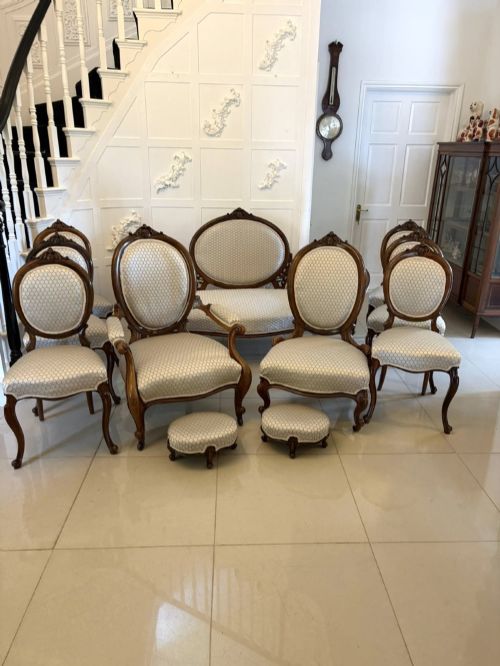
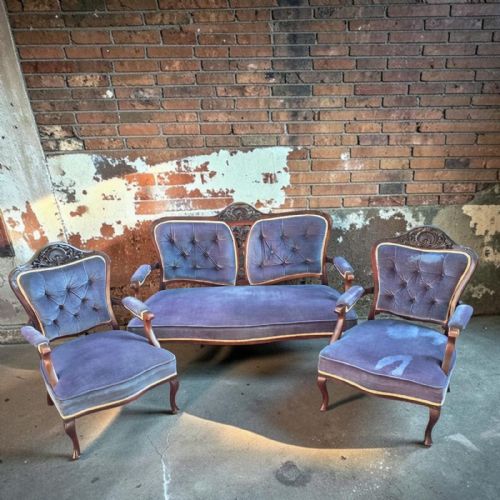
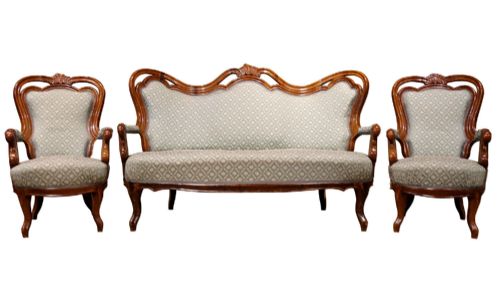
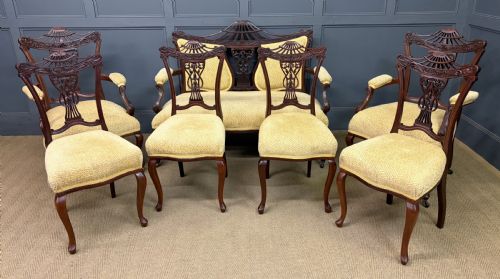
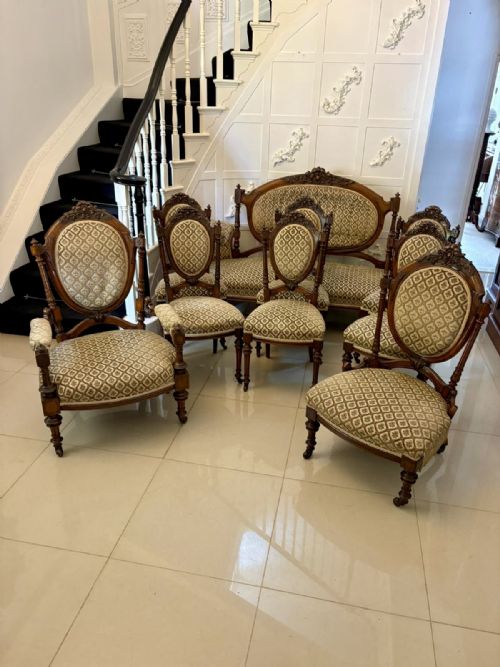
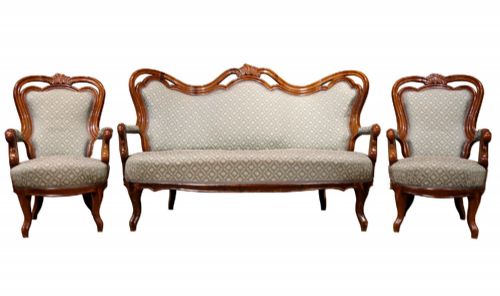
A victorian carved sofa suite consists of a matching set of upholstered seating, typically pairing a settee or sofa with matching armchairs and side chairs, designed for the principal reception rooms of the nineteenth century. These groupings span early, mid, and late Victorian periods, alongside Edwardian examples, appearing in configurations ranging from three-piece gatherings to extensive eleven-piece salon sets.
The evidence shows these groupings encompass various regional interpretations, including continental walnut suites and English framework, incorporating styles from Rococo Revival and Chippendale Revival to Egyptian Revival. Buyers encounter forms such as salon suites, drawing room suites, parlour suites, and lounge suites, often featuring specific seating designs like double spoon back settees and cameo back chairs.
How they were made
Carved wooden frames form the structural core of these pieces, constructed primarily from solid walnut and mahogany. Artisans shaped these hardwoods using manual carving techniques to achieve ornamental details such as lion paws, ball and claw feet, and elaborate scrollwork.
Upholstery completes the construction, utilising materials like leather, damask, velvet, fabric, and traditional textiles secured over internal springing and webbing. Brass components sometimes appear in castors or decorative hardware accents to support the heavy timber frames.
Victorian Carved Sofa Suite Retail Price Guide 2026
Typical asking prices for victorian carved sofa suite among the pieces listed under this phrase on Sellingantiques today, from the lower quarter to the upper quarter. They describe what is for sale here now, not the wider market.
Current listings demonstrate that walnut and mahogany serve as the primary woods for Victorian carved sofa suites, spanning the 1850s to the Edwardian period.
What varies in quality
The standard of carving determines much of the distinction in these suites, ranging from crisp, deep manual relief work on walnut or mahogany frames to simpler, more restrained mouldings. Suites bearing specific markers such as exhibition quality designations or attributed workshop origins exhibit superior sculptural execution in their woodwork.
The scale and completeness of the ensemble also define the tier of the piece, with larger multi-piece drawing room suites requiring uniform timber selection and matching upholstery across numerous chairs and settees. The integration of specialised design movements, such as French Rococo Revival or Egyptian Revival motifs, further separates standard commercial production from ambitious cabinet work.
Howard and Sons
The Victorian Carved Sofa Suite Glossary
- Salon suite
- A matching group of seating furniture designed for formal entertaining in nineteenth-century drawing rooms. It typically includes a settee and multiple matching chairs.
- Spoon back
- An upholstered chair or settee back carved into a concave, oval shape that resembles the bowl of a spoon. This ergonomic form became popular during the mid-Victorian era.
- Cameo back
- An upholstered chair back framed by carved wood in a distinct oval silhouette. The timber border frames the fabric panel much like a cameo brooch.
- Egyptian Revival
- An architectural and decorative style inspired by ancient Egyptian motifs. It incorporates characteristic geometric lines, sphinx figures, and lotus ornamentation into Victorian furnishings.
Victorian Carved Sofa Suite: Frequently Asked Questions
What pieces comprise a complete suite?
A standard suite typically includes a main settee or sofa paired with matching armchairs, sometimes accompanied by additional side chairs, footstools, or drawing room chairs. The exact composition varies from three-piece arrangements up to larger sets containing eleven distinct seating items.
Matching timber frames and uniform upholstery link the individual items together into a cohesive furnishing scheme intended for a single reception room.
How do I distinguish early from late Victorian suites?
Early Victorian suites, often dating around 1850, frequently display ornate Rococo Revival influences with curved walnut frames and deep buttoned upholstery. Later nineteenth-century examples incorporate diverse revival styles or heavier mahogany construction.
Examination of the woodwork joinery, carving depth, and stylistic markers helps determine where a suite falls within the broader nineteenth-century timeline.
Where were these suites originally placed?
These groupings belonged in the principal public spaces of nineteenth-century homes, such as the salon, drawing room, or parlour. They provided formal seating for receiving guests and hosting social gatherings.
The scale of the suite generally matched the dimensions of the room, with larger houses accommodating extensive multi-piece salon sets.
Are these suites suitable for daily modern use?
Many surviving suites retain sturdy hardwood frames made from solid walnut or mahogany that support everyday seating when maintained properly. Original upholstery or internal padding may require professional restoration to ensure comfortable seating support for modern living.
Placing these pieces away from direct sunlight and extreme humidity preserves both the historic timber frames and the textile coverings.