


Victorian Carved Pouffe
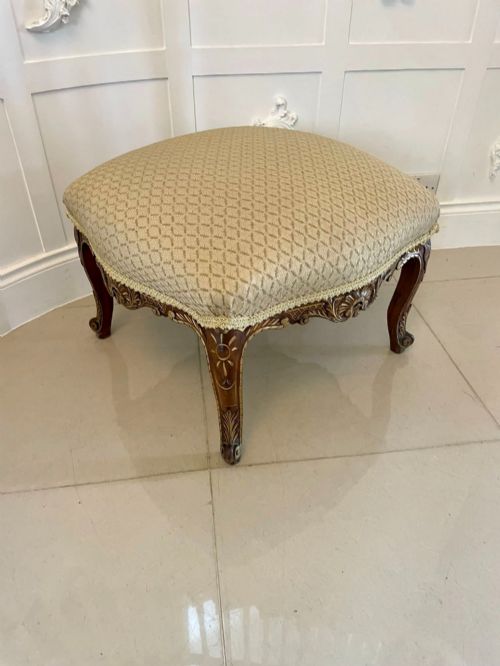
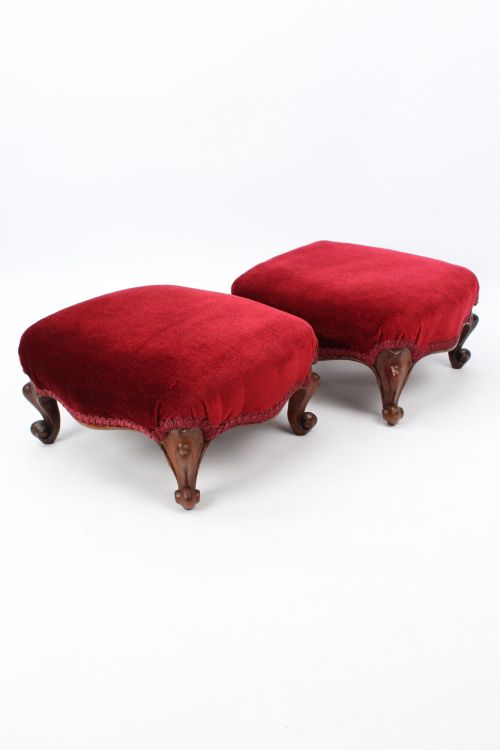
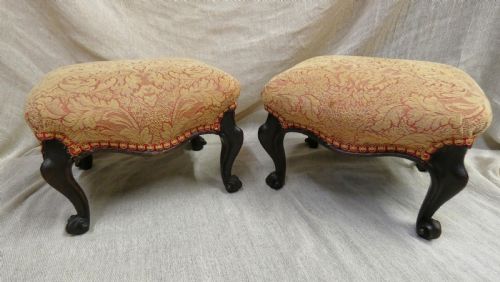
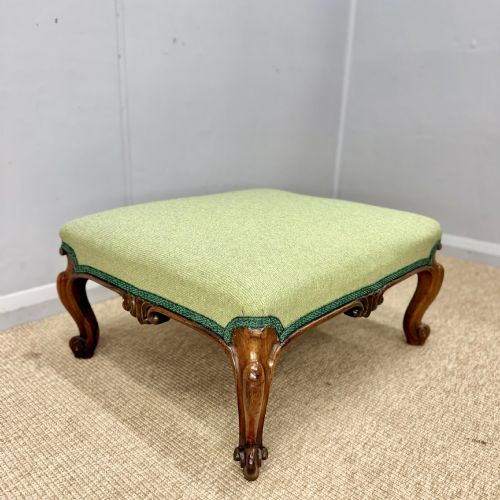
These Victorian carved pouffes are low, upholstered seating pieces built for the fireside, offering traditional comfort and period presence.
Victorian Carved Pouffe
A Victorian carved pouffe is a low seating piece designed for the nineteenth-century parlour, frequently encountered here as footstools, ottomans, and fireside stools. The pieces on this page span the Victorian period, with occasional examples drawing on Georgian or earlier revival influences alongside Anglo-Indian carving.
Most examples appear in rich timbers like walnut, rosewood, and mahogany, often featuring exposed carved frames and newly applied or needlepoint upholstery. Forms range from small pairs to larger buttoned leather stools and decorative variants dated through the 1850s, 1860s, 1870s, and 1880s.
Materials and construction
Makers utilised dense hardwoods including walnut, rosewood, mahogany, light oak, and giltwood to form the structural frames and decorative legs. Hand-carved details define the woodwork, ranging from traditional cabriole shapes to intricate Anglo-Indian patterns.
Upholstery methods combine traditional stuffing with fabric, velvet, textile, needlepoint, and buttoned leather secured with brass elements. Many pieces balance exposed carved timber borders with soft padded surfaces intended for domestic repose.
Listings feature periods spanning the Victorian era, including dated examples from the 1850s, 1860s, 1870s, and 1880s.
Assessing quality and craftsmanship
The distinction between ordinary and superior pieces rests upon the crispness of the hand-carving and the selection of timber. Dense, well-figured rosewood and walnut frames with deeply defined foliage or scrollwork represent a higher standard of workmanship.
Integrity of the underlying wooden frame and the fidelity of revival styles also set pieces apart. Refined proportions and harmonious pairing in matched sets elevate the stature of a stool far above basic utility.
The Victorian Carved Pouffe Glossary
- Cabriole leg
- A furniture leg curving outward at the knee and inward at the ankle, ending in a pad or foot. This form derives from classical furniture design and appears frequently on Victorian seating.
- Buttoned leather
- Upholstery pulled deep into the padding with fabric or leather buttons to create a diamond pattern. This technique provides firm support and texture.
- Needlepoint
- Canvas worked with wool or silk yarn in counted stitches to form pictorial or geometric designs. It is often seen on nineteenth-century footstool covers.
- Giltwood
- Timber coated with a thin layer of gold leaf or metallic paint. It highlights carved ornamentation on formal Victorian frames.
- Anglo-Indian
- Furniture made in the Indian subcontinent during the British colonial era, combining traditional eastern carving with European forms. Such pieces utilise dense hardwoods like rosewood and hardwood.
Victorian Carved Pouffe: Frequently Asked Questions
What is a Victorian carved pouffe?
A Victorian carved pouffe is a low upholstered seat or footstool featuring decorative woodwork from the nineteenth century. These pieces were designed to sit beside firesides and in parlours for resting feet or casual sitting.
They combine a solid timber frame, often in walnut or rosewood, with soft textile or leather upholstery. The visible woodwork typically displays hand-carved floral, scroll, or Anglo-Indian motifs.
How do I use a footstool today?
These low stools serve effectively as movable footrests beside armchairs or as small casual seats in living spaces. Their compact dimensions allow them to fit easily into various room layouts.
Many people also place them beneath windows or use them to support decorative trays. Their period character adds texture and traditional warmth to contemporary interiors.
How do I identify a Victorian piece?
Victorian pieces are identified through timber choices, construction methods, and characteristic ornament styles. Walnut, rosewood, and mahogany were standard during this era.
Design influences often include revival styles like Queen Anne or Jacobean, alongside ornate carved details and buttoned upholstery. Hand-tooling marks on the timber frame further indicate nineteenth-century origin.
What is the difference between a stool and an ottoman?
Stools generally feature a compact open frame with exposed wooden legs and a smaller upholstered top. Ottomans tend to be larger, sometimes fully upholstered to the floor or built with more substantial proportions.
Both forms share similar construction techniques in Victorian furniture, though ottomans often function as central room pieces while stools remain secondary seating.