


Victorian Buttoned Stool
These Victorian buttoned stools combine deep upholstery with solid timber frames, offering practical comfort and traditional period character for any interior.
Victorian Buttoned Stool
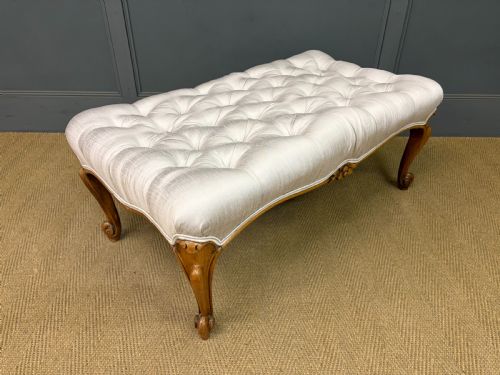
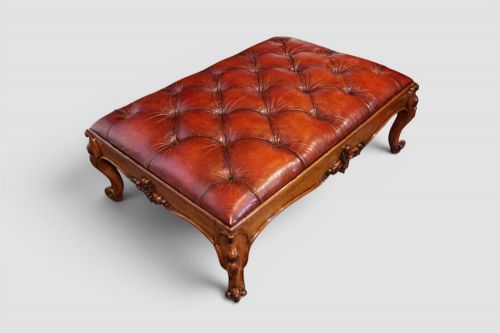
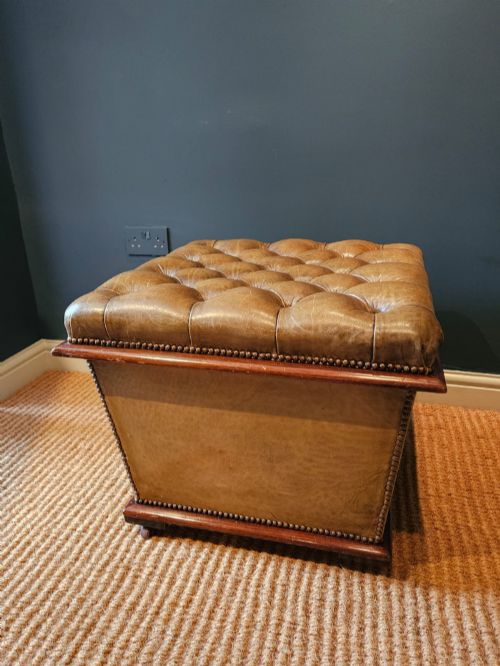
A victorian buttoned stool is a low seating piece defined by its upholstered top secured with deep tufting, appearing across various forms including footstools, long benches, and centre pieces. These items emerge predominantly from the nineteenth century, spanning decades from the middle years up to nineteen hundred.
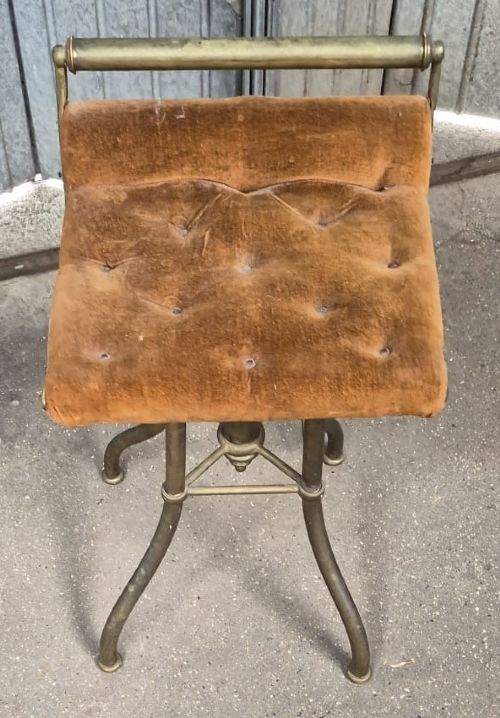
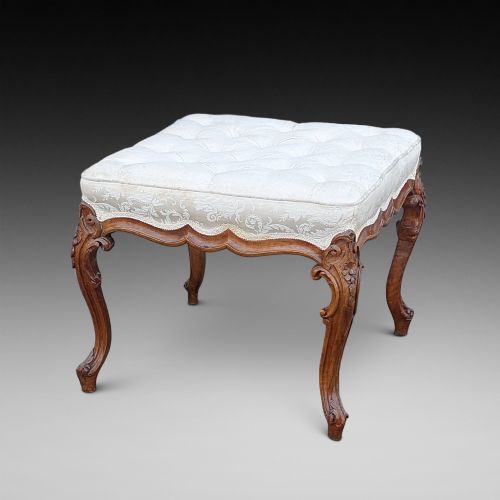
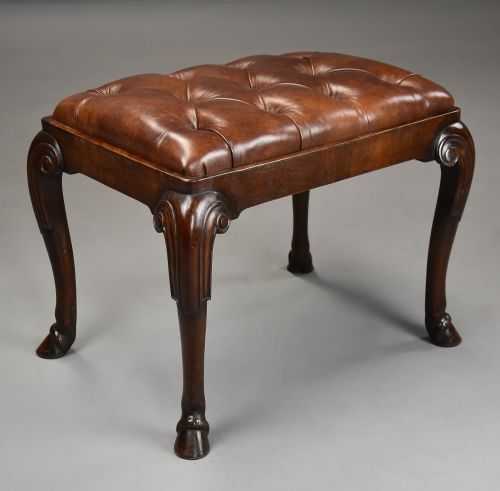
The most common examples on this page are walnut or mahogany frames featuring cabriole legs, alongside larger leather-topped centre stools and rosewood piano seats. Buyers encounter everything from compact footstools to substantial rectangular ottomans suited for use as coffee tables.
Origins stretch from formal English country houses to urban salons, reflecting the varied domestic requirements of the period. Makers utilised diverse timber frames and upholstery materials to create pieces ranging from intimate musical seats to grand parlour furnishings.
How they were made
Frames rely on cabinet timbers such as walnut, mahogany, rosewood, and light oak, often shaped with carved cabriole legs, X-frames, or turned supports fitted with brass castors. Joinery techniques from the era ensure sturdy construction beneath the upholstery.
Upholstery involves traditional stuffing secured with deep buttoning, using top covers of leather, velvet, damask, chenille, ticking stripe, or plain fabric. The tufting creates distinct geometric indentation patterns that pull the textile tight against the internal padding.
Listings feature walnut, mahogany, rosewood, and oak frames paired with leather, velvet, damask, and chenille upholstery.
What varies in quality
Timber selection and frame carving dictate the baseline standard, with richly figured walnut and rosewood standing apart from simpler secondary woods. Finer examples display crisply moulded cabriole legs, secure joints, and well-proportioned framing that supports the heavy tension of deep buttoning.
The precision of the upholstery work marks the distinction between standard production and superior pieces. Uniform button placement, neatly pleated folds in the textile or leather, and the choice of premium hand-dyed hides or luxury fabrics elevate the finished seating.
James Shoolbred·A.M.E. Fournier·H Brooks and Co
The Victorian Buttoned Stool Glossary
- Cabriole leg
- A furniture support that curves outward at the knee and tapers inward to a foot, typical of walnut and mahogany framing.
- Buttoning
- An upholstery technique where twine pulls the surface material down into the padding to form a patterned grid of indentations.
- Centre stool
- A large, freestanding seating piece designed to sit in the middle of a room rather than against a wall.
- X-frame
- A structural base formed by two intersecting members shaped like the letter X, providing robust support for low seats.
- Castor
- A small wheel attached to the base of a leg to allow smooth movement across floor surfaces.
Victorian Buttoned Stool: Frequently Asked Questions
How do I use a centre stool?
These large pieces sit in the middle of a room, providing extra seating or acting as a low surface.
Many owners top them with trays to serve drinks or hold books alongside everyday use.
Can I use a footstool as a coffee table?
Leather-topped variants work well as low tables because the sturdy hide surface resists minor spills.
Placing a rigid tray on top creates a stable area for cups while preserving the antique upholstery below.
What is a piano stool used for?
Musicians used these adjustable seats to reach the correct height while playing keyboard instruments.
Many feature revolving mechanisms or screw tops that alter the seating level with a simple twist.
How do I tell nineteenth century pieces apart?
Examine the choice of timber and the complexity of the leg carvings to gauge the period.
Walnut and rosewood frames often indicate mid to late century craftsmanship, while simpler oak versions follow regional styles.