



Victorian Bronze Horse Sculpture
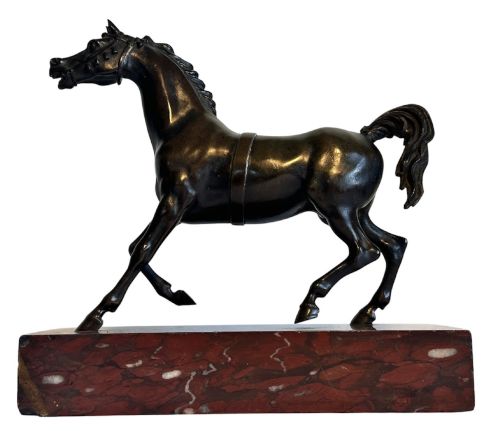
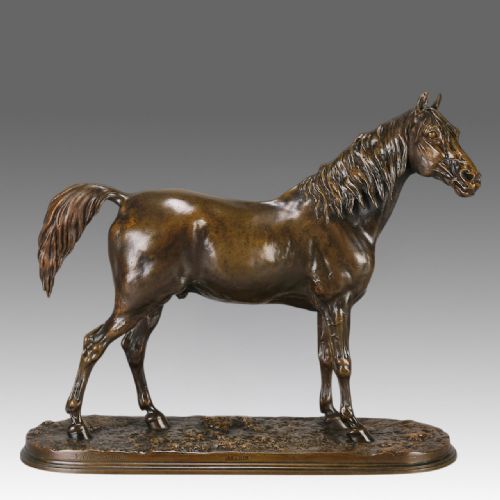
A victorian bronze horse sculpture captures the raw strength and spirit of the animal through the meticulous eye of nineteenth-century animalier founders.
Victorian Bronze Horse Sculpture
When you search for a victorian bronze horse sculpture, you encounter figures that span the nineteenth century, from mid-century French animalier works to later English and Austrian interpretations. These pieces depict subjects ranging from stallions and hunting groups to racing scenes and mounted Cossacks, often mounted on marble or wooden bases.
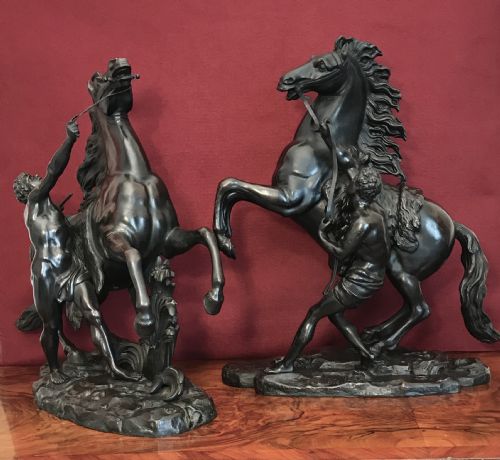
The versions most frequently met on this page include animalier studies influenced by the French school alongside English equestrian groups and Marly horse figures. Makers recorded in the evidence range from Pierre Jules Mêne and John Willis Good to Franz Bergman.
The forms vary from single figures such as a bronze stallion or bay hunter to complex narrative groups like a jockey and groom or an English hunting scene. Dating within the period typically spans from around eighteen fifty to nineteen hundred.
Materials and methods
These sculptures are produced using bronze, patinated bronze, cast bronze, and cold-painted bronze, often combined with marble bases, wooden elements, or brass components. The casting process allows for fine muscle definition and texture in the equine forms.
Surface treatments include dark patination and cold-painted polychrome finishes that highlight the details of tack, rider clothing, and animal anatomy. Bases of polished marble or timber provide structural stability and visual contrast to the metalwork.
Materials recorded across the inventory include bronze, patinated bronze, cold-painted bronze, marble, wood, and brass.
Distinctions in quality
Quality in these bronzes rests upon the crispness of the chasing and the fidelity of the anatomical modelling, distinguishing high workshop output from simpler commercial casting. The depth of the patina and the integration of the figure with its marble or wooden base also indicate the original maker's standard.
Signed works associated with known animalier sculptors or specific foundries demonstrate superior rendering of texture, movement, and expression compared to unsigned editions.
P J Mêne·John Willis Good·Pierre Jules·Cox & Sons·Franz Bergman
The Victorian Bronze Horse Sculpture Glossary
- Animalier
- A nineteenth-century artistic movement focused on the realistic portrayal of animals, particularly horses, lions, and dogs. Practitioners studied live subjects in menageries and stables.
- Patinated bronze
- Bronze that has been treated with chemical solutions to produce a specific surface colour, ranging from rich brown to deep black. This finish protects the metal and accentuates sculptural detail.
- Cold-painted bronze
- A technique where bronze figures are painted with oil or enamel paints after casting and left to dry without high-temperature firing. This method is particularly associated with Austrian workshops.
- Marly horses
- Large sculptural groups depicting rearing horses restrained by handlers, originally created for public installations in France. Nineteenth-century founders produced smaller bronze reductions of these iconic subjects.
Victorian Bronze Horse Sculpture: Frequently Asked Questions
What is an animalier bronze horse?
An animalier bronze horse is a nineteenth-century sculpture focused on accurate anatomical detail and dynamic movement. These pieces reflect the era's fascination with naturalism and equine behaviour.
The genre includes single subjects like stallions as well as narrative scenes involving riders, hunters, and grooms.
How do I identify the period of a bronze horse?
Dating relies on stylistic markers such as the naturalism of the modelling, the type of patination, and the construction of the base. Nineteenth-century works often feature distinct foundry marks or artist signatures.
Materials like polished marble bases and cast bronze techniques help narrow the production era between eighteen fifty and nineteen hundred.
Where were these bronze sculptures made?
Production centred primarily in France, England, and Austria, driven by prominent schools of animalier sculpture and specialist foundries. French founders established early standards for equine casting.
English and Austrian workshops later developed distinct traditions, ranging from hunting groups to cold-painted decorative figures.
How should I display a bronze sculpture?
Display these sculptures on stable, level surfaces away from direct heat sources and strong moisture fluctuations. The heavy marble or wooden bases provide adequate support for standalone placement.
Regular dusting with a soft, dry cloth preserves the patinated surface without disturbing the metal.