
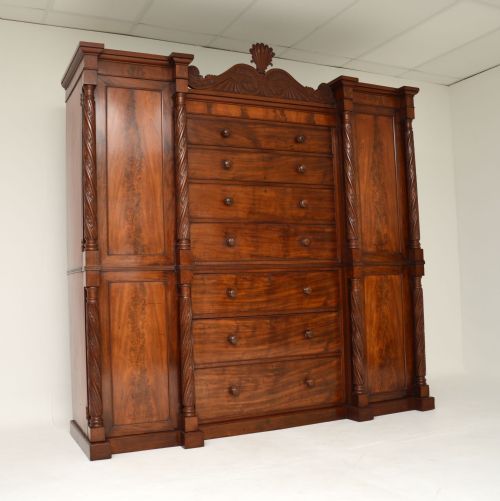


Victorian Breakfront Press Cupboard
These victorian breakfront press cupboard pieces are substantial storage furniture designed to anchor a large bedroom or hall with presence and utility.
Victorian Breakfront Press Cupboard
A victorian breakfront press cupboard typically presents as a large wardrobe, linen press or housekeeper cupboard with a central section projecting forward from flanking wings. The pieces found here span the nineteenth century, including Victorian and William IV eras, alongside English country interpretations and Gothic Revival expressions.
Most examples function as wardrobes, gentleman wardrobes, or linen cupboards, often constructed with multiple doors and fitted interior spaces. These items originate predominantly from nineteenth-century English workshops, ranging from formal mahogany pieces to regional painted pine variants.
Materials and construction methods
Makers utilised primary timbers such as mahogany, flame mahogany, rosewood, oak, and pine, frequently accentuating surfaces with satinwood inlay, marquetry, or pollard oak veneers. Secondary woods like pine appear on interior shelves and carcases.
Hardware details incorporate brass fittings and glass elements, while structural joinery accommodates large scale proportions through breakfront configurations, fielded panels, and fitted internal compartments.
Listings feature pieces from the Victorian era and the broader nineteenth century, utilising mahogany, rosewood, oak, and pine.
Judging quality in breakfront cabinetry
Quality rests upon the selection and matching of timber veneers, where symmetrical flame mahogany or figured grain demonstrates superior cabinet work. The handling of inlaid details, such as satinwood stringing or marquetry panels, reveals the competency of the workshop.
Proportion and architectural integrity dictate the standing of a piece, with well-balanced breakfront projections and crisply carved mouldings distinguishing finer commissions from utilitarian country alternatives.
Edwards and Roberts·Lamb of Manchester
The Victorian Breakfront Press Cupboard Glossary
- Breakfront
- A piece of furniture whose central section projects forward from the recessed left and right wings. This architectural arrangement creates depth and shadow across large cabinet facades.
- Compactum
- A multi-functional wardrobe designed to house various types of clothing in dedicated internal compartments. These pieces usually combine hanging space with linen shelves and drawers.
- Flame mahogany
- A veneer cut from the fork of the mahogany tree where branches meet the trunk, producing a distinctive flickering flame pattern. Cabinet makers reserved this highly figured timber for primary visible surfaces.
- Marquetry
- The art of applying decorative veneer pieces in wood, brass, or other materials to form pictorial or geometric designs. This technique elevates plain panels into ornamented displays.
- Housekeeper cupboard
- A large storage cabinet traditionally used in country houses for linens, dry goods, and domestic provisions. They typically feature panelled doors and sturdy utilitarian construction.
Victorian Breakfront Press Cupboard: Frequently Asked Questions
What is a breakfront press cupboard?
A breakfront press cupboard is a large nineteenth-century storage cabinet featuring a central section that extends forward from flanking side cupboards. These pieces provide extensive internal storage for garments and household goods.
They serve as focal points in large rooms, combining architectural presence with functional compartmentalisation.
How were these cupboards used historically?
Historically, these large cabinets stored fine garments, household linens, and domestic provisions in grand homes and country houses. Wardrobe versions housed hanging clothes and gentleman attire, while press cupboards held folded textiles.
Servants and family members accessed the internal shelves and drawers daily to maintain household organisation.
Where should I place one?
These large cupboards require substantial wall space and high ceilings to accommodate their imposing dimensions and breakfront projections. They suit large bedrooms, dressing rooms, or wide hallway spaces.
Ensure the room has sufficient clearance for wide doors to open fully without obstruction.
How do I distinguish between periods?
Distinguishing periods involves observing the timber choices, decorative motifs, and overall design vocabulary of the cabinet. William IV pieces often display heavier classical proportions, while Victorian Gothic Revival items incorporate pointed arches and ecclesiastical details.
Inlaid satinwood and figured flame mahogany became particularly prevalent during the mid to late nineteenth century.