



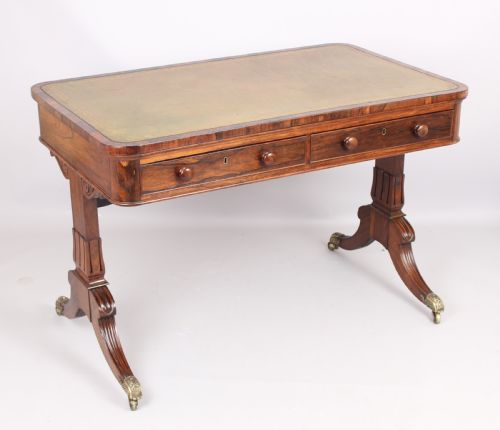

Victorian Brass Castored Desk
These victorian brass castored desk pieces provide practical writing surfaces fitted with metal wheels for movement.
Victorian Brass Castored Desk
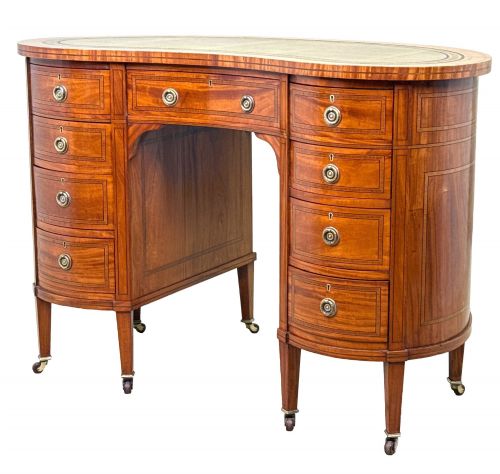
A victorian brass castored desk brings together nineteenth century writing furniture and mobile fittings. Buyers seeking this type encounter writing tables, kidney shaped desks, and partners desks originating from the 19th Century.
The pieces listed on this page span styles such as Victorian, Regency, Sheraton Revival, and Hepplewhite Style. Mahogany, oak, and walnut form the primary woods utilised for these items.
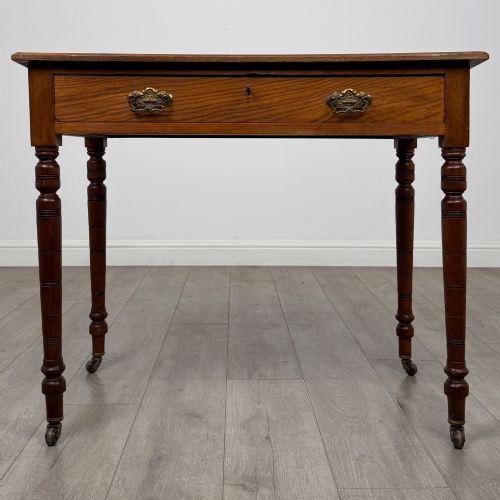
Forms vary from single drawer side tables and two drawer writing tables to larger four drawer configurations. Many examples incorporate leather writing surfaces or fabric inserts.
Materials and construction
Cabinet makers built these desks using solid and veneered hardwoods like mahogany, satinwood, and walnut. Brass hardware, including castors and drawer pulls, provided both function and decoration.
Writing surfaces frequently received leather or fabric inserts bordered by timber frames. Drawers utilised traditional dovetail joints, whilst internal framing often relied on oak or secondary softwoods.
Listings feature 19th Century and Victorian periods with materials including mahogany, oak, walnut, brass, and leather.
Judging quality in writing furniture
Excellence in these items rests on the selection of figured timber veneers and the crispness of cabinet work. Superior examples display careful timber matching across drawer fronts and top surfaces.
The integration of original brass castors and fitted leather inserts distinguishes finer workshop production. Subtleties in secondary framing timbers and drawer construction indicate the level of craftsmanship.
Hindley & Sons·W Williamson & Sons·Lamb of Manchester·Holland & Sons
The Victorian Brass Castored Desk Glossary
- Castor
- A small wheel mounted on a swivel assembly attached to the legs of furniture to allow easy movement. Brass versions are typical on nineteenth century desks.
- Partners desk
- A large double sided writing table designed for two people to work opposite one another. These frequently feature drawers on both long sides.
- Kidney shaped desk
- A writing table with a curved front profile resembling a kidney bean. This form offers a distinct ergonomic curve for the user.
- Dovetail
- A traditional wood joint interlocking wedge shaped fingers. This construction method secures drawer corners.
- Veneer
- A thin layer of figured timber applied over a secondary wood base. This technique allowed cabinet makers to display striking grain patterns.
Victorian Brass Castored Desk: Frequently Asked Questions
What is a victorian brass castored desk?
It is a nineteenth century writing table or desk fitted with metal wheels on the feet for mobility.
These pieces utilise timbers like mahogany and walnut, often with inset leather writing surfaces.
How do I identify a Victorian desk?
Victorian desks are characterised by nineteenth century timber construction styles, including mahogany and walnut.
They frequently feature turned legs, brass hardware, and traditional drawer joinery.
Where were these desks placed?
They served as functional writing furniture in libraries, studies, and principal rooms of nineteenth century homes.
Their mobility allowed them to be repositioned near natural light sources.
Are these desks suitable for daily use?
Many of these pieces provide practical writing surfaces and functional drawer storage for modern workspaces.
Their robust timber construction supports contemporary writing and computer tasks.